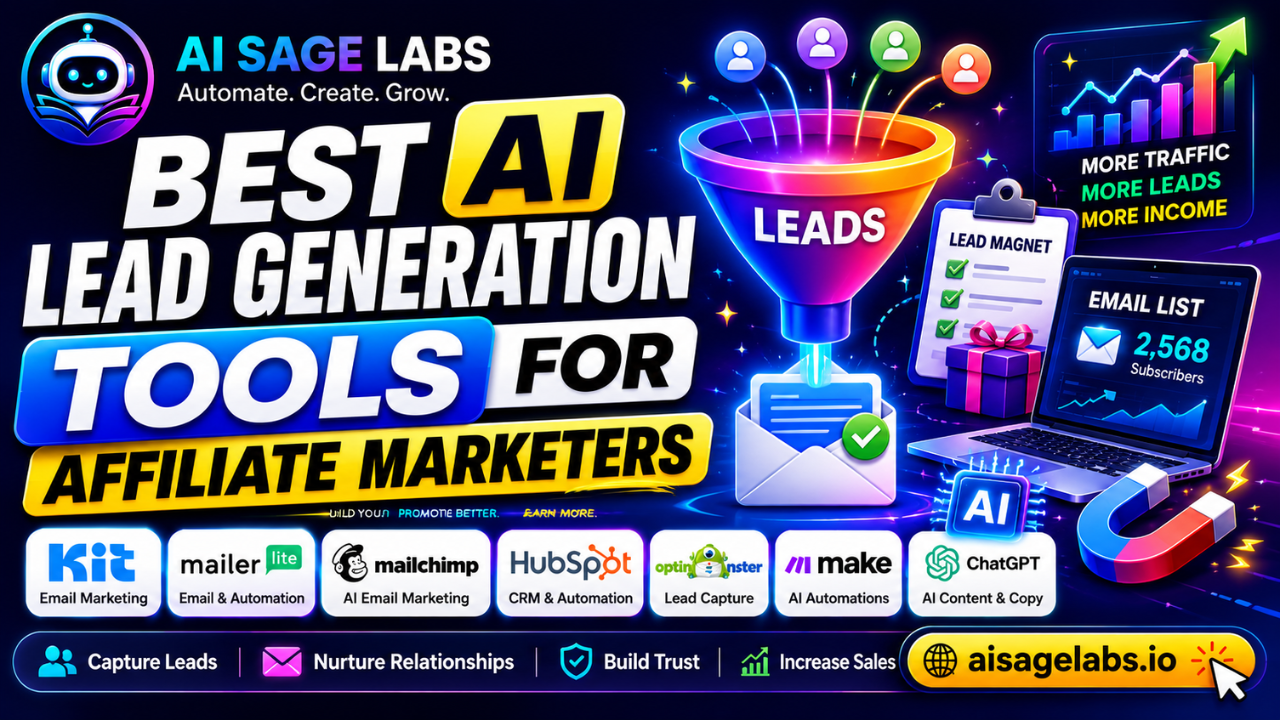
AI Lead Generation Tools for Affiliate Marketers in 2026: Build Lists and Convert Faster

AI Lead Generation Tools for Affiliate Marketers in 2026

Affiliate marketing beginners usually chase more traffic first.

More blog posts. More social posts. More YouTube videos. More AI-generated content. More links.

Traffic matters, but traffic alone is fragile.

If a reader visits your review, clicks nothing, joins nothing, and disappears forever, you only had one chance to earn trust. That is why lead generation matters so much for affiliate marketers in 2026.

The right AI tools can help you turn casual visitors into email subscribers, segment those subscribers by interest, send helpful follow-up emails, and recommend affiliate products more naturally over time.
 

AI Lead Generation Tools for Affiliate Marketers in 2026


This guide covers the best AI lead generation tools for affiliate marketers, how each tool fits into a real funnel, where AI actually helps, and what beginners should avoid if they do not want their site to feel spammy or salesy.

If you are still learning the basics, read our AI affiliate marketing beginner guide first. This article focuses specifically on building lists, capturing leads, and converting faster with AI-assisted workflows.

What AI Lead Generation Means for Affiliate Marketers

Lead generation means collecting contact details from people who are interested in your topic, product category, or recommendation.

For bloggers and affiliate marketers, the most common lead is an email subscriber.

A visitor lands on your blog, reads a helpful article, sees a relevant free resource, enters their email address, and joins your list. Then you can send follow-up emails, tutorials, comparison guides, product updates, discount alerts, and honest recommendations.

AI lead generation means using artificial intelligence to make that process faster and smarter.

AI can help with:

  • Lead magnet ideas
  • Landing page copy
  • Popup copy
  • Email welcome sequences
  • Subscriber segmentation
  • Subject line testing
  • Send-time optimization
  • Personalized follow-up content
  • Lead scoring inside a CRM
  • Repurposing blog posts into email campaigns

The goal is not to trick people into joining your list.

The goal is to offer something genuinely useful at the right moment, then follow up in a way that helps the subscriber make a better decision.

That is why the best AI lead generation tools for affiliate marketers are not just popup tools or email tools. They support the full path from visitor to subscriber to informed buyer.

Why Traffic Without Leads Is Risky

Affiliate blogs often depend on search traffic.

That can work well, but it is risky to depend only on Google rankings, social algorithms, or one traffic source.

If an update reduces your rankings, if a social platform changes reach, or if one article stops ranking, your income can drop quickly.

An email list gives you an asset you control more directly.

You still need to follow email laws, platform policies, and good deliverability practices, but your list lets you:

  • Bring readers back to new posts
  • Promote updated reviews
  • Send comparison guides
  • Test affiliate offers with warmer readers
  • Build trust beyond one article
  • Launch your own digital products later

This matters because affiliate conversions often happen after multiple touches.

A reader may not buy the first time they see your review. But if they join your list, read a helpful tutorial, compare alternatives, and then receive a thoughtful recommendation, the buying decision feels safer.

Lead generation turns one-time traffic into an audience.

The Best AI Lead Generation Tools for Affiliate Marketers in 2026

There is no single tool that does everything perfectly.

The strongest setup is usually a small stack: one email platform, one lead capture tool, one form or quiz tool if needed, one automation tool, and one AI writing assistant for copy and testing.

Here are the tools worth considering.

1. Kit – Best Creator Email Platform for Simple Affiliate Funnels

Kit, formerly ConvertKit, is built for creators, newsletter writers, bloggers, and solo businesses.

For affiliate marketers, Kit is useful because it combines landing pages, opt-in forms, email broadcasts, automated sequences, and visual automations in a creator-friendly interface.

Kit is not the most AI-heavy platform on this list, but it is one of the easiest places to build a clean affiliate email system.

Use Kit for:

  • Simple lead magnets
  • Newsletter signups
  • Welcome sequences
  • Tag-based segmentation
  • Creator-focused affiliate funnels
  • Digital product follow-up later

The practical affiliate workflow is simple.

Create a lead magnet such as “AI Tool Review Checklist,” add a Kit form inside your relevant blog posts, tag subscribers based on the form they joined through, and send a short email sequence that teaches first and recommends second.

Kit is best for affiliate bloggers who want fewer moving parts, not the most advanced enterprise CRM.

2. MailerLite – Best Budget Email and Landing Page Tool

MailerLite is a strong budget-friendly option for bloggers who want email marketing, landing pages, forms, popups, and automation without a steep learning curve.

It is a good fit for beginners because the interface is clean and the main features are easy to understand.

MailerLite can help affiliate marketers with:

  • Signup forms
  • Landing pages
  • Email automations
  • Newsletter campaigns
  • AI-assisted writing
  • Send-time optimization on supported plans

The best use case is a simple blog funnel:

  1. Publish a review or comparison post.
  2. Offer a relevant checklist or buyer guide.
  3. Capture the email with a MailerLite form.
  4. Send a three to five email sequence.
  5. Recommend your strongest affiliate resource naturally.

MailerLite is not perfect for complex sales teams, but for a solo affiliate blogger, it covers the essentials well.

3. Mailchimp – Best for AI-Assisted Email Optimization

Mailchimp has added more AI-assisted features around email content, automation, predictive analytics, send-time recommendations, and campaign optimization.

For affiliate marketers, the useful part is not just writing emails faster. It is using AI and audience data to improve when and how your subscribers receive messages.

Mailchimp can help with:

  • Email content generation
  • Subject line help
  • Automated customer journeys
  • Send-time optimization
  • Audience segmentation
  • Campaign performance insights

Mailchimp is especially useful if you want a more mature email platform and you care about templates, reporting, and AI-assisted campaign improvement.

The main downside is that pricing and plan limits can become less beginner-friendly as your list grows.

For affiliate marketers, always check Mailchimp’s acceptable use and affiliate-related rules before sending promotional campaigns. Email tools can have strict policies around certain niches and offers.

4. HubSpot Breeze – Best CRM-First AI Lead Generation System

HubSpot is more than an email tool. It is a CRM and customer platform with built-in AI through Breeze.

This makes it more powerful than most beginner email platforms, but also more serious than many new bloggers need.

HubSpot Breeze can help with:

  • CRM-based lead tracking
  • AI-assisted marketing and sales tasks
  • Lead segmentation
  • Contact activity tracking
  • Sales and service workflows
  • AI agents connected to customer data

HubSpot is best for affiliate marketers who are moving beyond a simple blog and into consulting, B2B lead generation, agency work, SaaS referrals, or high-ticket affiliate programs where tracking lead quality matters.

If you are writing basic product reviews, HubSpot may be more than you need.

If you are building a serious lead generation business, it may become useful because every contact has a record, history, source, and follow-up path.

5. OptinMonster – Best for Turning Blog Visitors Into Subscribers

OptinMonster is a lead capture and conversion optimization platform.

It is useful for affiliate blogs because many visitors leave without taking action. OptinMonster lets you create targeted popups, floating bars, inline opt-in forms, slide-ins, and exit-intent campaigns.

Use OptinMonster for:

  • Exit-intent popups
  • Content upgrade offers
  • Page-level targeting
  • Scroll-based offers
  • Campaign A/B testing
  • Recovering abandoning visitors

The key is relevance.

If someone reads a Jasper review, offer an AI writing checklist. If someone reads a hosting comparison, offer a WordPress launch checklist. If someone reads an automation guide, offer a workflow template.

Generic popups convert poorly and can annoy readers. Relevant offers feel helpful.

6. Typeform AI or Formless – Best for Quizzes and Conversational Lead Capture

Quizzes can work extremely well for affiliate marketers because they turn lead capture into a decision tool.

Instead of saying “join my newsletter,” you can offer:

  • Find your best AI writing tool
  • Choose the right hosting plan for your blog
  • Discover your affiliate marketing starter stack
  • Pick the right automation tool for your workflow

Typeform AI helps build forms, surveys, and quizzes from prompts. Formless by Typeform goes further with conversational forms that can ask and answer questions more naturally.

For affiliate marketers, a quiz can segment subscribers before they even join your list.

Example:

  • Beginner blogger gets a low-cost starter stack.
  • SEO-focused affiliate marketer gets writing and SEO tools.
  • Automation-heavy creator gets Zapier, Make.com, and n8n resources.
  • Video-focused blogger gets InVideo, Pictory, and Descript resources.

This creates more useful follow-up emails and better affiliate recommendations.

7. Make.com – Best for Automating the Lead Workflow

Make.com is not a lead capture tool by itself. It is the automation layer that connects your tools.

For affiliate marketers, Make.com can connect forms, email platforms, spreadsheets, CRMs, Slack, WordPress, Google Sheets, and AI tools.

Example workflows:

  • New Typeform lead -> tag in MailerLite -> log in Google Sheets -> send welcome email.
  • New Kit subscriber -> classify interest with AI -> add to the right sequence.
  • New lead magnet download -> notify you in Slack -> update affiliate campaign tracker.
  • New blog post published -> create newsletter draft -> add internal links and CTA notes.

Make.com becomes more valuable once your funnel is already working.

Do not automate a broken process. Prove the workflow manually first, then automate the repetitive parts.

Our Make.com review explains why it is one of the best-value automation platforms for bloggers.

8. ChatGPT or Claude – Best for Lead Magnet and Email Drafting

General AI assistants like ChatGPT and Claude are not lead generation platforms, but they are extremely useful for creating the content around lead generation.

Use them to draft:

  • Lead magnet outlines
  • Checklist content
  • Welcome emails
  • Quiz questions
  • Segmentation logic
  • Subject line variations
  • CTA copy
  • Landing page sections

The best approach is to give AI your audience, offer, article topic, and affiliate goal.

Do not ask, “write me an email funnel.”

Ask something more specific:

Create a five-email welcome sequence for beginner affiliate bloggers who downloaded an AI review checklist. The goal is to teach trust-first review writing before recommending an AI writing tool. Keep the tone helpful, not aggressive.

Specific prompts create better output.

Quick Comparison Table

Tool Best For Best Affiliate Use Case Main Limitation
Kit Creator email funnels Simple lead magnets and welcome sequences Not the most AI-heavy option
MailerLite Budget email marketing Forms, landing pages, automations Less advanced for complex CRM workflows
Mailchimp AI-assisted email campaigns Optimization, segmentation, automations Pricing can rise as the list grows
HubSpot Breeze CRM-first lead management B2B, high-ticket, agency, SaaS leads May be too much for small beginner blogs
OptinMonster Website lead capture Exit popups, content upgrades, targeting Needs a good offer to convert well
Typeform AI Quizzes and forms Tool finder quizzes and segmentation Not a full email platform
Make.com Workflow automation Connecting forms, email, CRM, sheets, AI Requires workflow planning
ChatGPT or Claude Copy and strategy help Lead magnet, email, quiz, CTA drafts No built-in subscriber management

Best Lead Magnets for Affiliate Marketers

The tool matters less than the offer.

A weak lead magnet will not convert even with the best software. A strong lead magnet can work with a simple form.

Good lead magnets for affiliate blogs include:

  • Product comparison checklist
  • AI tool buyer guide
  • Blog launch checklist
  • Affiliate review template
  • Email sequence swipe file
  • Automation workflow map
  • Hosting setup checklist
  • AI prompt pack
  • Tool stack quiz
  • Beginner mistake checklist

The best lead magnet should be directly connected to the page where it appears.

If your article is about affiliate review writing, offer a review checklist. If your article is about automation, offer a workflow template. If your article is about AI writing tools, offer a tool comparison worksheet.

Relevance beats size.

A one-page checklist that solves the next problem can convert better than a 40-page ebook nobody wants to read.

A Simple AI Lead Generation Funnel for Affiliate Bloggers

Here is a practical beginner funnel using the AI lead generation tools for affiliate marketers above.

Step 1: Publish a Buyer-Intent Blog Post

Start with a post that attracts readers who are already researching a problem or product.

Examples:

  • Best AI writing tools for bloggers
  • Jasper vs Writesonic
  • Best web hosting for AI blogs
  • How to write affiliate review posts with AI
  • Best automation tools for bloggers

If you need content strategy first, our best AI tools for affiliate marketing guide shows how writing, SEO, design, automation, and email tools fit together.

Step 2: Create a Relevant Lead Magnet

Use ChatGPT or Claude to draft a checklist, worksheet, or short guide connected to the article.

For example:

Create a one-page checklist for beginner bloggers choosing an AI writing tool. Include budget, SEO needs, editing needs, publishing frequency, and affiliate review use cases.

Edit the checklist manually and make it simple.

Step 3: Add an Opt-In Form

Use Kit, MailerLite, Mailchimp, or another email platform to create the form.

Place it:

  • After the introduction
  • In the middle of the article
  • Before the final verdict
  • Inside an exit-intent popup if using OptinMonster

Do not overwhelm the page with too many popups. One good offer placed well is better than five interruptions.

Step 4: Send a Helpful Welcome Sequence

A simple sequence can be enough.

  1. Email 1: Deliver the lead magnet and explain how to use it.
  2. Email 2: Teach the biggest mistake beginners make.
  3. Email 3: Share a practical workflow.
  4. Email 4: Compare two or three tool options.
  5. Email 5: Recommend the best next step with an affiliate disclosure.

This sequence builds trust before asking for a click.

Step 5: Segment Based on Interest

Tag subscribers based on what they downloaded or clicked.

Examples:

  • AI writing tools
  • Hosting
  • Automation
  • Affiliate review writing
  • AI video tools

Segmentation helps you avoid sending every offer to every subscriber.

If someone joined from an automation article, send automation resources first. If someone joined from a hosting article, send blog setup resources first.

Step 6: Track Results

Track simple numbers:

  • Page visits
  • Form conversion rate
  • Email open rate
  • Email click rate
  • Affiliate link clicks
  • Sales where available

Do not optimize everything at once.

Start by improving the lead magnet offer and the first email. Those two pieces usually create the biggest early gains.

Recommended Starter Stack

If you are a beginner, keep the stack simple.

Do not buy eight tools on day one.

A practical starter stack:

  • WordPress hosting: Hostinger
  • Email platform: MailerLite or Kit
  • Lead capture: Built-in forms first, OptinMonster later
  • AI copy help: ChatGPT or Claude
  • Automation: Make.com after the funnel works manually
  • Design: Canva for checklists, PDFs, and thumbnails

This is enough to build a real lead generation system without overspending.

Build Your Affiliate Lead Funnel on a Blog You Control

Your email list, lead magnets, reviews, and opt-in pages need a fast WordPress foundation. Start simple, then add automation once the funnel works.

Start your affiliate blog with Hostinger

If you want someone to set up the opt-in forms, landing pages, email sequence, or tracking sheet for you, hiring help can save time.

Need Help Setting Up Lead Capture?

A freelancer can help build your landing page, signup form, lead magnet design, email automation, and tracking workflow so you can focus on content.

Find lead generation experts on Fiverr

Useful AI Prompts for Lead Generation

Use these prompts with ChatGPT, Claude, or your preferred AI assistant.

Lead Magnet Prompt

Create 10 lead magnet ideas for an affiliate blog about [topic]. The audience is [reader type]. Each idea should solve one specific problem and naturally connect to an affiliate recommendation later.

Landing Page Prompt

Write a simple opt-in landing page for a free [lead magnet name]. The audience is [reader type]. Keep the tone helpful, not pushy. Include headline, subheadline, bullet benefits, form CTA, and privacy reassurance.

Welcome Sequence Prompt

Create a five-email welcome sequence for subscribers who downloaded [lead magnet]. Teach first, recommend second. Include email goal, subject line, short body outline, and affiliate disclosure reminder where needed.

Segmentation Prompt

Build a segmentation plan for an affiliate blog covering [topics]. Suggest tags, lead magnets, follow-up sequences, and which affiliate offers should be recommended to each segment.

CTA Improvement Prompt

Rewrite these opt-in CTAs to sound more specific and less salesy. The offer is [lead magnet]. The page topic is [topic]. Avoid hype, urgency tricks, and exaggerated claims.

Downsides and Compliance Risks

Lead generation can grow your affiliate business, but it also creates responsibilities.

Email Compliance Matters

If you send commercial email in the United States, the FTC’s CAN-SPAM guidance matters. Your emails should avoid misleading headers, avoid deceptive subject lines, identify commercial messages where required, include a valid postal address, and give people a clear way to opt out.

This is not just legal housekeeping. It also protects trust.

AI Can Create Overpromising Copy

AI tools often write stronger claims than you should publish.

Remove phrases like:

  • Guaranteed income
  • Push-button profits
  • Instant leads
  • Passive income machine
  • Effortless conversions

Replace hype with specific, realistic language.

Popups Can Hurt User Experience

Lead capture should not make your blog annoying.

If popups cover the page immediately, repeat too often, or interrupt mobile readers, they can reduce trust.

Use fewer campaigns and make them more relevant.

Bad Lead Magnets Attract Bad Leads

A vague freebie attracts low-quality subscribers.

A specific freebie attracts the right people.

“Free AI ebook” is vague. “AI affiliate review checklist for beginner bloggers” is specific.

Do Not Manipulate Search or Users

Google’s spam policies warn against tactics designed to deceive users or manipulate search systems. Affiliate lead generation should support helpful content, not hide links, mislead readers, or create pages only for search engines.

Affiliate Disclosures Still Apply

If your emails or landing pages include affiliate links, disclose the relationship clearly.

Trust is the asset. Do not trade it for a slightly higher short-term click rate.

Final Verdict: Which Tool Should You Start With?

The best AI lead generation tools for affiliate marketers depend on your stage.

If you are just starting, use MailerLite or Kit for email capture, ChatGPT or Claude for lead magnet and email drafts, and Canva for the downloadable resource.

If your blog already gets traffic, add OptinMonster for better page-level targeting and exit-intent offers.

If you want quizzes, use Typeform AI or Formless to segment subscribers before follow-up.

If you are building a more serious CRM-driven lead system, HubSpot Breeze becomes more relevant.

If your funnel already works and repetitive tasks are slowing you down, add Make.com to connect the moving parts.

The tool stack is important, but the real strategy is simple:

Create useful content. Offer a relevant next step. Follow up with helpful emails. Recommend products honestly.

That is how AI-assisted lead generation becomes an affiliate asset instead of another shiny object.

Frequently Asked Questions

What are AI lead generation tools for affiliate marketers?

AI lead generation tools for affiliate marketers are tools that help capture subscribers, create lead magnets, write email sequences, segment contacts, personalize follow-up, and automate parts of the affiliate funnel.

Do affiliate marketers need an email list?

No, but an email list is one of the safest long-term assets. It lets you follow up with readers after they leave your site and reduces dependence on one traffic source.

What is the best beginner tool for affiliate lead generation?

MailerLite and Kit are the strongest beginner-friendly options. Both support forms, landing pages, email broadcasts, and automated sequences without requiring complex setup.

Can AI write affiliate email sequences?

Yes, AI can draft affiliate email sequences, but you should edit them carefully. Remove hype, verify claims, add disclosures, and make the emails genuinely useful before sending.

What lead magnet works best for affiliate blogs?

The best lead magnet is specific to the article topic. Checklists, comparison worksheets, buyer guides, tool stack quizzes, and prompt packs usually work better than generic ebooks.

Is it legal to send affiliate emails?

Affiliate emails can be legal, but you need to follow applicable email laws, platform rules, and disclosure requirements. For US commercial email, review FTC CAN-SPAM guidance and include a clear opt-out method.

Can AI lead generation replace traffic?

No. Lead generation captures and nurtures interested visitors, but you still need traffic from SEO, social media, paid ads, partnerships, or other channels.

Should I use popups on an affiliate blog?

Yes, but carefully. Use relevant popups with useful offers and avoid interrupting readers too aggressively, especially on mobile.

Conclusion

AI can make lead generation faster, but it does not remove the human part of affiliate marketing.

You still need to understand your reader, choose relevant products, create useful content, offer a valuable lead magnet, and follow up honestly.

The best AI lead generation tools for affiliate marketers help you do those jobs more consistently. They do not turn random traffic into automatic commissions.

Used well, AI lead generation tools for affiliate marketers turn your best content into a repeatable relationship-building system.

Start simple.

Build one lead magnet for one strong article. Add one form. Write one welcome sequence. Track the results. Improve it.

That small system is more valuable than buying a large stack of tools you do not use.

How We Checked This Guide

Before writing this guide, we checked official pages from email, CRM, form, and lead capture platforms, plus FTC email compliance guidance and Google Search spam policies. Tool features, pricing, free plans, and AI capabilities may change, so verify each official pricing and policy page before subscribing.

Affiliate Disclosure

Some links in this article are affiliate links, which means I may earn a commission at no extra cost to you if you purchase through them. I only recommend tools, books and services that may help beginners build better blogs, improve their affiliate content, or grow their online work more effectively.
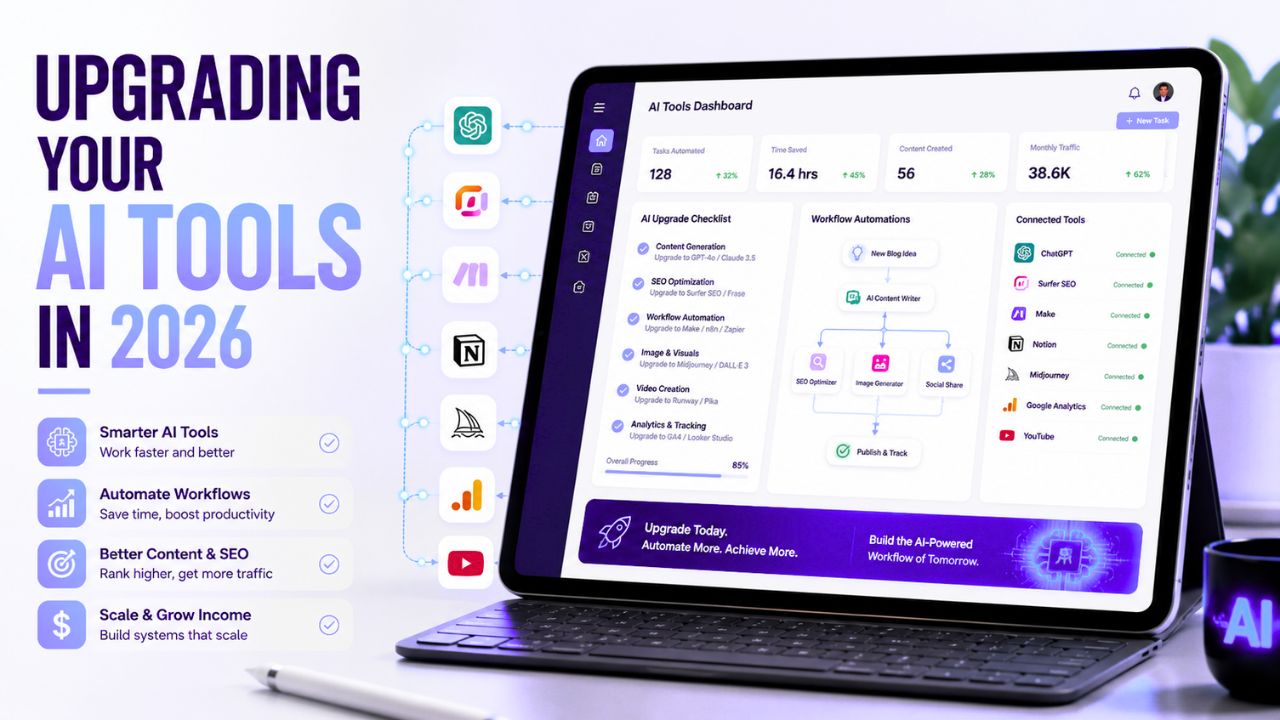
Upgrading Your AI Tools in 2026: Key Considerations Before You Switch

Upgrading Your AI Tools in 2026

Most people do not need more AI tools. They need better decisions about the tools they already use.

That is the real problem in 2026. New AI products launch almost every week. One promises faster writing. Another promises better automation. Another says it can replace your editor, designer, researcher, or assistant. If you are a blogger, creator, freelancer, or small business owner, it is easy to feel like you are always behind.

But upgrading your AI tools should not be a reaction to hype. It should be a careful decision based on your workflow, budget, privacy needs, content goals, and the real problems you are trying to solve.

A smart upgrade can save hours every week. A bad upgrade can create more subscriptions, more complexity, and more unfinished systems.

Upgrading Your AI Tools

In this guide, we will look at the key considerations and insights you should understand before upgrading your AI tools. You will learn when an upgrade makes sense, what to check before switching platforms, how to compare AI tools, what mistakes to avoid, and how to build a cleaner AI workflow that actually supports your blog or online business.

Upgrading Your AI Tools: What It Really Means

Upgrading your AI tools means improving the tools, workflows, prompts, integrations, and quality checks you use to get real work done with artificial intelligence.

It does not always mean moving from free to paid. It does not always mean choosing the newest tool. It does not even always mean adding another tool.

Sometimes the best upgrade is removing software you no longer use.

For example, a blogger may start with a simple AI writing assistant. That is enough in the beginning. But after publishing more content, they may notice new problems:

  • Content takes too long to edit
  • Images are inconsistent
  • Internal links are missing
  • SEO checks happen too late
  • Social promotion is manual
  • Old posts are never updated

At that point, the upgrade is not just “buy a better writing tool.” The real upgrade is building a better system.

That system may include a writing assistant, a design tool, a WordPress workflow, an automation platform, a spreadsheet tracker, and a simple content review checklist.

The goal is not to collect tools. The goal is to create a workflow that helps you produce better content with less friction.

Why AI Tool Upgrades Matter in 2026

AI tools are no longer just fun experiments. They are now part of how people write, research, design, code, automate, teach, sell, and build online businesses.

For bloggers, AI can help with:

  • Finding topic ideas
  • Creating SEO outlines
  • Writing first drafts
  • Editing weak sections
  • Creating featured image ideas
  • Repurposing posts into videos
  • Building social captions
  • Automating repetitive publishing tasks

That sounds powerful, but there is a catch. Faster content is not always better content.

If your AI tools help you publish generic articles, repeat the same introduction style, skip fact-checking, or add random affiliate links, the upgrade is not helping your brand. It is only helping you publish faster.

A better upgrade should improve quality and consistency.

Google’s guidance on AI-generated content is clear about the bigger principle: content should be helpful and created for people first, regardless of how it is produced. That means AI can be part of your workflow, but it should support usefulness, not replace judgment.

You can read Google’s official explanation here: Google Search guidance about AI-generated content.

When Should You Upgrade Your AI Tools?

You should not upgrade just because a tool is popular. You should upgrade when there is a clear reason.

Here are the strongest signs that upgrading your AI tools may make sense.

Your Current Workflow Is Too Slow

If you spend too much time moving between apps, rewriting the same prompts, formatting content manually, or rebuilding the same article structure every week, your workflow may need improvement.

A good upgrade should remove repeated effort. For example, saved prompt templates, reusable blog outlines, Canva templates, and publishing checklists can all speed up work without lowering quality.

Your Output Quality Is Not Improving

If every AI-assisted article sounds the same, your tools may not be the only problem. Your workflow may need better inputs, clearer instructions, stronger editing, and more real examples.

Before changing tools, improve your process. Give the AI better context. Add your audience, category, focus keyword, internal link targets, CTA rules, and tone instructions. You may get better output from the same tool.

You Have Outgrown Free Plans

Free plans are useful, but they often come with limits. You may run out of credits, lose access to advanced templates, or miss features like collaboration, brand voice, exports, or automation.

Paying can make sense when the tool saves enough time or creates enough business value to justify the cost.

You Need Better Integrations

A tool that works alone may be fine at the beginning. But as your blog grows, integrations matter more.

For example, you may want your tools to connect with WordPress, Google Sheets, Gmail, Notion, Airtable, Canva, Slack, or an email platform. If your current tool cannot connect with your workflow, it may create extra manual work.

You Need Better Privacy or Control

As you use AI tools more seriously, privacy becomes more important. You may be handling client information, unpublished drafts, affiliate revenue data, customer messages, or business documents.

Before upgrading, check how the tool handles data, whether it allows team permissions, and whether it gives enough control for your use case.

Key Considerations Before Upgrading Your AI Tools

Before you pay for a new platform, move your workflow, or replace your existing tools, review these important factors.

1. Start With Your Actual Use Case

The first question is not “What is the best AI tool?”

The better question is:

“What job do I need this AI tool to do?”

A blogger needs different features than a developer. A YouTuber needs different features than an affiliate marketer. A small business owner needs different features than a student.

For AI Sage Labs readers, common use cases include:

  • Writing SEO blog posts
  • Creating affiliate review content
  • Designing blog thumbnails
  • Turning blog posts into videos
  • Automating content promotion
  • Tracking rankings and performance
  • Building simple online income systems

Once the use case is clear, the tool decision becomes easier.

If you are still building your beginner workflow, this guide on how to use AI tools is a useful next step.

2. Check the Learning Curve

A powerful tool is not always the best tool for beginners.

Some AI platforms have advanced settings, custom workflows, API options, prompt libraries, and automation logic. That can be useful for experienced users, but confusing for someone who only wants to publish blog posts consistently.

Before upgrading, ask:

  • Can I understand the interface quickly?
  • Does the tool offer tutorials or templates?
  • Will I use the advanced features?
  • Is the setup worth the time?
  • Can I get help if I get stuck?

A tool should match your current stage. You can always move to more advanced software later.

3. Evaluate Output Quality

Do not judge an AI tool only by its homepage claims. Test the output.

If it is a writing tool, create a draft and review:

  • Does it understand search intent?
  • Does it avoid generic filler?
  • Can it follow your tone?
  • Does it structure sections clearly?
  • Does it require heavy rewriting?

If it is an image tool, test:

  • Image quality
  • Prompt control
  • Text accuracy
  • Commercial-use terms
  • Export quality

If it is an automation tool, test:

  • Available integrations
  • Reliability
  • Setup difficulty
  • Error handling
  • Monthly task limits

A good tool should reduce work after setup, not create more work every time you use it.

4. Review Pricing Carefully

AI tool pricing can look simple at first, but the real cost may depend on credits, usage limits, seats, exports, storage, automation runs, or premium features.

Before paying, check:

  • Monthly price
  • Annual discount
  • Credit limits
  • Usage limits
  • Export restrictions
  • Team pricing
  • Upgrade and cancellation rules

Do not buy a tool because it feels cheap. Buy it because it solves a clear problem and fits your budget.

If a tool saves three hours every week, it may be worth paying for. If it only looks interesting but does not change your workflow, skip it for now.

5. Check Data Privacy and Risk

This is one of the most important parts of upgrading your AI tools, especially if you use AI for client work, business planning, customer support, or private documents.

Before using a new AI platform, check:

  • What data you are uploading
  • Whether the tool stores prompts or files
  • Whether your content may be used for training
  • Team permission controls
  • Security features
  • Export and deletion options

For a broader risk-management view, NIST’s AI Risk Management Framework is a useful trusted resource for understanding trustworthy AI practices. You can review it here: NIST AI Risk Management Framework.

6. Look at Integration With Your Existing System

The best tool is not always the tool with the most features. It is the tool that fits your workflow.

If you run a WordPress blog, your tool stack may include WordPress, Rank Math, Google Search Console, Canva, email marketing software, Google Sheets, and automation tools.

A new AI tool should support that system. If it forces you to copy and paste everything manually, it may slow you down.

If you are planning automation, this guide on best AI automation tools for bloggers can help you compare beginner-friendly options.

7. Check Support and Documentation

Support matters more than people think.

When a workflow breaks, you need answers. A tool with poor documentation, slow support, or unclear settings can waste hours.

Before upgrading, check:

  • Help docs
  • Video tutorials
  • Community forum
  • Live chat or email support
  • Template library
  • Update history

If the tool is critical to your business, support is part of the value.

AI Tool Upgrade Checklist

Use this checklist before buying or switching any AI tool.

Question Why It Matters
What problem does this tool solve? Prevents random purchases
Will I use it every week? Helps avoid wasted subscriptions
Does it improve quality or only speed? Protects content trust
Does it connect with my current workflow? Reduces manual work
Can I test it before paying? Lowers risk
Are pricing limits clear? Avoids surprise costs
Is my data safe? Protects private information
Does support exist if I get stuck? Improves long-term usability

If you cannot answer these questions, wait before upgrading.

Best AI Tools to Consider Upgrading First

You do not need to upgrade everything at once. Focus on the categories that affect your work the most.

AI Writing Tools

AI writing tools are usually the first upgrade for bloggers. They help with ideas, outlines, drafts, meta descriptions, FAQs, and content repurposing.

Look for tools that help you write clearly, follow structure, and reduce editing time. Do not choose a tool only because it creates long articles quickly. Speed without quality is not enough.

AI Design Tools

Design tools are important because your visuals affect trust. A clean featured image, strong thumbnail, or branded graphic can make your blog look more professional.

Canva is often a practical starting point for bloggers. AI image tools like Leonardo AI or Stable Diffusion can also help when you need custom visuals.

AI Video Tools

Video tools are useful if you want to repurpose blog posts into YouTube videos, shorts, reels, or explainers.

For bloggers, tools like Pictory, InVideo AI, Synthesia, Runway, or Descript may fit different needs. Choose based on your workflow: blog-to-video, avatar videos, advanced editing, or transcript-based editing.

AI Automation Tools

Automation tools are useful when you repeat the same steps every week.

For example:

  • New post published → add URL to a spreadsheet
  • New lead captured → send welcome email
  • New content idea saved → create task in your content calendar
  • New article published → create social promotion reminders

Zapier is often easier for beginners, while Make.com gives more visual control. n8n is powerful for technical users who want more flexibility.

SEO and Analytics Tools

SEO tools help you see whether your content is moving in the right direction. Rank Math can help with on-page optimization. Google Search Console can show which queries bring traffic. Analytics tools can help you understand reader behavior.

Do not use SEO tools only to chase scores. Use them to improve helpfulness, structure, internal links, and clarity.

How Bloggers Should Approach AI Tool Upgrades

Bloggers should be especially careful because AI tools can either improve a content system or make it feel mechanical.

Here is a simple upgrade path for bloggers:

  1. Fix your topic planning system.
  2. Create better prompt templates.
  3. Standardize your article structure.
  4. Add two internal links during drafting.
  5. Add one trusted external source when useful.
  6. Create reusable featured image templates.
  7. Use AI to repurpose each post into social content.
  8. Add automation only after publishing becomes consistent.
  9. Review tool costs every month.

This approach keeps the workflow practical.

The most important thing is to protect trust. AI can help you create more, but readers still need useful explanations, honest recommendations, and clear next steps.

Recommended Setup for a Better AI Blog Workflow

If your goal is to use AI tools for blogging or affiliate marketing, your website is still the foundation. Social media can help, but a self-hosted blog gives you more control over search traffic, branding, content updates, affiliate links, email capture, and long-term monetization.

For beginners, WordPress is a strong option because it is flexible and easy to expand as your site grows.

Build Your AI Blog on WordPress

If you want your AI content system to become a real asset, start with a reliable WordPress blog. Hostinger is beginner-friendly and works well for launching content and affiliate websites.

Start your blog with Hostinger

When to Get Help With AI Tool Setup

Not every upgrade needs to be done alone. If you are spending days trying to connect tools, fix WordPress issues, create automation workflows, or design a content system, hiring help may be smarter.

You can hire freelancers for:

  • WordPress setup
  • AI automation workflows
  • SEO cleanup
  • Canva template design
  • AI video editing
  • Blog content formatting

This can save time if the task is blocking your publishing schedule.

Need Help Upgrading Your AI Workflow?

If you want expert help setting up AI tools, automations, WordPress, SEO, or content systems, Fiverr is a practical place to find freelancers for one-time setup tasks.

Find AI workflow freelancers on Fiverr

Recommended Book for Smarter AI Decisions

When you are comparing AI tools, it helps to understand how AI changes work itself. One useful book for that is Co-Intelligence: Living and Working with AI by Ethan Mollick.

It is not a tool manual. It is more useful as a thinking guide for people who want to work with AI more intelligently instead of jumping from one tool to another.

Recommended Reading

If you want to think more clearly about how AI fits into work, creativity, and productivity, this book is a helpful next step.

Check Co-Intelligence on Amazon

Common Mistakes When Upgrading AI Tools

Chasing Trends Instead of Solving Problems

A tool being popular does not mean it is right for your workflow. Start with your problem first, then choose the tool.

Ignoring Hidden Costs

Some tools look affordable until you hit credit limits, export limits, seat limits, or automation task limits. Always check the full pricing page.

Switching Too Often

If you keep switching tools every week, you never build a stable workflow. Test tools carefully, but give your main system enough time to work.

Publishing AI Output Without Editing

AI drafts need human review. Add examples, remove repeated phrases, check facts, and make sure the article actually helps the reader.

Forgetting Internal Links

Internal links should be part of your publishing process. Add them before publishing, not weeks later.

Ignoring Privacy

Do not upload sensitive client, financial, or business information into a tool unless you understand the privacy settings and terms.

Final Verdict

Upgrading your AI tools can be one of the smartest moves you make in 2026, but only if you do it with a clear strategy.

Do not upgrade because a tool is trending. Upgrade because your current workflow has a real limitation. Maybe you need faster drafting, better visuals, smoother automation, cleaner internal linking, stronger SEO checks, or more reliable content review.

The best AI tool stack is not the biggest one. It is the one that helps you work consistently without lowering trust.

For bloggers, creators, and affiliate marketers, the smartest upgrade path is simple: improve your process first, then choose tools that support that process.

If you do that, upgrading your AI tools becomes less about chasing software and more about building a better online business system.

Frequently Asked Questions

What does upgrading AI tools mean?

It means improving your AI workflow by choosing better tools, removing unnecessary software, creating better prompts, adding integrations, and building quality checks that help you work faster and produce better results.

When should I upgrade my AI tools?

You should upgrade when your current tools slow you down, limit your output quality, create too much manual work, lack important integrations, or no longer fit your content or business goals.

Should beginners pay for AI tools?

Beginners do not need to pay immediately. Start with free plans where possible. Upgrade only when a paid feature clearly saves time, improves quality, or supports a real business workflow.

What is the biggest mistake when upgrading AI tools?

The biggest mistake is buying tools without a clear workflow. If you do not know what problem the tool solves, it may become another unused subscription.

Are AI tools safe for business use?

AI tools can be safe when used carefully, but you should review privacy settings, data policies, permissions, and security features before uploading sensitive business or client information.

Which AI tool should bloggers upgrade first?

Most bloggers should upgrade their writing and content planning workflow first. After that, improve design, SEO, automation, and video based on the biggest bottleneck in the publishing process.

Can AI tool upgrades help me make money online?

Yes, but not automatically. Better tools can help you publish more consistently, improve content quality, create visuals, automate tasks, and build affiliate systems. Income still depends on strategy, traffic, trust, and execution.

Conclusion

AI tools are changing fast, but your upgrade decisions should stay grounded.

Start with your workflow. Find the slowest or weakest part. Test whether a better tool, prompt, template, or automation can fix it. Then upgrade carefully.

For bloggers and online creators, the best AI setup is not complicated. It helps you plan better, write clearer, design faster, link smarter, publish consistently, and keep the reader’s trust.

That is the real value of upgrading your AI tools.

Affiliate Disclosure

As an Amazon Associate, I earn from qualifying purchases. Some links in this article are affiliate links, which means I may earn a commission at no extra cost to you if you buy through them. I only recommend tools, books, and services that may help beginners learn, build, or grow their online work more effectively.
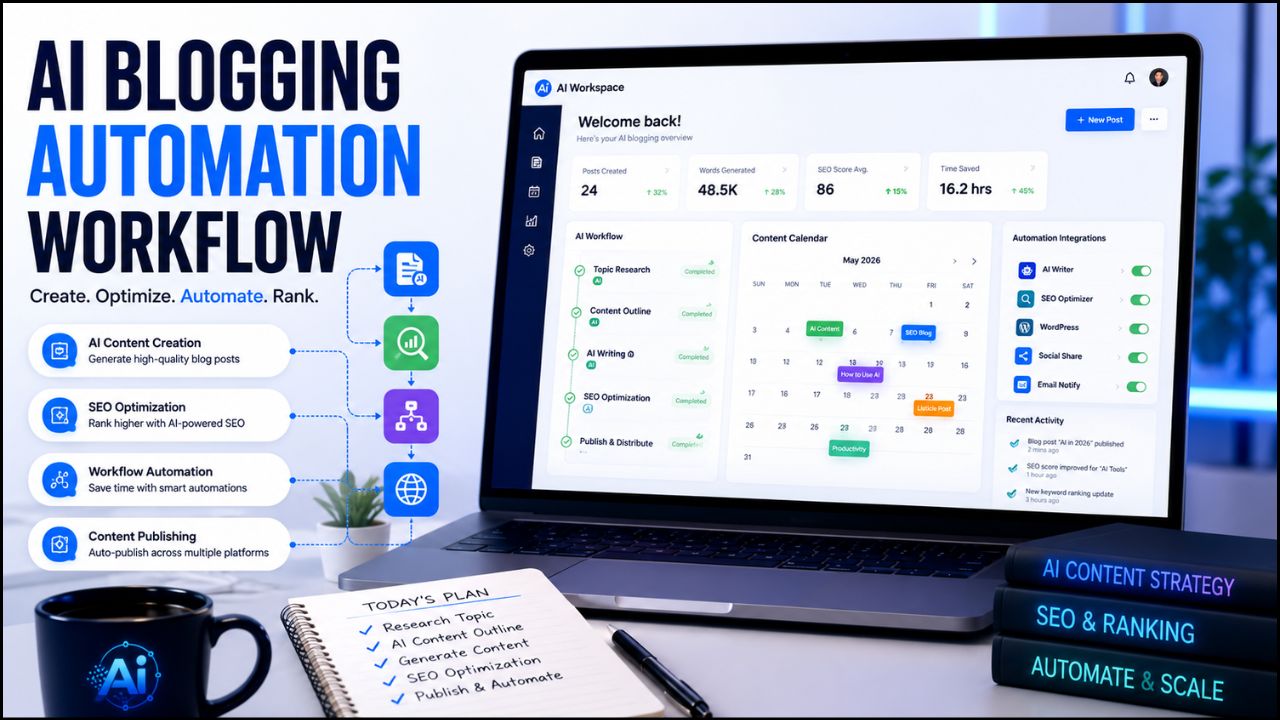
Upgrade Your AI Tools in 2026: 7 Smart Ways to Build a Better AI Workflow

Upgrade Your AI Tools

Your AI tools should make your work easier, not add more confusion to your day.

But that is exactly what happens to many bloggers and creators in 2026. They start with one writing tool, then add a design tool, then try an automation platform, then test a video tool, then subscribe to something else because everyone online says it is “essential.” After a few weeks, their browser is full of bookmarks, their budget is stretched, and their workflow is still messy.

That is why it is important to upgrade your AI tools with a clear strategy instead of chasing every new launch.

Upgrading does not always mean buying more expensive software. Sometimes it means removing tools you do not use. Sometimes it means replacing three average tools with one better platform. Sometimes it means building a simple workflow where writing, visuals, SEO, publishing, and promotion finally connect properly.


Upgrade Your AI Tools


In this guide, you will learn how to upgrade your AI tools in a practical way, especially if you are a blogger, affiliate marketer, creator, freelancer, or small business owner. We will cover what upgrading really means, when your current AI stack is outdated, which tools to improve first, common mistakes, and how to build a cleaner workflow that saves time without making your content feel robotic.

Upgrade Your AI Tools in 2026: What It Really Means

To upgrade your AI tools means improving the way you use AI to complete real work. It is not only about switching from a free plan to a paid plan. It is about making your workflow faster, cleaner, more reliable, and easier to repeat.

A real upgrade can include:

  • Choosing better tools for writing, research, design, video, SEO, or automation
  • Removing duplicate tools that do the same job
  • Creating reusable prompts and templates
  • Connecting tools so tasks move smoothly from one step to another
  • Adding quality checks before publishing AI-assisted content
  • Tracking which tools actually help you save time or earn money

For example, a beginner blogger may start with ChatGPT for writing ideas and Canva for images. That is enough at the beginning. But once the blog grows, the same person may need a better content calendar, a workflow automation tool, a stronger SEO process, and a consistent system for updating old posts.

That is when upgrading makes sense.

The goal is not to look advanced. The goal is to reduce friction. If your tools help you publish better content more consistently, they are doing their job.

Why Upgrading AI Tools Matters for Bloggers and Creators

AI is now part of almost every content workflow. Bloggers use it for outlines, research, draft writing, image ideas, social captions, email sequences, video scripts, and automation. But the quality of your results depends heavily on the quality of your system.

A weak system creates weak output.

If your AI workflow is random, you may publish content that sounds generic, misses search intent, uses outdated facts, or repeats the same phrases across multiple posts. That can hurt trust with readers and make your site feel less useful.

A stronger workflow does the opposite. It helps you create content that is structured, edited, fact-checked, visually consistent, and easier for readers to understand.

Google’s own guidance focuses on helpful, reliable, people-first content. That means your AI tools should support real usefulness, not just produce more words. You can read Google’s official guidance on creating helpful, reliable, people-first content if you want to understand how search quality is framed from Google’s side.

For AI Sage Labs, this matters because the audience is not only looking for tool names. They want practical systems. They want to know which tools are worth using, how to use them, and how those tools can help with blogging, affiliate marketing, content creation, or online income.

That is why a smarter AI setup can become a real advantage.

Signs Your Current AI Tool Stack Is Outdated

You do not need to change your AI stack every time a new product launches. But there are clear signs that your current setup is slowing you down.

1. You Use Too Many Tools for the Same Task

If you have three writing tools, two image tools, three SEO tools, and four automation accounts, your workflow may be heavier than it needs to be.

Too many tools create decision fatigue. You spend more time choosing where to work than actually finishing the work.

A better approach is to pick one main tool for each job. One writing assistant. One design platform. One SEO process. One automation platform. You can test alternatives, but your daily workflow should stay simple.

2. Your AI Content Sounds Generic

If every post starts the same way, uses the same phrases, and gives the same basic advice, your AI workflow needs improvement.

This often happens when you rely too much on basic prompts like “write a blog post about this topic.” The AI produces a clean draft, but it does not know your audience, your site structure, your monetization strategy, or your personal judgment.

Instead, use prompts that include audience, search intent, tone, examples, internal links, CTA rules, and fact-checking requirements. This single change can make a big difference.

3. You Still Do Repetitive Tasks Manually

If you manually copy every new post into a tracker, manually create social captions, manually format every outline, and manually repeat the same publishing checklist, you may be ready for automation.

Automation does not need to be complicated. Even a simple workflow can save hours each month.

For example, after publishing a WordPress post, you can create a task to design Pinterest pins, add the URL to a spreadsheet, and prepare a social media draft. Tools like Zapier, Make, or n8n can help with this kind of workflow.

4. Your Visuals Do Not Match Your Brand

AI tools can create images quickly, but fast visuals are not always good visuals. If every featured image looks different, your blog may feel less professional.

A better setup uses brand colors, repeatable layouts, consistent image sizes, and a clear thumbnail style. Canva, Leonardo AI, and Stable Diffusion can all help, but the real upgrade is having a visual system.

5. You Do Not Track Results

If you do not know which tools save time, which posts get clicks, which CTAs convert, or which workflow steps create bottlenecks, your tool decisions become guesses.

Before buying more software, track your process for a few weeks. Note how long research takes, how long writing takes, how long editing takes, and which tools you actually open every week.

Data makes upgrading easier.

7 Smart Ways to Upgrade Your AI Tools

The best way to upgrade your AI tools is to improve one part of your workflow at a time. Do not rebuild everything in one weekend. Start with the area that creates the most friction.

1. Start With a Workflow Audit

Before upgrading anything, write down your current workflow.

For a blogger, the workflow may look like this:

  • Choose a topic
  • Research the keyword
  • Create an outline
  • Write the draft
  • Edit the article
  • Add images
  • Add internal links
  • Add affiliate CTAs
  • Publish in WordPress
  • Promote the post
  • Track performance

Now mark the slowest steps. Maybe research takes too long. Maybe images delay publishing. Maybe internal linking is always forgotten. Maybe social promotion never happens.

Upgrade the bottleneck first.

If writing is slow, improve your writing assistant and prompt system. If visuals are slow, improve your Canva templates or AI image workflow. If promotion is slow, add automation. This keeps your upgrades practical instead of random.

2. Build a Smaller, Cleaner AI Stack

A beginner does not need twenty AI tools. Most bloggers can start with a simple stack:

Workflow Area Tool Type Example Tools
Writing and planning AI writing assistant ChatGPT, Claude, Writesonic
Design AI design tool Canva, Leonardo AI
Video AI video tool Pictory, InVideo AI, Synthesia
Automation No-code automation tool Zapier, Make, n8n
SEO and publishing SEO plugin or content tool Rank Math, Google Search Console


You can add advanced tools later, but the foundation should stay clean. The best stack is the one you actually use every week.

If you are still building your beginner setup, this internal guide can help: how to use AI tools for beginners in 2026.

3. Upgrade Your Prompt System Before Buying New Tools

Many people think their AI tool is weak when the real problem is their prompt.

A weak prompt gives weak direction. A strong prompt gives the AI a clear task, audience, format, tone, and rules.

Instead of writing:

“Write a blog post about AI tools.”

Use:

“Create a beginner-friendly outline for a 3000-word blog post about upgrading AI tools in 2026. The audience is bloggers and affiliate marketers. Use simple US English, practical examples, RankMath-friendly H2/H3 structure, two internal link opportunities, one trusted external source, and natural CTA placements. Do not use hype.”

That is a much better instruction.

Before paying for another tool, build prompt templates for your common tasks:

  • Blog outline prompt
  • Product review prompt
  • FAQ prompt
  • Meta description prompt
  • Internal linking prompt
  • CTA placement prompt
  • Human editing prompt

Good prompts make almost every AI tool more useful.

4. Add a Real Internal Linking Process

Internal links should not be an afterthought. They help readers discover related content and help search engines understand how your site is connected.

The problem is that many bloggers publish posts first and think about internal links later. That creates broken anchors, missing related posts, and weak content clusters.

A better process is simple:

  • Before writing, choose two related posts to link inside the article
  • Use natural anchor text, not random “click here” text
  • Link to posts that actually help the reader continue the journey
  • Keep a spreadsheet of post titles, slugs, focus keywords, and categories
  • Update old posts when you publish a strong new pillar post

For example, this post naturally connects with 7 trending AI tools in 2026 because readers who want to upgrade their stack also need tool ideas that are useful for bloggers.

This kind of internal linking is cleaner than forcing unrelated posts into the article.

5. Upgrade Your Visual Workflow

Visual content is no longer optional for bloggers. Your post needs a featured image, and your content can often be repurposed into Pinterest pins, YouTube thumbnails, LinkedIn graphics, and short video visuals.

The simplest upgrade is to create reusable templates.

For example, create a template for:

  • Blog featured images
  • Tool review thumbnails
  • Comparison graphics
  • Pinterest pins
  • YouTube thumbnails

Then use AI to support the design process instead of starting from scratch each time.

Canva can help with templates and quick editing. Leonardo AI can help with creative images. Stable Diffusion can help advanced users who want more control. The tool matters, but the system matters more.

If your blog visuals look consistent, readers start recognizing your brand. That builds trust.

6. Add Automation Only After the Workflow Is Clear

Automation is powerful, but it can also create confusion if you use it too early.

Do not automate a messy workflow. First, repeat the task manually a few times. Once the steps are clear, automate the boring parts.

Good beginner automations include:

  • Adding new post URLs to a Google Sheet
  • Creating social media tasks after publishing
  • Sending yourself a reminder to update old posts
  • Saving form submissions into a CRM or spreadsheet
  • Creating draft email newsletters from new blog posts

If you want a deeper beginner explanation, read this guide on what AI automation tools are.

Automation should support your content system. It should not become another complicated project that distracts you from publishing useful content.

7. Create a Quality Control Checklist

The final way to upgrade your AI tools is to add a review process before publishing.

AI can help you move faster, but it can also create mistakes. It may repeat phrases, miss context, use outdated information, or sound too generic. A simple checklist protects your content quality.

Before publishing, check:

  • Does the article answer the reader’s main question?
  • Is the focus keyword used naturally?
  • Does the post include helpful examples?
  • Are internal links connected to real posts?
  • Is there at least one trusted external source?
  • Are affiliate links relevant and not spammy?
  • Does the intro sound different from your other posts?
  • Did you remove hype and generic AI phrases?
  • Is the final verdict clear?
  • Is the affiliate disclosure included at the end?

This checklist is simple, but it makes your AI-assisted content feel more human and more useful.

Best AI Tools to Upgrade First

If you cannot upgrade everything at once, start with the tool category that affects your output most directly.

Writing and Research Tools

Writing tools usually create the biggest time savings for bloggers. They help with topics, outlines, drafts, FAQs, meta descriptions, and content repurposing.

But do not treat them as automatic article machines. Use them for structure and speed, then add your own research, examples, judgment, and editing.

Good writing upgrades include better prompts, saved templates, brand voice instructions, and a consistent editing workflow.

Design and Image Tools

If your blog looks unprofessional, readers may not trust it even if the writing is helpful.

Design tools can help you create better featured images, social graphics, and thumbnails. For most beginners, Canva is the easiest starting point. For AI image generation, Leonardo AI and Stable Diffusion are useful depending on your skill level.

Use these tools to create a recognizable visual style, not random images for every post.

Video Tools

Video tools matter because one blog post can become multiple content assets. A written article can turn into a YouTube script, short video, social clip, or explainer video.

Pictory, InVideo AI, Synthesia, Runway, and Descript all serve different video workflows. The right choice depends on whether you want blog-to-video, avatar videos, advanced editing, or text-based editing.

For bloggers, the first upgrade is usually a blog-to-video tool or a simple editing tool.

Automation Tools

Automation tools help connect apps and reduce manual work. Zapier is beginner-friendly, Make is flexible, and n8n is useful for more technical users who want control.

Start with one simple automation. Do not build a giant system before your content process is stable.

SEO and Tracking Tools

SEO tools help you improve content, but they cannot replace useful writing. Rank Math, Google Search Console, and keyword research tools can help you understand what is working.

For WordPress users, Rank Math is helpful because it turns on-page SEO into a checklist. Just remember that a green score is not the same as a helpful article. Use the score as a guide, not as the final goal.

Recommended AI Workflow for Bloggers

Here is a practical workflow you can use after you upgrade your AI tools:

  1. Choose one topic based on your content plan.
  2. Check the search intent and existing internal link opportunities.
  3. Create an outline with your AI writing assistant.
  4. Add your own examples, notes, and monetization angle.
  5. Draft the article section by section.
  6. Edit manually for clarity and human tone.
  7. Add two internal links to relevant existing posts.
  8. Add one trusted external source where it helps the reader.
  9. Create a 16:9 featured image in your visual tool.
  10. Add natural CTAs for relevant tools, services, books, or hosting.
  11. Publish in WordPress and track performance.
  12. Update the article after 60 to 90 days if needed.

This is simple enough to repeat every week, but strong enough to support long-term growth.

Recommended Setup for AI Bloggers

If you want to turn your AI workflow into a real blog or affiliate site, you need a reliable place to publish your content. Social platforms are useful, but your own website gives you more control over SEO, branding, email capture, and affiliate monetization.

For beginners, WordPress is still one of the best foundations because it is flexible, searchable, and easy to monetize over time.

Build Your AI Blog on a Strong Foundation

If your goal is to publish AI tool reviews, tutorials, and affiliate content, start with a self-hosted WordPress site. Hostinger is a beginner-friendly option for launching a blog without making the setup too complicated.

Start your AI blog with Hostinger

When You Should Hire Help Instead of Doing Everything Yourself

Sometimes the smartest way to upgrade is not another subscription. It is getting help from someone who already knows the workflow.

For example, you may want help with:

  • Setting up WordPress properly
  • Creating a blog design system
  • Building AI automation workflows
  • Designing featured image templates
  • Fixing SEO and internal linking issues
  • Creating video content from blog posts

If you are stuck for weeks trying to set up something technical, hiring help can save time and reduce frustration.

Need Help Building Your AI Workflow?

If you do not want to set up every tool yourself, you can hire freelancers for WordPress setup, AI automation, SEO cleanup, Canva templates, or blog workflow systems.

Find AI and WordPress freelancers on Fiverr

Recommended Book for Thinking Better About AI

Tools change quickly, but good thinking stays useful. If you want to understand how AI fits into real work, decision-making, and creativity, a helpful book to explore is Co-Intelligence: Living and Working with AI by Ethan Mollick.

This book is a good fit for bloggers, creators, and business owners who want to use AI thoughtfully instead of treating it like a magic button.

Recommended Reading

If you want a deeper understanding of how to work with AI in a practical way, this book is a strong next step.

Check Co-Intelligence on Amazon

Common Mistakes to Avoid

Buying Tools Before You Have a Workflow

Do not buy a tool just because it is trending. First, know the task it will solve. If you cannot explain where the tool fits in your workflow, wait before paying.

Using AI to Publish Generic Content

AI can help you write faster, but generic content will not build a strong blog. Add examples, opinions, comparisons, screenshots, and real judgment whenever possible.

Ignoring Internal Links

Internal links should be part of the writing process, not a task you postpone for later. Add them while drafting so your content cluster grows naturally.

Trusting AI Facts Without Checking

AI tools can be wrong. Always check pricing, features, claims, and important facts from official sources before publishing.

Making Every CTA Feel Like a Sales Pitch

Affiliate links should appear where the reader has a clear next step. Hosting makes sense when the reader needs a website. Fiverr makes sense when they need help. Amazon makes sense when they want deeper learning.

Final Verdict

You should upgrade your AI tools when your current setup is slowing you down, creating generic output, wasting money, or making your workflow harder than it needs to be.

But do not confuse upgrading with collecting tools.

The best AI setup is not the biggest stack. It is the cleanest system that helps you create useful content consistently. For bloggers, that usually means one strong writing workflow, one visual workflow, one SEO process, one publishing checklist, and simple automation added only when needed.

If you are a beginner, start small. Improve your prompts. Create reusable templates. Fix your internal linking process. Add a trusted external source where it helps. Build your website on a solid foundation. Then add better tools only when your workflow proves that you need them.

That is how you upgrade your AI tools without wasting money or losing the human quality that makes readers trust your content.

Frequently Asked Questions

What does upgrading AI tools mean?

It means improving your AI workflow so your tools help you work faster, create better content, reduce manual tasks, and publish more consistently. It can include better prompts, better software, automation, templates, or a cleaner tool stack.

Do I need paid AI tools as a beginner?

No. Beginners can start with free or low-cost tools. Upgrade only when you clearly understand the limitation you are trying to solve, such as low AI credits, missing templates, weak automation, or slow content production.

What AI tool should bloggers upgrade first?

Most bloggers should upgrade their writing and planning workflow first because it affects every article they publish. After that, improve visuals, SEO, and automation based on your biggest bottleneck.

Are too many AI tools bad for productivity?

Yes, they can be. Too many tools create confusion, duplicate costs, and scattered workflows. A smaller stack with clear roles is usually better than a large stack you do not use consistently.

How can I make AI content sound more human?

Use specific examples, edit manually, vary your introductions, include real opinions, avoid hype, and write for one clear audience. AI should help with structure and speed, not replace your judgment.

Should I automate my blog workflow?

Yes, but only after the workflow is clear. Start with simple automations like tracking published posts, creating promotion tasks, or preparing newsletter drafts. Do not automate a messy process too early.

How often should I review my AI tool stack?

Review your tools every 60 to 90 days. Check which tools you use regularly, which ones save time, which ones cost money without clear value, and which workflow steps still feel slow.

Conclusion

AI tools are powerful, but they only become valuable when they fit into a real workflow.

If you want to build a better blogging system in 2026, do not chase every new AI launch. Start with your actual problems. Where are you losing time? Where is your content weakest? Where are your links missing? Where does publishing slow down?

Answer those questions first. Then upgrade the tools that solve those problems.

For most bloggers, the smartest path is simple: improve your writing workflow, create better visuals, connect related posts properly, use trusted sources, add automation slowly, and keep your final content useful for real readers.

That is how AI becomes a serious advantage instead of another distraction.

Affiliate Disclosure

As an Amazon Associate, I earn from qualifying purchases. Some links in this article are affiliate links, which means I may earn a commission at no extra cost to you if you buy through them. I only recommend tools, books, and services that may help beginners learn, build, or grow their online work more effectively.
What Is an AI Agent? The Ultimate Beginner’s Guide (2026)

What Is an AI Agent

Imagine opening your laptop in the morning and finding that the boring parts of yesterday’s work are already handled.

Your email inbox is sorted. Your calendar is updated. A blog outline is waiting in Google Docs. Competitor notes are summarized. Pinterest pin ideas are ready. A weekly performance report is sitting in your inbox.

You did not hire a full-time assistant.

You did not stay awake all night.

An AI agent handled the workflow.

That is why so many people are asking the same question in 2026: what is an AI agent, and how is it different from ChatGPT, chatbots and normal AI tools?

The short answer is simple.

An AI agent is AI that can work toward a goal. It can understand a task, make a plan, use tools, take actions, check progress and return a finished result with less step-by-step prompting from you.


What Is an AI Agent


That does not mean AI agents are magic. They still make mistakes. They still need permissions, good instructions, safe data access and human review. But they represent an important shift from AI that only answers questions to AI that can help complete work.

This beginner guide explains what is an AI agent in plain language, how AI agents work, how they compare with chatbots, real-world examples, risks, beginner tools, and how bloggers, affiliate marketers, freelancers, and small businesses can start using them safely.

By the end, you should be able to explain what is an AI agent to a beginner without using technical jargon.

What Is an AI Agent?

An AI agent is a software system that can understand a goal, plan steps, use available tools, and take actions to complete a task or workflow for a user.

In simpler words, an AI agent is like a digital worker that does more than reply to a prompt.

A chatbot answers.

An AI agent works toward an outcome.

For example, if you ask a normal chatbot:

Write a blog post about AI automation.

It may generate a draft and wait for your next instruction.

An AI agent-style workflow could go further:

  • Research the topic
  • Analyze competing articles
  • Create an outline
  • Draft the article
  • Suggest internal links
  • Write SEO metadata
  • Create image prompts
  • Draft social posts
  • Save the output into your workspace

That is the key difference.

The agent is not only generating text. It is trying to complete a larger goal.

IBM describes AI agents as systems that autonomously perform tasks by designing workflows with available tools. AWS describes AI agents as software programs that can interact with an environment, collect data and perform self-directed tasks toward goals. Those definitions are useful, but for beginners the simplest explanation is this:

An AI agent is AI that can plan and act, not just chat.

A Simple Analogy

Imagine you are opening a small coffee shop.

A chatbot is like asking a friend for advice.

You ask:

How should I market my coffee shop?

The friend gives suggestions. Maybe they say to post on Instagram, offer a launch discount and create a loyalty card.

Helpful, but the conversation stops there.

An AI agent is more like assigning the task to a junior operations manager.

You say:

Help me launch the coffee shop marketing plan.

The manager might research competitors, create a launch calendar, draft promotional emails, prepare social posts, organize local partnership ideas, track responses and send you a summary.

That is the mental model.

A chatbot gives answers. An AI agent coordinates work.

Why AI Agents Are Becoming Popular in 2026

AI agents are becoming popular because modern work is full of repetitive digital tasks.

People spend hours every week:

  • Organizing emails
  • Researching information
  • Updating spreadsheets
  • Creating reports
  • Writing first drafts
  • Scheduling content
  • Answering common questions
  • Moving information between apps
  • Checking analytics
  • Creating similar documents again and again

Most of those tasks follow patterns.

AI agents are designed to handle those patterns so humans can spend more time on strategy, creativity, relationships and decisions.

This is especially important for solo creators, bloggers, affiliate marketers, freelancers and small businesses because they usually do not have large teams. A good AI agent workflow can feel like adding a small digital teammate without hiring a full employee.

If you want the practical blogging side of this idea, our guide to AI automation tools for bloggers explains the tools that help connect content, email, social and workflow systems.

How Do AI Agents Work?

AI agents can look complicated, but the basic workflow is easy to understand.

Most AI agents follow six stages.

1. Goal

Everything starts with a goal.

Instead of giving the AI every tiny instruction, you describe the outcome you want.

Examples:

  • Create a weekly content plan.
  • Research the best AI video tools.
  • Summarize customer feedback.
  • Prepare an email newsletter from my latest blog post.
  • Find broken affiliate links and create an update checklist.

The goal tells the agent what success should look like.

2. Context

The agent needs context to do useful work.

Context may include:

  • Your audience
  • Your brand voice
  • Previous documents
  • Project rules
  • Company data
  • Examples of good output
  • Tool permissions

Without context, an agent may still produce something, but it will often feel generic or misaligned.

3. Planning

A good AI agent does not jump straight to the final answer.

It breaks the goal into smaller steps.

For example, if the goal is to publish a blog post, the plan might be:

  1. Review the keyword and search intent.
  2. Collect research from trusted sources.
  3. Create a blog outline.
  4. Draft sections.
  5. Add examples and FAQs.
  6. Suggest internal links.
  7. Create a final publishing checklist.

This planning step is one reason AI agents feel more useful than basic chatbots.

4. Tool Use

Tool use is where agents become powerful.

An AI model alone can mostly generate text. An AI agent connected to tools can do work across software.

Tools may include:

  • Web search
  • Email
  • Calendars
  • Documents
  • Spreadsheets
  • CRMs
  • Databases
  • Automation platforms
  • Design tools
  • Code editors

Google Cloud describes enterprise agent platforms around building, deploying, governing, and optimizing AI agents and model-based solutions. That enterprise framing matters because serious agents need more than clever prompts. They need access control, testing, monitoring, and governance.

5. Action

After planning and choosing tools, the AI agent performs actions.

Examples:

  • Drafting a document
  • Updating a spreadsheet
  • Sending a summary
  • Creating a task
  • Running a search
  • Calling an API
  • Generating a report
  • Creating a workflow step

Action is what separates an agent from a passive assistant.

6. Review and Feedback

AI agents should check progress.

They may ask:

  • Did the output match the goal?
  • Is more information needed?
  • Did a tool fail?
  • Should the plan change?
  • Does this need human approval?

This feedback loop helps agents handle multi-step work. But it does not remove the need for human review.

Important content, customer messages, code, affiliate claims, pricing details, and business decisions should still be checked by a person.

AI Agent vs ChatGPT

Many beginners ask whether ChatGPT is an AI agent.

The answer is: sometimes, depending on how it is used.

ChatGPT is primarily an AI assistant and conversational interface. It can answer questions, generate ideas, explain concepts, write drafts, and help with reasoning.

But a basic chat conversation is not the same as a full AI agent.

The difference is workflow and action.

Feature ChatGPT-style assistant AI agent
Main job Respond to prompts Work toward goals
Workflow User guides each step Can plan multiple steps
Tool use May use tools if enabled Designed around tool use
Autonomy Usually waits for instructions Can continue through a task within limits
Best for Ideas, explanations, drafts Workflows, automation, multi-step tasks


Think of ChatGPT as a powerful conversation engine. Think of an AI agent as a workflow built around an AI model, tools, memory, permissions and a goal.

AI Agent vs Chatbot vs AI Assistant

These terms overlap, which creates confusion.

Here is the simple difference.

Chatbot

A chatbot usually answers questions or follows a conversation. Older chatbots often followed fixed rules. Modern chatbots use large language models and can be much smarter, but many still depend on user prompts.

AI Assistant

An AI assistant helps with individual tasks such as writing, summarizing, brainstorming, scheduling, or answering questions.

AI Agent

An AI agent is more goal-focused. It can plan, use tools, take actions, and continue through a multi-step workflow.

In simple terms:

  • A chatbot talks.
  • An AI assistant helps.
  • An AI agent works through a goal.

That is why the question what is an AI agent is not just a vocabulary question. It is about a shift from conversation to execution.

The Five Core Parts of an AI Agent

Most AI agents include five core parts.

1. Reasoning Engine

This is the “brain” of the agent. It understands the goal, processes information, compares options, and decides what to do next.

2. Memory

Memory helps the agent remember useful information such as your writing style, audience, brand rules, past tasks, or project details.

Memory can be useful, but it also creates privacy considerations. Do not connect sensitive data unless you trust the platform and understand its data policies.

3. Planning

Planning turns one big goal into smaller steps. This is what lets agents handle longer workflows instead of giving one quick answer.

4. Tools

Tools let the agent interact with the digital world. Without tools, the agent mostly writes. With tools, it can search, update, send, retrieve, create, or trigger actions.

5. Guardrails

Guardrails include permissions, approvals, limits, policies, logs, and human review steps.

Beginners often forget this part, but it is critical. The more power an agent has, the more important guardrails become.

Types of AI Agents

Not every AI agent is built for the same job.

Task Automation Agents

These agents handle repetitive work such as updating spreadsheets, moving data between apps, creating tasks or sending routine summaries.

Research Agents

Research agents gather information, summarize sources, compare competitors, monitor trends and organize notes.

Content Agents

Content agents support blog posts, scripts, newsletters, social captions, email sequences and SEO workflows.

Customer Support Agents

Support agents answer common questions, route tickets, summarize conversations and help human support teams respond faster.

Coding Agents

Coding agents can help developers write code, debug errors, review pull requests, generate tests and explain technical problems.

Sales and CRM Agents

These agents help organize leads, summarize calls, draft follow-ups, update CRM records, and prioritize outreach.

Multi-Agent Systems

A multi-agent system uses several agents together. One agent may research, another may write, another may check SEO, another may create social posts, and another may prepare reports.

This is powerful, but beginners should not start here. Multi-agent systems can become confusing quickly if the workflow is not clear.

Real-World AI Agent Examples

AI agents are easiest to understand through examples.

1. Blogging Agent

A blogging agent could help research keywords, analyze competitors, create outlines, draft sections, suggest internal links, write meta descriptions and create promotion ideas.

This does not replace the blogger’s judgment. It reduces repetitive preparation work.

For a practical content system, start with our guide to what AI automation tools are, then build one workflow around your current blogging process.

2. Affiliate Marketing Agent

An affiliate marketing agent could monitor product launches, organize review notes, draft comparison tables, suggest FAQs, check older posts for update opportunities and prepare email promotion drafts.

It should not invent personal experience, fake results or make unsupported income claims.

If you monetize with affiliate content, our AI affiliate review writing guide is the safer starting point.

3. Pinterest Marketing Agent

A Pinterest agent could turn a blog post into pin titles, descriptions, board suggestions, image prompt ideas and a weekly publishing plan.

4. Customer Support Agent

A customer support agent could answer common questions, summarize tickets, route requests and prepare draft replies for human review.

5. Research Agent

A research agent could monitor a niche, collect trusted sources, summarize changes, compare competitors and prepare a weekly briefing.

6. Coding Agent

A coding agent could inspect a codebase, suggest changes, write tests, fix bugs and explain what it changed.

7. Local Business Agent

A local business agent could help prepare appointment reminders, summarize customer messages, draft review responses and update task lists.

How Bloggers and Affiliate Marketers Can Use AI Agents

Blogging and affiliate marketing are strong use cases because they involve repeated workflows.

A blogger may repeat the same process every week:

  • Choose topic
  • Research search intent
  • Create outline
  • Draft article
  • Edit
  • Add images
  • Add internal links
  • Add affiliate disclosure
  • Create pins
  • Write newsletter
  • Update tracker

An AI agent can help coordinate parts of that process.

For example:

Goal: Prepare a complete publishing package for my article about AI video tools.

The agent-style workflow might create:

  • Article outline
  • FAQ ideas
  • Internal link suggestions
  • Featured image prompt
  • Pinterest titles
  • Newsletter draft
  • Social captions
  • Publishing checklist

That is the practical answer to what is an AI agent for bloggers: it is a workflow helper that reduces repeated steps while you keep control over final decisions.

If you are building affiliate income, this guide on AI tools for affiliate marketing shows the broader stack around writing, design, email, automation and conversion.

Benefits of AI Agents

They Save Time

AI agents can handle repetitive research, summarizing, drafting, organizing and reporting tasks faster than doing everything manually.

They Reduce Context Switching

Instead of jumping between many apps, an agent can coordinate several steps in one workflow.

They Help Small Teams Do More

Creators, freelancers and small businesses can use AI agents to reduce administrative load without hiring a full team immediately.

They Make Workflows More Consistent

A repeatable agent workflow can help ensure the same checklist is followed every time.

They Support Better Decisions

Agents can summarize data, compare information and surface patterns. Humans still make the final call.

Risks and Limitations of AI Agents

AI agents are useful, but they are not perfect.

This section is important because the hype around agents can make them sound more reliable than they are.

AI Agents Can Make Mistakes

They can misunderstand instructions, use outdated information, miss context or produce confident but wrong outputs.

Bad Inputs Create Bad Outputs

If your goal is vague, your data is messy or your instructions are unclear, the agent’s work may be weak.

Tool Access Creates Risk

An agent connected to email, files, payments, publishing tools or customer systems can do real damage if configured poorly.

Privacy Matters

Do not connect private documents, customer data, financial information or sensitive business systems without understanding how the platform handles data.

Not Every Task Should Be Automated

Do not fully automate legal advice, medical decisions, financial decisions, final hiring decisions, crisis communication, sensitive customer responses or public publishing without review.

NIST’s AI Risk Management Framework is useful here because it encourages organizations to manage AI risks intentionally rather than treating AI as a harmless toy.

Are AI Agents Safe?

AI agents can be safe when they are used with clear limits.

Use these beginner guardrails:

  • Start with low-risk tasks.
  • Keep human approval for publishing, payments, deletions, and customer messages.
  • Limit access to sensitive data.
  • Check facts before using outputs.
  • Use reputable platforms.
  • Review privacy and data policies.
  • Keep logs of important actions.
  • Test the workflow before using it in real business operations.

Safe AI agent use is not about fear. It is about giving the agent the right level of responsibility.

Best AI Agent Tools and Platforms to Know in 2026

The AI agent tool market changes quickly, so think in categories instead of chasing every new launch.

General AI Assistants

Tools like ChatGPT, Claude, Gemini and Perplexity are good starting points for research, writing, summarizing, planning and learning.

They are not always full agents by default, but they can support agent-like workflows.

Workflow Automation Platforms

Make.com, Zapier and n8n help connect apps and automate repeatable workflows. These are useful when you want AI to move information between tools.

Our Make.com review explains why visual automation can be a practical starting point for bloggers.

Enterprise Agent Platforms

Google Cloud, AWS, Microsoft, IBM and other enterprise providers offer platforms for building, deploying and governing AI agents at scale.

These are more technical and usually more relevant for developers or companies than beginner bloggers.

Customer Support Agents

Support tools use AI agents to answer FAQs, summarize conversations, route tickets and assist human support teams.

Coding Agents

Coding agents help with software development tasks such as editing files, debugging, writing tests and reviewing code.

Content and Marketing Agents

These tools help marketers generate content briefs, create social posts, refresh old articles, organize campaigns, and prepare reports.

For beginners, the best agent platform is usually not the most advanced one. It is the one that solves one real workflow without creating more complexity.

Beginner Roadmap: How to Start Using AI Agents

If you are new, do not try to automate your entire business in one weekend.

Start with this roadmap.

Step 1: Learn One AI Assistant Well

Use ChatGPT, Claude, Gemini, or Perplexity for research, outlines, summaries, and planning.

Step 2: Choose One Repetitive Task

Pick something low-risk:

  • Blog outlines
  • Meeting summaries
  • Email organization
  • Social post drafts
  • Weekly reports
  • Content tracker updates

Step 3: Write the Workflow Manually

Before automating, write the steps down.

If you cannot explain the workflow clearly, the AI agent will struggle too.

Step 4: Add AI Support

Use AI to draft, summarize, classify or suggest next steps.

Step 5: Add Automation Later

Once the workflow works manually, connect tools with Make.com, Zapier, n8n, or another automation platform.

Step 6: Keep Human Review

Review the output before publishing, sending, deleting, buying or making decisions.

This is the beginner-friendly path from simple AI assistance to real AI agent workflows.

Recommended Setup for Bloggers

If you want to use AI agents for blogging, affiliate marketing, or an AI-focused website, your own blog is still the foundation.

Social platforms are useful for distribution, but your website gives you control over SEO, internal links, lead magnets, affiliate disclosures and long-term content updates.

Build Your AI Agent Content Hub on WordPress

If you plan to publish AI tutorials, automation guides, reviews or affiliate content, start with a fast blog you control.

Start your AI blog with Hostinger

If setup feels technical, do not force yourself to learn everything at once. Hiring help for WordPress setup, automation workflows, email forms or technical cleanup can save a lot of time.

Need Help Building Your First AI Workflow?

A freelancer can help set up WordPress, connect automation tools, design content templates or build simple AI workflows so you can focus on strategy.

Find AI automation experts on Fiverr

Recommended Learning Resource

If you want a deeper technical understanding after this beginner guide, a book on AI agents, LLM apps, retrieval and knowledge graphs can help you understand how modern agent systems are built.

Want to Go Deeper Into AI Agents?

For readers who want more technical depth, a focused AI agents book can help explain LLM apps, RAG, memory and agent architecture beyond beginner definitions.

Explore an AI agents book on Amazon

Common Myths About AI Agents

Myth 1: AI Agents Replace Everyone

AI agents can automate repetitive tasks, but most serious work still needs human judgment, context, taste, ethics and accountability.

Myth 2: AI Agents Never Make Mistakes

They make mistakes. Sometimes they make them confidently. Review important output.

Myth 3: AI Agents Are Only for Big Companies

Large companies have advanced agent systems, but beginners can use simple agent-like workflows for research, writing, summaries and automation.

Myth 4: More Autonomy Is Always Better

More autonomy also means more risk. The right level of autonomy depends on the task.

Myth 5: AI Agents Are Just Chatbots With a New Name

Some products use the term loosely, but real AI agents involve goals, planning, tools, action and review loops.

Final Checklist Before Using an AI Agent

Before giving an AI agent a task, ask:

  • What exact goal do I want completed?
  • What information does the agent need?
  • Which tools should it access?
  • Which tools should it not access?
  • What can it do without approval?
  • What requires human review?
  • How will I check the result?
  • What happens if the agent makes a mistake?

If you cannot answer those questions, start with a smaller workflow.

Frequently Asked Questions

What is an AI agent in simple words?

An AI agent is software that can understand a goal, plan steps, use tools and help complete tasks with less step-by-step prompting from a human.

Is ChatGPT an AI agent?

ChatGPT is mainly an AI assistant, but it can be part of agent-like workflows when it uses tools, memory, instructions and automation. A normal chat conversation is not always a full AI agent.

What is the difference between an AI agent and a chatbot?

A chatbot usually answers questions. An AI agent works toward a goal and may plan steps, use tools, take actions and check progress.

Can beginners use AI agents?

Yes. Beginners can start with simple use cases such as blog outlines, email summaries, research organization, social content drafts and weekly reports.

Do AI agents need coding?

Not always. Some AI agent workflows can be built with no-code tools and automation platforms. More advanced custom agents may require APIs, coding, databases and security knowledge.

Are AI agents safe?

AI agents can be safe when used with good guardrails. Start with low-risk tasks, limit permissions, avoid sensitive data and keep human approval for important actions.

What are examples of AI agents?

Examples include research agents, coding agents, customer support agents, sales agents, content workflow agents, calendar agents and automation agents that connect apps together.

What should bloggers use AI agents for first?

Bloggers should start with research organization, content outlines, internal link suggestions, FAQ drafting, social repurposing and content tracker updates.

Will AI agents replace jobs?

AI agents are more likely to change tasks inside jobs than replace every job. People who learn to use AI agents may become more productive because they can delegate repetitive digital work.

Conclusion

What is an AI agent? It is one of the most important AI concepts beginners should understand in 2026.

An AI agent is not just a chatbot. It is a goal-focused AI system that can plan, use tools, take action and help complete workflows.

For bloggers, creators, affiliate marketers, freelancers, developers and small businesses, AI agents can save time and make work more consistent.

But they are not magic.

They need clear goals, good context, safe tool access, privacy awareness and human review.

The smartest way to start is simple: choose one repetitive workflow, use AI to improve it, review the output and only automate more once the process works.

That is how AI agents become useful digital teammates instead of another overhyped tool.

If someone asks you what is an AI agent, the honest answer is this: it is a useful system for turning goals into workflows, as long as humans stay responsible for the final judgment.

How We Checked This Guide

Before writing this guide, we checked official and primary sources from IBM, AWS, Google Cloud, Anthropic and NIST to ground the explanation of AI agents, tool use, agent platforms and responsible AI risk management. AI agent platforms change quickly, so verify official documentation before choosing a tool for business-critical workflows.

Affiliate Disclosure

Some links in this article are affiliate links, which means I may earn a commission at no extra cost to you if you purchase through them. I only recommend tools, books and services that may help beginners build better blogs, improve their affiliate content, or grow their online work more effectively.