
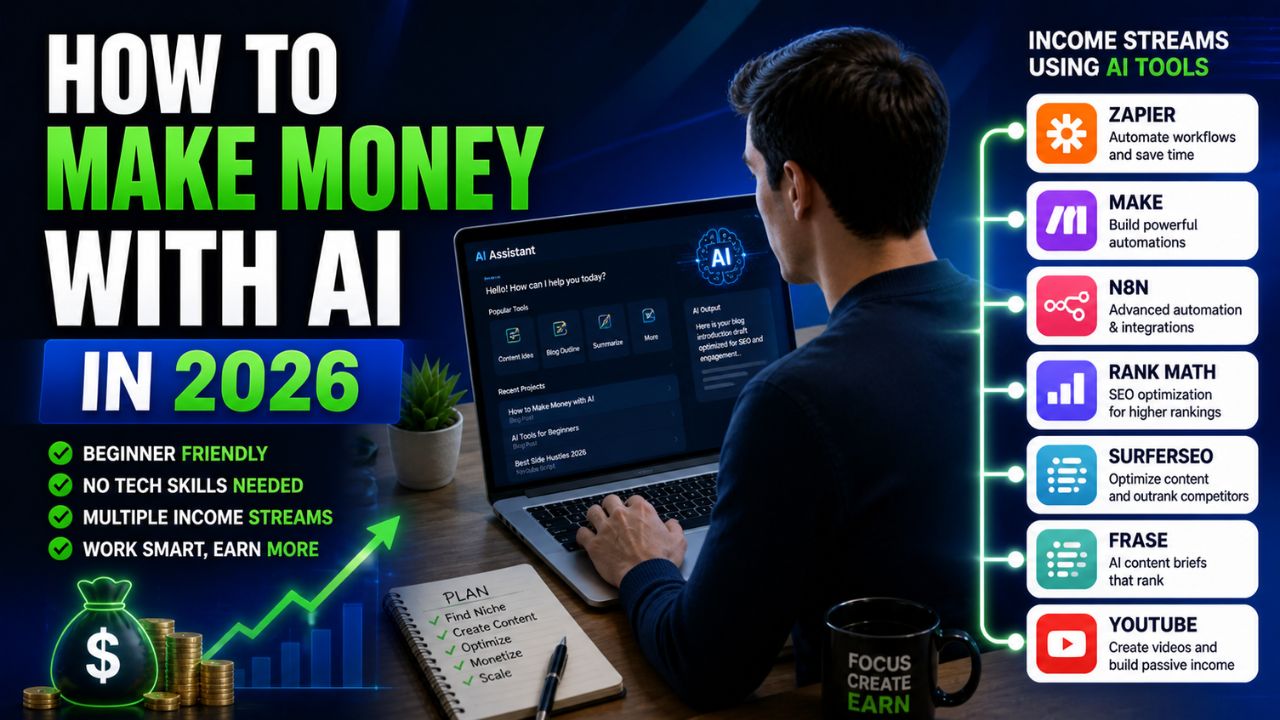
How to Make Money with AI in 2026: 9 Proven Methods to Build Real Online Income

How to Make Money With AI: What Does It Actually Mean? Making money with AI means using artificial intelligence tools to create value and earn income online. In simple words, you use AI to help with work that people or businesses already need.

AI income sounds exciting until you remove the hype.

You have probably seen videos claiming that AI can make you thousands of dollars with one prompt, one tool, or one “secret” workflow. Some people really are making money with AI. But many claims online are exaggerated, incomplete, or designed to sell you another shortcut.

The honest truth is simple: AI can help you make money, but AI is not the business by itself.

AI is a multiplier. It helps you write faster, design faster, research faster, automate repeated work, create more content, and deliver services more efficiently. But the income still comes from a real business model: clients, traffic, products, affiliate offers, ads, services, or consulting.

If you are searching for how to make money with AI in 2026, this guide will give you practical paths instead of push-button fantasy.

 

How to Make Money with AI in 2026


We will cover blogging, freelancing, affiliate marketing, digital products, YouTube automation, AI automation services, social media content, niche websites, and AI agency services. You will also get a simple 30-day beginner action plan so you can start with one path instead of chasing every method at once.

How to Make Money With AI: What Does It Actually Mean?

Making money with AI means using artificial intelligence tools to create value and earn income online.

In simple words, you use AI to help with work that people or businesses already need.

AI can help you create content, design graphics, write emails, edit videos, automate workflows, research topics, summarize information, build websites, plan campaigns, and improve productivity.

Then you monetize that work through a real business model.

For example:

  • Use AI to write blog drafts faster, then earn from ads and affiliate links.
  • Use AI to create social media content for clients, then charge for the service.
  • Use AI to build automation workflows, then sell setup services.
  • Use AI to create digital products, then sell them online.

That is the realistic answer to how to make money with AI. AI supports the business. It does not replace the business.

Why Making Money With AI Matters in 2026

AI matters in 2026 because it lowers the barrier to starting online work.

You do not need a big team to write content, design simple graphics, edit short videos, create outlines, plan campaigns, or automate tasks. AI tools can help one person do more work with less manual effort.

That does not mean everyone will succeed.

The people who win are usually the ones who combine AI with a clear niche, useful skills, human judgment, and consistent execution.

There are five reasons this matters:

AI Is Being Adopted Everywhere

Businesses, creators, marketers, bloggers, students, and freelancers are using AI tools every day. That creates demand for people who know how to apply AI practically.

The Entry Barrier Is Lower

You do not need coding skills to start. Many AI tools are no-code or beginner-friendly.

Businesses Need AI Help

Many small businesses know they should use AI, but they do not know where to begin. That creates opportunities for freelancers, consultants, and service providers.

AI Helps You Scale

AI can help you create more content, test more ideas, repurpose work, and automate repeated tasks.

You Can Build Multiple Income Streams

AI can support blogging, affiliate marketing, freelancing, digital products, YouTube, automation services, and agency models.

If you are still new to tools, start with this beginner guide on how to use AI tools. If your focus is affiliate content, this guide on writing affiliate review posts with AI is a useful next step.

 

how to make money with AI


How Making Money With AI Works

Before jumping into methods, it helps to understand the basic process.

Most AI income paths follow three steps.

Step 1: Choose One Method

Pick one income method first.

Examples include blogging, freelancing, affiliate marketing, digital products, YouTube automation, or AI automation services.

Do not try all of them at once. Beginners usually make better progress by choosing one path and staying focused long enough to build skill.

Step 2: Use AI Tools to Do the Work Faster

AI can help with content creation, research, design, automation, editing, SEO, video scripts, and productivity.

For example, a blogger can use AI to create outlines, draft sections, generate FAQs, make social captions, and plan updates.

Step 3: Monetize the Output

Once you create value, you monetize it.

Common monetization options include ads, affiliate links, freelance services, client retainers, digital products, online courses, paid templates, and consulting.

That is the simple framework for how to make money with AI: choose a method, use AI to work faster, then monetize through a real business model.

9 Proven Methods to Make Money With AI in 2026

Here are the most realistic ways beginners and advanced users can use AI to build online income.

1. AI Blogging

AI blogging is one of the best long-term methods because it can create search traffic, affiliate income, ad revenue, email subscribers, and digital product opportunities.

The model is simple:

  1. Choose a niche.
  2. Research keywords.
  3. Write helpful content.
  4. Rank on search engines.
  5. Monetize with affiliate links, ads, products, or services.

AI can help with topic ideas, outlines, drafts, editing, FAQs, social captions, and content updates.

But AI should not replace your judgment. Google’s guidance on helpful content focuses on people-first, reliable content. Google also says automation or AI should not be used mainly to manipulate rankings.

For AI blogging, the safest approach is:

  • Use AI for speed and structure.
  • Add real examples and human editing.
  • Check facts.
  • Write for a specific reader.
  • Monetize naturally.

If you want long-term online income, blogging is still one of the strongest AI-supported methods.

Start Your AI-Powered Blog

A self-hosted WordPress blog gives you control over SEO, affiliate links, email capture, and long-term content assets.

Start your AI-powered blog with Hostinger

2. Freelancing With AI

Freelancing is one of the fastest ways to start earning with AI because you do not need to wait months for SEO traffic.

You can offer services that businesses already need and use AI to work faster.

Examples include:

  • Blog writing
  • SEO content briefs
  • Social media captions
  • Email sequences
  • Canva designs
  • AI automation setup
  • Video scripts
  • Product descriptions
  • Research summaries

AI helps you produce drafts faster, but clients still pay for your thinking, editing, strategy, communication, and final quality.

Do not sell raw AI output as finished professional work. That damages trust.

Start Freelancing With AI Services

Fiverr can help you study real service categories, see what buyers already need, and position a beginner-friendly AI service.

Explore AI service ideas on Fiverr

3. Affiliate Marketing With AI

Affiliate marketing means promoting products or services and earning a commission when someone buys through your link.

AI can help affiliate marketers create content faster, compare products, build review outlines, write email drafts, create social captions, and organize affiliate links.

Common affiliate content types include:

  • Product reviews
  • Best tools lists
  • Comparison posts
  • Alternatives posts
  • How-to tutorials
  • Buying guides

Affiliate marketing works best when the content is honest and useful. The FTC’s endorsement guidance says affiliate relationships should be disclosed clearly and conspicuously when your recommendation may earn a commission.

For AI Sage Labs-style content, that means every affiliate post should include a clear disclosure and a recommendation that helps the reader make a better decision.

AI can help you create the review structure, but you should provide the final judgment.

4. Selling Digital Products

AI can help you create digital products faster.

Examples include:

  • Ebooks
  • Checklists
  • Prompt packs
  • Canva templates
  • Notion templates
  • Automation templates
  • Mini courses
  • Worksheets

For example, a blogger in the AI niche could create a small guide called “50 AI Prompts for Affiliate Bloggers” or a Canva template pack for blog thumbnails.

AI can help outline the product, draft the content, create examples, write the sales page, and generate promotional emails.

The product still needs to be useful. Do not sell generic AI output. Add structure, examples, design, and a real outcome.

5. AI YouTube Automation

YouTube automation usually means creating videos without personally recording every part yourself.

AI can help with topic research, scripts, voiceover drafts, captions, thumbnails, video summaries, and short-form repurposing.

Common niches include education, software tutorials, finance explainers, history, productivity, AI tools, and product reviews.

However, this method is often overhyped.

Low-effort faceless videos are not a strong long-term strategy. You still need original scripts, good pacing, useful visuals, clear editing, and a niche people care about.

AI can speed up YouTube production, but it does not remove the need for quality.

6. AI Automation Services

AI automation services are one of the most practical income opportunities in 2026.

Many businesses want to automate tasks but do not know how.

You can offer services such as:

  • Zapier workflow setup
  • Make.com automation
  • n8n workflows
  • Email automation
  • Lead capture systems
  • Google Sheets automation
  • Client onboarding workflows
  • AI chatbot setup

This method can be strong because businesses pay to save time.

You do not need to be a programmer to start with basic no-code automation, but you do need to understand workflows, testing, and client requirements.

If you want the tool foundation first, read this guide on AI automation tools for bloggers.

7. Social Media Content Automation

Many businesses and creators need social media content but do not have time to create it consistently.

AI can help you create content calendars, captions, hooks, short scripts, image ideas, carousel outlines, and repurposed posts.

You can use this for your own brand or offer it as a service.

For example, one blog post can become:

  • Five LinkedIn posts
  • Ten short captions
  • Three carousel outlines
  • One newsletter section
  • One short video script

This is a useful service because many clients already have ideas but need help turning them into consistent content.

8. Niche Website Building

Niche websites are focused websites built around one topic.

Examples include:

  • AI tools for bloggers
  • Home office gear
  • Budget travel guides
  • Software comparison sites
  • Online business tools

AI can help you build niche websites faster by supporting keyword research, article outlines, product review drafts, comparison tables, FAQs, and update workflows.

But quality matters more than quantity.

Do not build 20 low-quality sites with generic AI content. Build one useful niche site with strong topical coverage, honest reviews, and helpful recommendations.

This method is slower than freelancing, but it can become more passive over time if the site earns from ads, affiliate links, or digital products.

9. AI Agency Model

The AI agency model means offering AI-powered services to businesses.

Examples include:

  • AI content systems
  • AI automation workflows
  • AI chatbot setup
  • AI social media systems
  • AI video content packages
  • AI lead generation workflows
  • AI SEO content production

This model is more advanced because you need to manage clients, results, delivery, revisions, and expectations.

But it can also be more profitable than simple freelancing because businesses may pay for complete systems.

Beginners should start with one service first. For example, offer AI blog content systems or Zapier automation setup. Then expand after you get results.


How to Make Money With AI


Best AI Tools for Making Money Online

The best tools depend on your method, but these categories are useful for most beginners.

Use Case Tool Type Example Tools
Writing and planning AI assistant ChatGPT, Claude, Writesonic
Design AI design tool Canva AI, Leonardo AI
Video AI video tool Pictory, Synthesia, Runway
Automation Workflow tool Zapier, Make, n8n
SEO SEO tool Rank Math, SurferSEO, Frase


Do not start with too many tools. Choose the tool based on the method you picked.

Best AI Income Method for Beginners

If you are new and want to know how to make money with AI as a beginner, the best method depends on your goal.

Goal Best Method Why
Fastest income Freelancing You can sell a service without waiting for SEO traffic
Long-term income Blogging Content can rank and earn over time
Passive-style income Affiliate niche site Reviews and guides can earn commissions after ranking
Higher-ticket income AI automation services Businesses pay for time-saving systems
Creator income Digital products You can sell templates, guides, or prompt packs


For most beginners, freelancing is the fastest path and blogging is the best long-term path.

If you want to build long-term AI income, start a blog and use freelancing to earn while your content grows.

Common Mistakes Beginners Make

Believing Push-Button Income Claims

AI can help you work faster, but it does not create money out of nothing. Be careful with anyone promising effortless income.

Trying Too Many Methods at Once

Blogging, YouTube, freelancing, digital products, and agency services are all different businesses. Start with one.

Publishing Raw AI Content

Raw AI content often feels generic. Edit, fact-check, add examples and make it useful.

Ignoring Disclosure Rules

If you use affiliate links, disclose them clearly. Readers should understand when you may earn a commission.

Not Building a Real Skill

AI is a tool. You still need skills such as writing, SEO, editing, automation, design, client communication or marketing.

Recommended Resource Before the Ending

Want a Simple AI Income Roadmap?

If you are starting from zero, do not chase 20 methods. A simple roadmap should help you choose one path, pick one skill, build one sample, and create one offer or content asset in the next 30 days.

Access the AI Income Starter Roadmap

Recommended Book for Making Money With AI

If you want a broader understanding of how AI fits into work and productivity, a useful book to explore is Co-Intelligence: Living and Working with AI by Ethan Mollick.

It can help you think about AI as a serious work partner rather than a shortcut. That mindset is important because real AI income comes from useful systems, not random tool experiments.

Recommended Reading

If you are serious about using AI for work and online income, this book can help you think more clearly about AI-assisted productivity.

Check Co-Intelligence on Amazon

How to Make Money With AI Verdict: What Should You Start With?

After breaking down how to make money with AI, the best beginner recommendation is simple.

Choose one method.

If you want faster income, start with freelancing. Offer a service such as AI writing support, Canva design, automation setup, or content repurposing.

If you want long-term income, start a blog. Use AI to create better workflows, publish consistently, and monetize with affiliate links, ads, and digital products.

If you want higher-ticket opportunities, learn AI automation services and help businesses save time.

The biggest mistake is waiting for the perfect method.

Pick one. Build skill. Create value. Improve over time.

30-Day Beginner Action Plan

If you are starting from zero, do not spend the next month only watching AI income videos. Use the month to build one small asset or offer.

Week 1: Choose One Method

Pick freelancing, blogging, affiliate marketing, digital products, or automation services. Do not choose all five.

Week 2: Learn the Basic Tools

Choose one writing tool, one design tool, and one platform for your method. Create one sample project.

Week 3: Publish or Offer Something

Publish your first blog post, create your first Fiverr gig, build your first automation demo, or create your first small digital product draft.

Week 4: Improve and Repeat

Improve the offer, share it, track results, and create the next piece of content or service sample.

This action plan keeps things realistic. You are not trying to build a full business in 30 days. You are building the first proof that your chosen method can work.

Start With One Practical Path

If you want faster income, explore AI service ideas on Fiverr. If you want long-term income, build your AI blog and publish consistently.

Start offering AI services on Fiverr

Build your AI income blog with Hostinger

Frequently Asked Questions

Can beginners make money with AI?

Yes, beginners can make money with AI, but they need a real method. Freelancing, blogging, affiliate marketing, digital products, and automation services are realistic options.

How fast can I make money with AI?

Freelancing can be faster because you can sell a service directly. Blogging and niche websites are slower because they depend on content, SEO, traffic, and trust.

Do I need coding skills to make money with AI?

No. Many AI income methods do not require coding. Blogging, writing, design, freelancing, affiliate marketing, and no-code automation can be started without coding.

What is the easiest way to make money with AI?

For many beginners, freelancing is the easiest starting point because you can offer a specific service. Affiliate blogging is easier to scale long term, but it takes more time.

Can I make passive income with AI?

You can build passive-style income streams with AI-supported blogging, affiliate sites, digital products, or YouTube content. But they still require upfront work, updates, and strategy.

How much can I earn with AI?

Earnings depend on your method, skill, niche, offer, traffic, clients, and consistency. Avoid anyone promising guaranteed income from AI.

Is AI income sustainable?

AI income can be sustainable if it is built around real value, useful content, strong services, or genuine products. Low-quality AI spam is not a reliable long-term strategy.

What AI tool should I start with?

Start with one flexible AI assistant for writing and planning, one design tool like Canva, and one automation tool if your method needs workflows. Do not collect tools before choosing a business model.

Conclusion

This guide showed how to make money with AI in 2026 without falling for hype.

The honest truth is that AI is not a shortcut. It is a multiplier.

It helps you create faster, plan better, automate repeated tasks, and scale your effort. But the income comes from the business model behind the tool.

If you want faster income, start with freelancing. If you want long-term income, build a blog or niche site. If you want higher-value services, learn automation. If you want scalable products, create templates, guides, or courses.

Start small. Pick one method. Use AI to work faster. Keep improving.

That is the cleanest way to understand how to make money with AI: real skill, real value, and AI-assisted execution.

That is how beginners turn AI from a trend into real online income.

How We Checked This Guide

Before updating this guide, we checked Google’s guidance on helpful, reliable, people-first content and the FTC’s endorsement guidance for affiliate disclosures. This helps keep the article realistic, trust-focused, and safer for readers building online income with AI.

Affiliate Disclosure

As an Amazon Associate, I earn from qualifying purchases. Some links in this article are affiliate links, which means I may earn a commission at no extra cost to you if you buy through them. I only recommend tools, books, and services that may help beginners, creators, and online business owners create better content or grow their work more effectively.


7 Trending AI Tools in 2026 That Are Actually Making Bloggers Money

7 Trending AI Tools in 2026 That Are Actually Making Bloggers Money

Every week, another AI tool claims it can help bloggers make money faster.

Some of those tools are useful. Some are overhyped. Some look exciting for two weeks and then disappear from everyone’s workflow.

The hard part is not finding AI tools. The hard part is knowing which tools actually support income-producing work.

For bloggers, the answer is usually not one magic app. Real income comes from a system: useful content, search traffic, affiliate links, email subscribers, videos, digital products, and services. AI tools help by making that system faster and easier to repeat.

That is the angle of this guide.

Instead of listing random shiny tools, we will look at 7 trending AI tools in 2026 that can help bloggers create, promote, polish, automate, and monetize content more effectively.

This is not a promise that any tool will make money for you automatically. It is a practical breakdown of how each tool can support a real blogging income workflow.


7 Trending AI Tools in 2026


7 Trending AI Tools in 2026: What Makes a Tool Worth Using?

A trending AI tool is only worth your time if it solves a repeated problem in your workflow.

For bloggers, that usually means one of these problems:

  • Writing takes too long.
  • Design work slows down publishing.
  • Video content feels too hard to create.
  • SEO optimization is confusing.
  • Editing takes too much time.
  • Promotion tasks are repetitive.
  • Email and social content are inconsistent.

The best AI tools reduce friction around these tasks. They do not replace your strategy, niche knowledge, or reader trust.

That is why this list focuses on tools that support real blogger workflows, not tools that only look impressive in demos.

If your main goal is income, also read this companion guide on how to make money with AI tools. This article focuses on the specific tools behind those workflows.

Why Most Trending AI Tools Do Not Deliver

Many AI tools disappoint bloggers because they automate output without improving the underlying strategy.

For example, an AI tool that creates 50 article titles in 10 seconds is useful only if you already understand your niche, search intent, reader problems, and monetization plan.

Otherwise, it just helps you create more noise.

The second problem is generic content. AI can create drafts quickly, but generic drafts do not build trust. Readers can tell when an article has no real judgment, no examples, no pros and cons, and no useful recommendation.

Google’s guidance around AI-assisted content focuses on whether content is helpful and reliable for people. That means the safest blogger workflow is to use AI for support, then add human editing, fact-checking, examples, and honest opinions.

The 7 trending AI tools in 2026 below are useful because they help with real work: writing, automation, design, video, editing, SEO, and strategy.

The 7 Trending AI Tools in 2026 for Bloggers

Here are the seven tools that make the most sense for bloggers who want to build traffic, trust, and income in 2026.

Think of these 7 trending AI tools in 2026 as workflow helpers, not shortcuts that replace the work of building a real blog.

1. Writesonic: AI Writing and SEO Content Workflow

Writesonic is an AI writing and SEO platform that helps bloggers create outlines, drafts, marketing copy, FAQs, and content ideas faster.

It is useful because blogging income often depends on publishing helpful content consistently. If every article takes a full day to outline and draft, your publishing system can slow down fast.

Writesonic can help with:

  • Blog post outlines
  • SEO article drafts
  • FAQ ideas
  • Product review structure
  • Social captions
  • Meta descriptions
  • Content updates

The income connection is simple: better content workflows can help you publish more useful review posts, tutorials, comparisons, and buying guides. Those posts can then earn through affiliate links, display ads, email signups, or product sales.

But Writesonic should not be used as a copy-paste publishing machine.

AI drafts still need editing. You should check facts, update pricing, add screenshots when possible, include honest pros and cons, and explain who should actually use the tool.

Best for: bloggers who need faster long-form content workflows.

Main limitation: output can still sound generic if your instructions are weak or if you skip editing.

Income use case: use Writesonic to draft the structure for affiliate reviews, then add your research, examples, internal links, CTAs, and final verdict.

For a deeper breakdown, read this Writesonic review.

2. Make: AI Automation and Workflow Builder

Make is a visual automation platform that helps apps work together through automated workflows.

It does not make money directly. It helps bloggers save time on repeated tasks that support traffic and income.

For example, when you publish a new blog post, Make can help automate parts of the follow-up workflow:

  • Save the post title and URL to a Google Sheet.
  • Create a task to design Pinterest pins.
  • Send a notification to yourself or your team.
  • Prepare a social media draft.
  • Add the post to a content tracker.
  • Connect lead forms with email tools.

Make’s official pricing page currently lists a Free plan with monthly credits and paid plans that scale by credit usage. It also highlights AI-related workflow features, including AI apps and agents.

For bloggers, the biggest benefit is consistency. If every post automatically enters your tracking and promotion system, fewer things fall through the cracks.

Best for: bloggers who publish regularly and want a more organized content system.

Main limitation: Make has a learning curve. You need to understand triggers, actions, filters, routers, and credits.

Income use case: automate content promotion and affiliate tracking so your published articles get more consistent exposure.

If automation is new to you, start with this beginner guide on what AI automation tools are.

3. Canva AI: Visual Content for Blogs, Pinterest, and YouTube

Canva AI is one of the most practical AI tools for bloggers because every blog needs visuals.

You need featured images, Pinterest pins, YouTube thumbnails, social graphics, lead magnet covers, comparison graphics, and simple brand assets.

Canva helps with:

  • Blog featured images
  • Pinterest pins
  • YouTube thumbnails
  • Social media graphics
  • Lead magnet PDFs
  • Templates
  • Brand Kits
  • Magic Resize
  • Background removal

The income connection comes from trust and distribution.

A clean blog graphic can make an article look more professional. A strong YouTube thumbnail can improve clicks. Pinterest pins can bring traffic for months. Lead magnet covers can help email opt-ins feel more valuable.

Canva Free is enough to start. Canva Pro becomes more useful when you create visuals every week and need Brand Kit, background remover, Magic Resize, premium templates, and faster design workflows.

Best for: bloggers who need clean visuals without learning advanced design software.

Main limitation: templates can look generic if you do not customize them.

Income use case: create a repeatable design system for blog graphics, Pinterest pins, and affiliate review visuals.

For more detail, read this Canva AI review.

4. InVideo AI: Blog-to-Video Repurposing

InVideo AI helps creators turn prompts, scripts, and written ideas into videos.

For bloggers, this matters because a blog post can become a video asset.

For example, a review article can become:

  • A YouTube video summary
  • A short social clip
  • A product explainer
  • A tutorial video
  • A video embed inside the blog post

Video can support income through YouTube ads, affiliate links in descriptions, product promotion, sponsorships, and better trust on the blog itself.

InVideo’s help center says its plans use credits for creating content and accessing AI features, while plan details can change over time. That means bloggers should check the current pricing page before upgrading and avoid wasting credits on random experiments.

Best for: bloggers who have written content and want to repurpose it into video.

Main limitation: AI-generated videos still need review. Stock footage, pacing, voiceover, and captions may need manual edits.

Income use case: turn your highest-value affiliate articles into YouTube videos and add the video back into the blog post for more engagement.

For a dedicated breakdown, read this InVideo AI review.

5. Grammarly Pro: Editing, Clarity, and Trust

Grammarly is not the flashiest AI tool, but it is one of the most useful for bloggers.

Reader trust matters. If your review is full of awkward phrasing, unclear sentences, grammar mistakes, or inconsistent tone, readers may not trust your recommendation.

Grammarly helps polish content before publishing.

According to Grammarly’s official Pro page and help center, Grammarly Pro includes advanced writing support such as full-sentence rewrites, tone adjustments, and AI writing prompts, with pricing listed around $12/month per member when billed annually and $30 monthly.

For bloggers, Grammarly can help with:

  • Grammar checks
  • Clarity improvements
  • Sentence rewrites
  • Tone suggestions
  • Polishing AI drafts
  • Improving emails and social copy

The income connection is indirect but real. Better writing improves trust, and trust affects affiliate clicks, email signups, and repeat visitors.

Best for: almost every blogger, especially non-native English writers and fast publishers.

Main limitation: Grammarly improves writing, but it does not replace strategy, research, or original insight.

Income use case: use Grammarly as the final polish layer before publishing affiliate reviews, newsletters, and service pages.

6. Surfer: SEO Optimization and Content Planning

Surfer is an SEO content optimization platform.

It helps bloggers understand what top-ranking pages cover, which related terms may matter, how to structure content, and how to improve on-page SEO.

For bloggers targeting affiliate keywords, SEO matters because search traffic is often the main income engine.

A review article on page one of Google can bring clicks and commissions for months. The same article buried on page five may earn nothing.

Surfer’s pricing page currently positions the platform around visibility in search and AI search, with paid plans for teams and SEO content workflows. Because pricing can change, always check the official page before buying.

Surfer can help with:

  • Content optimization
  • Keyword usage guidance
  • Content structure ideas
  • Topical coverage
  • Existing post improvements
  • SEO briefs

The income connection is search visibility. Better optimized posts have a better chance of attracting the right readers.

Best for: bloggers actively targeting SEO traffic and affiliate keywords.

Main limitation: Surfer is more expensive than beginner tools, so it makes more sense once you publish consistently or already have traffic.

Income use case: optimize your highest-value affiliate posts and update old content that is close to ranking better.

7. ChatGPT: Strategy, Research, Drafting, and Repurposing

ChatGPT is one of the most flexible AI tools for bloggers.

It can help with topic ideas, outlines, content structure, research planning, email drafts, social captions, product comparison frameworks, FAQs, and repurposing.

OpenAI’s official ChatGPT pricing page lists a Free plan and a Plus plan at $20/month, with expanded limits and additional features on paid tiers. Availability and model access can change, so check the current pricing page before upgrading.

For bloggers, ChatGPT is useful because it can support many parts of the workflow:

  • Brainstorming blog topics
  • Creating article outlines
  • Drafting intro variations
  • Summarizing research notes
  • Rewriting sections for clarity
  • Planning email sequences
  • Turning posts into social captions
  • Creating checklists and templates

The income connection is versatility. ChatGPT can support affiliate marketing, digital products, newsletters, freelancing, YouTube scripts, and service delivery.

Best for: bloggers who want one flexible AI assistant for many tasks.

Main limitation: ChatGPT is not a dedicated SEO tool, design tool, or video editor. You still need the right specialized tools for those workflows.

Income use case: use ChatGPT as your strategy and repurposing assistant across every income method.

Trending AI Tools Compared

Here is a simple comparison of the 7 trending AI tools in 2026 and where each one fits.

Tool Main Use Best Income Support Best Stage
Writesonic AI writing and SEO content Affiliate reviews, tutorials, comparison posts Beginner to growing blog
Make Automation workflows Content tracking, promotion, lead workflows Any stage after basic publishing
Canva AI Visual design Thumbnails, pins, graphics, lead magnets Any stage
InVideo AI Text-to-video creation YouTube, social video, affiliate video descriptions After you have written content
Grammarly Pro Editing and clarity Trust, conversions, professional publishing Any stage
Surfer SEO optimization Search rankings and affiliate traffic Active SEO bloggers
ChatGPT General AI assistant Strategy, drafts, repurposing, product ideas Any stage

The Best AI Tool Stack for Beginner Bloggers

You do not need all seven tools on day one.

If you are starting from zero, use this simpler path:

  1. Start with ChatGPT Free for brainstorming and outlines.
  2. Use Canva Free for blog graphics and social visuals.
  3. Use Grammarly Free for basic cleanup.
  4. Add a WordPress blog and basic SEO plugin.
  5. Upgrade to paid tools only when your workflow needs them.

Once your blog has a clear niche and publishing schedule, you can add a dedicated writing tool, automation tool, video tool, or SEO tool based on the bottleneck you actually feel.

Do not buy tools because they are trending. Buy tools because they remove a real problem from your workflow.

Build the Blog Before Buying Every Tool

AI tools work best when they support a real website, useful content, and a clear monetization path.

Start your AI tools blog with Hostinger

How These AI Tools Help Bloggers Make Money

These tools support income in different ways.

Writesonic and ChatGPT help with content creation. Canva helps with visuals. Grammarly improves trust. Make saves time and keeps workflows consistent. InVideo AI adds video repurposing. Surfer helps with SEO optimization.

Together, they support common blogger income streams:

  • Affiliate marketing
  • Display ads
  • YouTube traffic
  • Email list growth
  • Digital products
  • Freelance services
  • Sponsored content

But the tool stack only matters if the content is useful.

A poor review with better grammar is still a poor review. A generic AI video with a nice thumbnail is still generic. An automated workflow will not fix a weak niche or unclear offer.

The best bloggers use AI tools to improve a real strategy, not replace one.

If you want more detail on income methods, read this guide on how to make money with AI.

Common Mistakes Bloggers Make With Trending AI Tools

Buying Too Many Subscriptions Too Early

A beginner blogger does not need seven paid AI tools. Start free, publish consistently, then upgrade when a tool solves a proven problem.

Publishing Raw AI Drafts

Raw AI content can sound generic and may contain mistakes. Always edit, fact-check, and add your own judgment.

Ignoring Search Intent

AI can write words, but it does not automatically understand what your reader needs. Match the article to the search intent before publishing.

Creating Videos Without a Viewer Reason

Turning every blog post into a video is not always useful. Start with posts that have strong tutorial, review, or comparison potential.

Automating Messy Workflows

Automation makes a process faster. If the process is unclear, automation can make the mess bigger. Clean the workflow first, then automate it.

Recommended Resource Before the Verdict

Want an AI Blogger Tool Stack Checklist?

A simple checklist can help you choose which tools to start with, which tools to skip, and when to upgrade as your blog grows.

CTA idea: Access the AI Sage Labs AI blogger tool stack checklist.

Note: When you create your own Google Doc, PDF, Gumroad product, Digistore24 offer, or JVZoo resource for AI tool stacks, turn the CTA text above into a real sponsored affiliate or product link.

Recommended Book for AI Tool Users

If you want to understand how to use AI tools with better judgment, a useful book to explore is Co-Intelligence: Living and Working with AI by Ethan Mollick.

It is not a blogging tutorial, but it helps creators think about AI as a partner in real work. That mindset is useful because the goal is not to collect tools. The goal is to build better systems.

Check Co-Intelligence on Amazon

7 Trending AI Tools in 2026 Verdict

The best 7 trending AI tools in 2026 for bloggers are not the loudest tools. They are the tools that support real publishing and monetization workflows.

Writesonic helps with content creation. Make helps with automation. Canva AI helps with visuals. InVideo AI helps with video repurposing. Grammarly helps with trust and clarity. Surfer helps with SEO. ChatGPT helps with strategy, drafting, and repurposing.

None of them will build income alone.

But together, they can make blogging more efficient, more consistent, and easier to scale.

The smartest approach is simple: start with free tools, publish useful content, identify your bottleneck, then upgrade the tool that removes that bottleneck.

That is how AI tools become part of a real blogging business instead of another expensive distraction.

Launch your AI tools blog with Hostinger

FAQs About Trending AI Tools in 2026

What are the best trending AI tools for bloggers in 2026?

Useful options include Writesonic, Make, Canva AI, InVideo AI, Grammarly Pro, Surfer, and ChatGPT. The best choice depends on whether your main problem is writing, design, video, SEO, automation, or editing.

Can AI tools really help bloggers make money?

Yes, AI tools can help bloggers make money by speeding up content creation, improving visuals, supporting SEO, creating videos, automating workflows, and polishing content. But income still comes from real business models such as affiliate marketing, ads, products, and services.

Which AI tool should beginner bloggers start with?

Beginner bloggers can start with ChatGPT Free, Canva Free, and Grammarly Free. This gives you writing support, design support, and editing support without adding paid subscriptions immediately.

Do I need paid AI tools to start blogging?

No. Paid tools can save time, but they are not required at the beginning. Start with free tools and upgrade only when a paid tool solves a clear workflow problem.

Is Surfer worth it for beginner bloggers?

Surfer can be useful for SEO-focused bloggers, but it may be too expensive for complete beginners. It makes more sense once you publish consistently, target competitive keywords, or have posts that are close to ranking better.

Is Canva AI good for affiliate bloggers?

Yes. Canva AI is useful for affiliate bloggers because it helps create featured images, comparison graphics, Pinterest pins, YouTube thumbnails, lead magnets, and social visuals.

Can I use AI tools for YouTube income?

Yes. Tools like InVideo AI, Canva, ChatGPT, and Descript can help create scripts, videos, thumbnails, captions, and repurposed clips. YouTube income still depends on content quality, audience, watch time, and monetization eligibility.

What is the biggest mistake bloggers make with AI tools?

The biggest mistake is buying too many tools before building a real workflow. Start with one income method, one content system, and a small tool stack. Add tools only when they solve a real bottleneck.

Conclusion

This guide covered 7 trending AI tools in 2026 that can genuinely support blogger income workflows.

The important word is support.

AI tools help you write faster, design faster, edit faster, automate faster, optimize faster, and repurpose faster. But the income still comes from useful content, reader trust, search traffic, affiliate offers, email subscribers, services, and products.

If you are a beginner, do not overcomplicate this.

Start with ChatGPT, Canva, and Grammarly. Build your blog. Publish helpful content. Learn what slows you down. Then add tools like Writesonic, Make, InVideo AI, or Surfer when the need becomes obvious.

That is the practical way to use trending AI tools without wasting money.

Hire AI workflow help on Fiverr

Start your AI blog with Hostinger

Explore Co-Intelligence on Amazon

How We Checked This Guide

Before writing this guide, we checked official pricing, help, and product pages for the tools mentioned, along with Google’s guidance around AI-assisted content. Pricing and plan details can change, so always confirm current plans before buying.

Affiliate Disclosure

As an Amazon Associate, I earn from qualifying purchases. Some links in this article are affiliate links, which means I may earn a commission at no extra cost to you if you buy through them. I only recommend tools, books, and services that may help beginners, creators, and online business owners create better content or grow their work more effectively.