
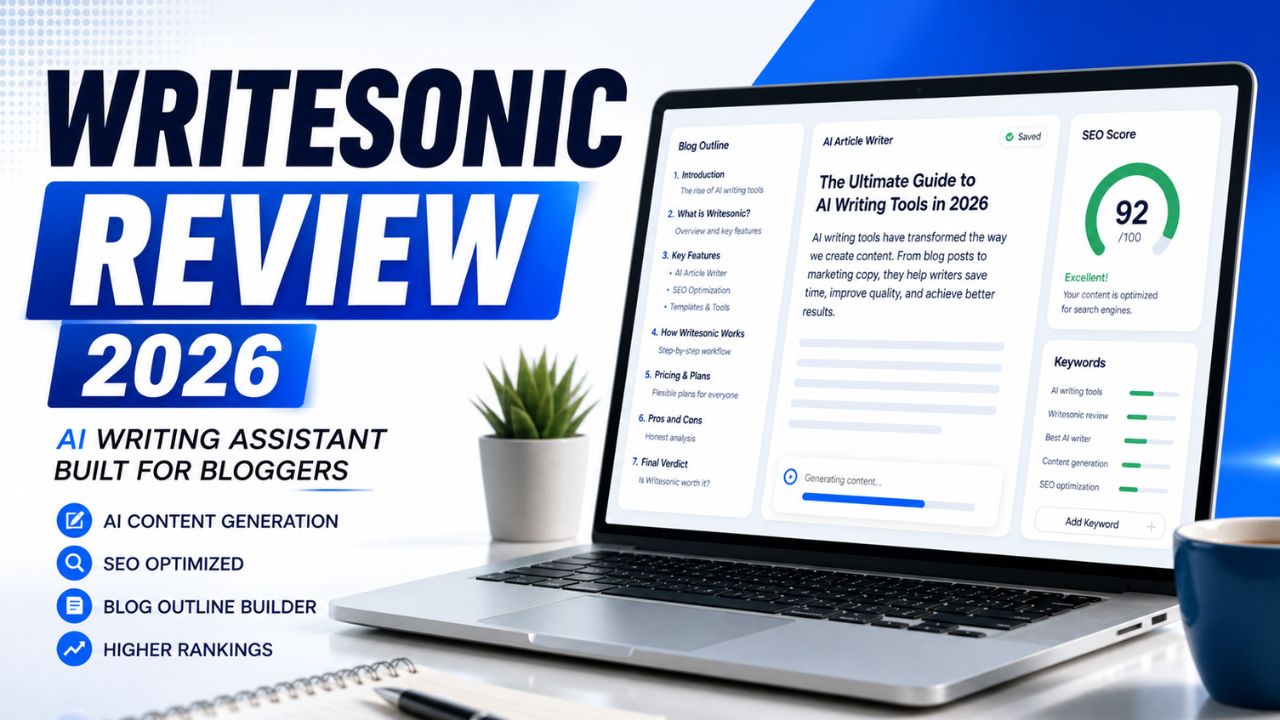
AI writing tools are easy to find now. Useful AI writing tools are harder to choose.
That is the real problem for bloggers in 2026. Almost every tool promises faster drafts, better SEO, higher rankings, and more content. But when you actually use them, many drafts still sound generic, repetitive, or too polished in the wrong way.
Blogging is not only about writing more words.
You still need search intent, topic research, useful structure, fact-checking, internal links, examples, CTAs, affiliate disclosures, and a human final verdict. An AI writing tool can help with speed, but it cannot replace judgment.
That is why Writesonic is worth reviewing carefully.
Writesonic is no longer just a basic AI writing tool. Its current platform focuses heavily on AI search visibility, SEO workflows, AI Article Writer, Chatsonic, content optimization, site audits, and agent-style marketing tasks.
But is it actually useful for bloggers, affiliate marketers, and content creators?
In this Writesonic review 2026, we will look at what Writesonic does, how it works, its best features, pricing considerations, pros and cons, alternatives, blogger workflows, money-making use cases, and whether it is worth using this year.
Writesonic Review 2026: What Is Writesonic?
Writesonic is an AI-powered content, SEO, and AI search visibility platform designed to help users create, optimize, and improve content workflows.
In simple beginner language, Writesonic helps you plan, write, improve, and optimize content faster.
It started as a more traditional AI writing tool, but its current positioning has moved further into SEO, GEO, AI visibility, and content execution. Writesonic’s official website now focuses on helping brands track visibility across AI answers, identify content gaps, and act on those opportunities with AI agents and content tools.
For bloggers, that means Writesonic is not only about writing a quick draft. It can also support article creation, keyword research, content optimization, audits, and AI-assisted marketing workflows.
This makes Writesonic more interesting for serious bloggers than a simple one-click paragraph generator.
It also means beginners should be clear about what they need. If you only need occasional short writing help, a general AI assistant may be enough. If you want a more structured SEO content workflow, Writesonic becomes more relevant.
Why Writesonic Matters for Bloggers in 2026
Writesonic matters because blogging has become more competitive.
Bloggers are not only competing with other blogs anymore. They are competing with YouTube videos, Reddit threads, AI Overviews, social posts, product pages, forums, and AI-generated content at scale.
Publishing random articles is not enough.
A useful blog post needs to match search intent, answer real questions, include helpful structure, cite important sources, include related internal links, and help the reader make a decision.
Writesonic can help with parts of this workflow.
A blogger can use it to create article outlines, draft sections, generate FAQs, rewrite weak content, plan SEO content, create supporting marketing copy, and improve older posts.
The real value is not replacing the blogger. The value is reducing blank-page time and making the content process more structured.
That is the key point of this Writesonic review 2026: Writesonic is most useful when you use it as an assistant, not as a copy-paste publishing machine.
If you are comparing AI writing tools more broadly, read this guide on AI writing tools tested in 2026. If your goal is affiliate content, this guide on writing affiliate review posts with AI will help you use tools more responsibly.
How Writesonic Works
Writesonic works by giving users different tools for writing, SEO, AI chat, optimization, audits, and marketing tasks.
A basic blogger workflow usually looks like this:
- Choose a content type, such as blog article, landing page, ad, or social post.
- Add your topic, keyword, audience, and instructions.
- Use Writesonic to generate an outline or draft.
- Edit the content manually.
- Use SEO or optimization features to improve the post.
- Add examples, sources, internal links, CTAs, and human judgment.
- Publish only after review.
For long-form blog posts, Writesonic’s AI Article Writer is the main feature to understand.
Writesonic’s documentation says AI Article Writer includes multiple versions, including AI Article Writer 4, 5, and 6. Article Writer 6 is described as a more advanced option with tone customization, internal linking, source citation, AI-generated cover image creation, FAQ integration, and call-to-action support.
That makes it more structured than simply asking a chatbot for a full article.
Still, the final quality depends on your input, niche knowledge, editing, and fact-checking.
7 Powerful Writesonic Features for Bloggers
The most important part of this Writesonic review 2026 is understanding which features actually matter for bloggers.
1. AI Article Writer
Writesonic’s AI Article Writer is its main long-form content tool.
According to Writesonic’s documentation, AI Article Writer is a suite of tools designed to streamline long-form article creation. Article Writer 6 is positioned for more advanced content creation and SEO-focused workflows.
For bloggers, this can help create structured drafts faster.
You can use it for:
- Blog post drafts
- SEO article outlines
- FAQ sections
- Intro and conclusion drafts
- Article rewrites
- Call-to-action sections
The limitation is important: do not publish raw AI drafts. Even when the structure looks strong, you still need to edit for accuracy, examples, reader fit, brand voice, and trust.
2. Article Writer 6 Workflow
Article Writer 6 gives users more control than a basic instant draft workflow.
Writesonic’s documentation describes three writing modes: a 10-step article workflow, a 4-step article workflow, and an instant article workflow. The 10-step mode gives the most control and can include article type, competitor or reference selection, keywords, word length, outline, brand voice, CTA, image settings, FAQs, and other advanced settings.
For serious bloggers, this matters because better inputs usually create better drafts.
If you want trust-friendly content, use the slower, more controlled workflow instead of relying only on instant generation.
3. SEO AI Agent
Writesonic’s SEO AI Agent is designed to support SEO and content marketing workflows.
Writesonic’s documentation describes the SEO AI Agent as combining AI capabilities with SEO strategies. It includes workflow areas such as market analysis, keyword research, audience segmentation, content strategy, blog creation, and optimization.
For bloggers, this is useful because SEO content is not only writing. You need research, keyword intent, content planning, optimization, and updates.
The SEO AI Agent may be helpful if you want a more guided workflow instead of starting from a blank prompt.
4. Chatsonic
Chatsonic is Writesonic’s AI chat tool.
For bloggers, Chatsonic can help with brainstorming, outlines, content ideas, summaries, marketing copy, research support, and repurposing.
It can be useful if you want an AI assistant inside the same platform where you manage writing and SEO workflows.
As with any AI chat tool, you should verify important facts, pricing, product claims, and recommendations before publishing.
5. SEO and Content Optimization
Writesonic includes SEO and content tools that help users research, plan, and improve content.
For bloggers, this matters because writing fast is not enough. Your article still needs to match search intent, answer reader questions, include useful headings, and compete with existing pages.
SEO recommendations can support your process, but you should not follow every suggestion blindly.
Use SEO tools as guidance. The final article still needs original value and human judgment.
6. AI Search Visibility and GEO Workflows
Writesonic’s current homepage focuses heavily on AI search visibility and GEO-style workflows.
It describes tracking brand visibility across AI answer engines, identifying citation gaps, prioritizing issues, and using AI agents to create or refresh content.
This may be more advanced than what a beginner blogger needs on day one. But for growing sites, it reflects where content marketing is moving.
Search is no longer only about traditional Google rankings. Bloggers also need to think about whether their brand, tools, and content are visible in AI-generated answers.
Writesonic’s AI visibility features may be useful for teams and serious marketers, but casual bloggers should evaluate whether they really need those advanced features before paying.
7. Rewriting and Content Improvement
Writesonic can also help rewrite, improve, and repurpose existing content.
This is one of the safer ways to use AI writing tools because you already have a human-reviewed base.
For example, you can use Writesonic to rewrite a weak intro, create a cleaner CTA, turn a blog section into a LinkedIn post, or make an old article section easier to read.
Bloggers should not only create new content. Updating old posts is often just as important.
Writesonic Pros and Cons
No Writesonic review 2026 should ignore the tradeoffs. Writesonic can be useful, but it is not perfect.
| Pros | Cons |
|---|---|
| Strong long-form article workflow | Still requires human editing and fact-checking |
| Article Writer 6 offers more control than simple AI drafts | Advanced features may be more than casual bloggers need |
| SEO AI Agent can support keyword and content planning | Content can still sound generic without clear instructions |
| Useful for SEO, GEO, and AI search visibility workflows | Pricing and usage limits can change by plan |
| Helpful for scaling content systems | Not a replacement for real experience or product research |
The biggest benefit is speed and workflow structure. The biggest limitation is that Writesonic output still needs a real editor.
Writesonic Pricing in 2026
Writesonic pricing can change, and plan details depend on usage, content volume, SEO features, AI search visibility needs, and team requirements.
At the time of writing, Writesonic’s official website and pricing flow focus heavily on AI visibility, SEO, content execution, and agent-style workflows. Its official pages also promote a free trial.
Because Writesonic has shifted beyond basic AI writing, compare the plan against your actual workflow, not only the monthly price.
Before upgrading, ask:
- How many long-form articles do I publish each month?
- Do I need SEO AI Agent workflows?
- Do I need AI search visibility tracking?
- Do I need content optimization and site audits?
- Will Writesonic save enough time to justify the cost?
For beginners, the safest pricing advice is simple: test the free trial or lowest suitable option first, create one real blog post workflow, and upgrade only if the tool genuinely saves time and improves your process.
For this Writesonic review 2026, Writesonic is easiest to justify when content production and SEO are serious parts of your business.
Try Writesonic for AI Blog Writing
If you want structured AI article writing plus SEO workflow support, test Writesonic with one real blog post before upgrading.
Is Writesonic Beginner-Friendly?
Yes, Writesonic can be beginner-friendly, but it depends on which features you use.
If you only use basic templates or article generation, the workflow is fairly easy. You choose a tool, enter your topic or keyword, and generate content.
The SEO-focused features may take more time to understand.
Beginners should not start by trying to use every feature. Start with one workflow:
- Create an outline.
- Generate a draft.
- Edit manually.
- Fact-check important claims.
- Add examples and internal links.
- Optimize the final article.
This keeps Writesonic useful without making the process overwhelming.
Writesonic vs Other AI Writing Tools
A practical Writesonic review 2026 should compare Writesonic with the types of tools bloggers are already considering.
Writesonic vs ChatGPT
ChatGPT is more flexible for brainstorming, outlining, editing, research support, and custom workflows.
Writesonic is more structured for article writing, SEO workflows, AI visibility, and content execution.
If you like building your own prompts, ChatGPT may be enough. If you want dedicated article and SEO workflows, Writesonic may feel more organized.
Writesonic vs Rytr
Rytr is usually a simpler budget AI writing tool.
Writesonic is more feature-rich, especially for long-form content, SEO, and marketing workflows.
Budget users may prefer a simpler tool. Bloggers who want more content workflow support may prefer Writesonic.
Writesonic vs Surfer AI
Surfer AI is strongly tied to SEO content optimization workflows.
Writesonic includes writing, SEO, AI search visibility, and content execution features. The best choice depends on your budget, workflow, and how much SEO guidance you need.
Writesonic vs Writer-GPT
Writer-GPT may be a better fit for users who want a simpler AI SEO content tool.
Writesonic is broader and more advanced, especially if you care about SEO AI Agent workflows and AI visibility. For a lighter SEO writing tool comparison, read this Writer-GPT review.
How Bloggers Can Use Writesonic
Writesonic can fit into a blogging workflow if you use it carefully.
A simple workflow looks like this:
- Choose a focus keyword.
- Use Writesonic to create an outline.
- Generate the first draft section by section.
- Edit for human tone and accuracy.
- Add personal examples or testing notes.
- Check SEO structure.
- Add affiliate disclosure and CTAs.
- Publish in WordPress.
- Update the article after it gets data.
This workflow keeps Writesonic in the right role.
It helps with speed and structure, but you still control the final quality.
If you are building a blog around AI tools, affiliate reviews, or online business, you need a reliable website where your content can rank and convert.
Build Your AI Writing Blog
If you want to publish AI writing tool reviews and SEO content, start with a WordPress site that gives you control over traffic, links, and monetization.
How to Make Money With Writesonic
Writesonic does not automatically make money for you, but it can support several online business models.
Blogging
Writesonic can help bloggers create outlines, drafts, FAQs, social captions, and content updates faster.
If this helps you publish more useful content consistently, it can support traffic growth over time.
Affiliate Marketing
Affiliate marketers can use Writesonic to draft product reviews, comparison posts, buying guides, email sequences, and social content.
The key is to add real research, honest pros and cons, current pricing checks, alternatives, and a human verdict.
Freelance Writing
Freelancers can use AI tools to speed up outlines, first drafts, rewrites, content briefs, and supporting copy.
However, clients pay for judgment, editing, strategy, and quality. Do not deliver raw AI content as finished work.
Content Agency
Agencies can use Writesonic as part of a content production system, especially when combined with editors, SEO review, content briefs, and human quality control.
Need AI Content Workflow Help?
If you want help setting up a blog writing workflow, content calendar, SEO process, or AI-assisted article system, freelancers can save setup time.
Who Should Use Writesonic?
Writesonic is best for bloggers and marketers who want structured AI writing and SEO workflow support.
It is a good fit for:
- Bloggers publishing regular long-form content
- Affiliate marketers creating reviews and comparisons
- Content teams needing drafts and optimization
- SEO writers who want workflow support
- Freelancers who need faster first drafts
- Small businesses creating marketing copy
If blogging is a serious part of your business, Writesonic is worth testing.
Who Should Skip Writesonic?
Writesonic is not the best fit for every user.
You may want to skip it if:
- You only need occasional short writing help.
- You do not want to edit AI drafts.
- You already have a content workflow that works well.
- You only want the cheapest AI writing tool.
- You expect AI to publish perfect articles without review.
For casual writing help, a general AI assistant may be enough. For structured SEO content workflows, Writesonic becomes more useful.
Common Writesonic Mistakes Beginners Make
Publishing Raw AI Drafts
This is the biggest mistake. Writesonic can create useful drafts, but every article still needs editing, fact-checking, and human examples.
Using Weak Inputs
If you give Writesonic a vague topic, the output may feel generic. Add audience, keyword, tone, examples, structure, and content goal.
Ignoring Product Research
For affiliate reviews, do not let AI invent product details. Check official pages, pricing, feature docs, and real limitations before publishing.
Overusing CTAs
Too many buy buttons can make a review feel desperate. Place CTAs after useful information, not before the reader understands the product.
Forgetting Internal Links
AI drafts often miss natural internal links. Add links to related posts so readers and search engines understand your content structure.
Recommended Resource Before the Verdict
Want an AI Blog Writing Workflow?
If you use Writesonic or any AI writing tool, a simple workflow checklist can help you avoid raw AI content. Include keyword research, outline, draft, fact-check, internal links, CTA placement, and final human edit.
Access the AI Blog Writing Workflow Checklist
Recommended Book for AI Content Creators
If you want to understand how AI can support writing and knowledge work, a useful book to explore is Co-Intelligence: Living and Working with AI by Ethan Mollick.
It can help bloggers think about AI as a work partner instead of a shortcut. That mindset is important when using tools like Writesonic because the best content still needs human editing, experience and judgment.
Recommended Reading
If you use AI for writing, this book can help you think more clearly about where AI helps and where human judgment matters.
Writesonic Review 2026 Verdict: Is It Worth It?
After researching this Writesonic review 2026, my honest verdict is that Writesonic is worth considering if you are serious about AI-assisted SEO content.
It is not perfect. It still needs editing. It can still produce generic sections if your input is weak. It is not a replacement for product research, original examples, or a human final verdict.
But Writesonic is stronger than a basic AI writing tool because it includes more structured content and SEO workflow features.
For bloggers who publish regularly, Writesonic can help create outlines, drafts, FAQs, marketing copy, and optimized content faster.
If you only need occasional writing help, you may not need it. But if you want an AI writing platform with SEO-focused tools, Writesonic is worth testing in 2026.
Start Testing Writesonic
If you want AI article writing with SEO workflow support, test Writesonic on one real blog post and compare the time saved with the editing needed.
Frequently Asked Questions
Is Writesonic worth it in 2026?
Writesonic is worth considering if you need AI-assisted long-form content, SEO workflow support, content optimization, and marketing copy tools. It may be too much if you only need occasional short writing help.
Can Writesonic replace human writers?
No. Writesonic can speed up drafting and content planning, but human editing, fact-checking, experience, and judgment are still needed for trustworthy blog content.
Is Writesonic beginner-friendly?
Yes, basic Writesonic tools are beginner-friendly. Advanced SEO and content workflow features may take more time to learn.
Does Writesonic help with SEO?
Yes. Writesonic includes SEO-focused features such as AI Article Writer, SEO AI Agent, content optimization, AI search visibility, and site audit workflows depending on plan access.
Does Writesonic have a free plan?
Writesonic pricing and free access can change, so check the official pricing page or current signup flow for plan details before using it.
Can I make money using Writesonic?
Yes, Writesonic can support blogging, affiliate marketing, freelancing, and agency content workflows. Income depends on your niche, traffic, offers, editing quality, and consistency.
Is Writesonic better than ChatGPT?
Writesonic is more structured for article writing and SEO workflows. ChatGPT is more flexible for general brainstorming, editing, and custom workflows. The better choice depends on how you work.
Is Writesonic good for affiliate reviews?
Writesonic can help draft affiliate reviews, but you should provide real research, honest pros and cons, pricing checks, alternatives, and a human verdict before publishing.
Conclusion
This Writesonic review 2026 shows that Writesonic is still one of the more useful AI writing platforms for bloggers who care about SEO and content workflows.
It is not magic. It will not automatically create perfect articles, rank your site, or replace your judgment.
But it can help you write faster, organize content better, create SEO-focused drafts, improve productivity, and support a more consistent publishing system.
The best way to use Writesonic is simple: let it help with outlines, drafts, rewrites, FAQs, content improvement, and marketing copy. Then edit manually, check facts, add examples, and make the final article genuinely useful.
If you use it that way, Writesonic can be a valuable tool in your AI blogging stack.
How We Checked This Review
Before updating this review, we checked Writesonic’s official website, AI Article Writer documentation, Article Writer 6 documentation, and SEO AI Agent documentation. This helps keep the review practical and safer for bloggers comparing AI writing and SEO tools.
- Writesonic official website
- Writesonic pricing
- Writesonic Docs: AI Article Writer
- Writesonic Docs: AI Article Writer 6
- Writesonic Docs: SEO AI Agent
Affiliate Disclosure
As an Amazon Associate, I earn from qualifying purchases. Some links in this article are affiliate links, which means I may earn a commission at no extra cost to you if you buy through them. I only recommend tools, books, and services that may help beginners, creators, and online business owners create better content or grow their work more effectively.