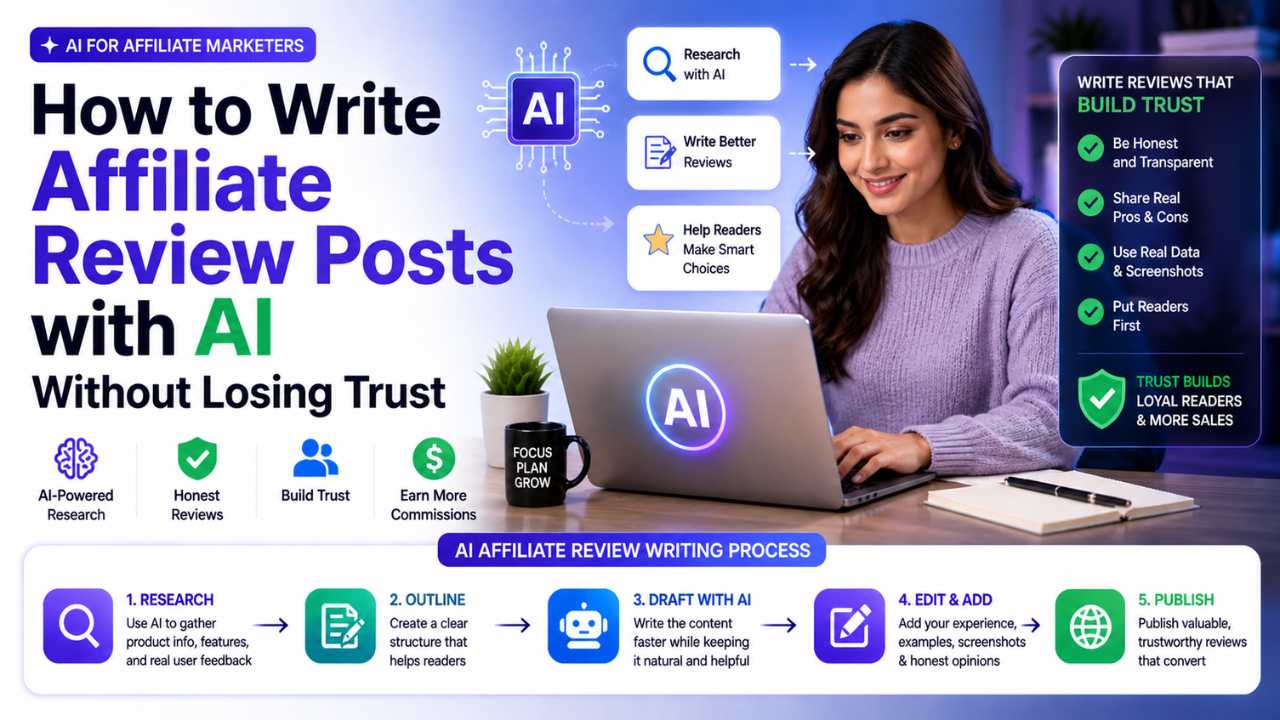
How to Write Affiliate Review Posts with AI Without Losing Trust

Write Affiliate Review Posts with AI

Affiliate review posts can earn real income, but only when the reader believes you are helping them make a better decision.

That is the part many beginner affiliate marketers miss. They think the review is only about ranking on Google and placing links. But a review is more personal than that. A reader is often close to buying something. They are comparing options, checking risks, and trying to avoid wasting money.

AI can make the writing process much faster, but it can also make reviews feel empty if you use it the wrong way.

In 2026, you can ask ChatGPT, Claude, Writesonic or another AI writing tool to create a long review draft in minutes. The headings may look clean. The pros and cons may sound confident. The article may even look ready to publish at first glance.

But if the review feels fake, generic, or copied from a product page, readers can sense it. And when readers do not trust the review, they do not click the affiliate link.
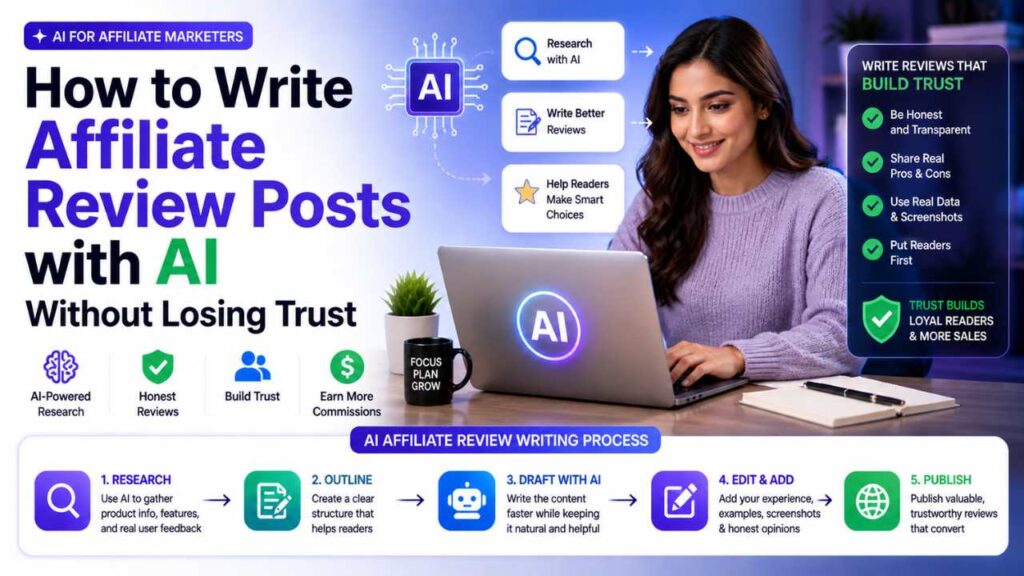
 

Write Affiliate Review Posts with AI


That is why this guide focuses on how to write affiliate review posts with AI without losing trust. AI should not be used to fake experience. It should be used to organize real research, explain findings clearly, compare options fairly, and make your writing process easier.

The goal is not to publish more low-quality reviews. The goal is to publish better, more useful affiliate reviews with less manual struggle.

Can You Write Affiliate Review Posts With AI?

Yes, you can write affiliate review posts with AI, but you should use AI as an assistant, not as the final judge.

AI is useful for:

  • Organizing product research
  • Creating review outlines
  • Drafting individual sections
  • Explaining features in simple language
  • Building comparison tables
  • Creating FAQ sections
  • Improving readability
  • Repurposing reviews into social posts

But AI should not control the whole review.

Do not use AI to invent personal experience, create fake test results, make up pricing, pretend you used a product you have never touched, hide limitations, rewrite product pages in slightly different words, or push every reader toward the same affiliate offer.

The trust-first rule is simple:

Use AI to organize your review, not fake your experience.

Start with one product you actually understand. Then use AI to help structure, draft, edit, and improve the review. That is the safest and smartest way to use AI for affiliate content.

Why Trust Matters More Than Speed

AI has made writing faster. That is useful. But affiliate marketing is not just a writing game. It is a trust game.

Readers come to a review post because they are trying to make a decision. They want to know whether a product is worth their money, whether it fits their situation, and whether there are better alternatives.

If your article only repeats marketing claims, the reader learns nothing.

If your review sounds like every other AI-generated article, the reader has no reason to believe you.

If every tool is described as powerful, game-changing, and perfect for everyone, the reader can tell the post is written for commission, not usefulness.

A trustworthy affiliate review does something different. It helps the reader decide.

That means your review should explain who the product is best for, who should avoid it, what it does well, where it feels limited, what pricing means, how it compares with alternatives and whether it is worth buying for a specific type of user.

AI can help you write those sections, but it cannot replace your judgment.

The bloggers who win with AI-assisted affiliate reviews are the ones who use AI to make honest content clearer, not dishonest content faster.


ChatGPT Plus
Canva Pro
Midjourney
Claude Pro
⚡ SAVE 80%
Market: ₹15,000 → ₹2,999/year

132+ Premium AI Tools
Instant
Verified
24/7

What Makes an Affiliate Review Trustworthy?

A trustworthy affiliate review is not just long. It is useful, specific, balanced and clear.

Google’s official review guidance focuses on quality and originality. A useful review should help readers compare options, understand tradeoffs, and see evidence behind the recommendation. You can read Google’s official guide on writing high-quality reviews for a deeper look at how review content should be improved.

Here are the main qualities that make an affiliate review feel trustworthy.

Real Research

Before writing, collect facts from official product pages, pricing pages, support docs, demos, screenshots, user reviews, competitor pages and your own testing where possible.

Do not ask AI to guess.

AI can summarize research, but the research needs to exist first. If you give AI weak input, it will usually create weak output with polished wording.

Clear Audience Fit

A good review does not say, “This tool is best for everyone.”

It says something more specific:

“This tool is best for bloggers who publish regular long-form content and need a repeatable review workflow. It may be too expensive for beginners who only publish one article per month.”

That kind of recommendation builds trust because it helps the right reader make a decision.

Honest Pros and Cons

Every product has limitations. If your review only includes positive points, it starts to feel like an ad.

Useful cons might include pricing, learning curve, limited free plan, missing features, weak templates, slow support, export issues or niche-specific limitations.

Honest cons do not destroy conversions. They improve the quality of conversions because the right reader understands the tradeoff before clicking.

Practical Use Cases

Readers want to know how the product works in real life.

Instead of saying, “This tool saves time,” explain exactly how it saves time.

For example:

“A blogger can use this tool to turn one product research document into a review outline, then use the editor to rewrite weak sections before adding screenshots, pricing notes, and affiliate CTAs.”

That is more helpful than a vague feature list.

Human Verdict

The verdict is where your judgment matters most.

AI can help polish the wording, but the recommendation should come from you. Your verdict should answer whether you recommend the product, who it is best for, who should skip it, what alternative may be better, and what the reader should check before buying.

That is what separates a real review from a generic AI article.

The Trust-First AI Review Workflow

The best way to write affiliate review posts with AI is to keep the workflow simple and controlled.

Here is the process I recommend:

  1. Choose one product you understand.
  2. Collect real research.
  3. Define the reader and search intent.
  4. Build a review outline.
  5. Ask AI to organize your notes.
  6. Draft section by section.
  7. Add honest pros, cons, and use cases.
  8. Fact-check pricing and features.
  9. Add screenshots, examples, and personal notes where possible.
  10. Write a human verdict.
  11. Edit for clarity, tone, and trust.
  12. Add affiliate disclosure and natural CTAs.

This workflow keeps AI in the right role. AI helps with structure and speed. You provide accuracy, judgment and trust.

Step 1: Choose a Product You Actually Understand

If your goal is to write affiliate review posts with AI that people trust, product understanding has to come before drafting.

The safest affiliate review starts with a product you have used, tested, researched deeply, or at least understand well enough to explain honestly.

This does not mean you need to be a world expert. But you should know more than what appears on the homepage.

For example, if you are reviewing an AI writing tool, you should understand:

  • What type of content it creates
  • Whether it supports long-form writing
  • How templates work
  • Whether brand voice is available
  • What the pricing tiers include
  • Whether there is a free plan or trial
  • Which alternatives compete with it
  • Who benefits most
  • What limitations beginners may face

If you cannot answer those basics, do more research before writing.

AI can help you create a review faster, but it cannot responsibly replace product understanding.

Beginner rule: review fewer products more deeply instead of reviewing many products shallowly.

That is better for SEO, trust, and affiliate conversion.

Step 2: Research Before Prompting AI

Do not start your review with a prompt like, “Write a review of this product.”

That is how you get generic content.

Instead, gather research first. Useful research sources include the official product homepage, pricing page, feature pages, help docs, demo videos, free trial or free plan, user reviews, competitor pages, your own screenshots, and notes from testing the tool.

Create a simple research document with these sections:

  • Product overview
  • Main features
  • Pricing notes
  • Best use cases
  • Pros
  • Cons
  • Alternatives
  • Personal notes
  • Final opinion

Then use AI to organize those notes.

A better prompt would be:

I am writing an affiliate review of [product] for beginner bloggers. Here are my research notes. Organize them into a review outline with sections for features, pricing, pros, cons, best use cases, alternatives, and final verdict. Do not invent facts.

That prompt gives AI real material to work with.

Step 3: Define the Reader and Search Intent

Every affiliate review should be written for a specific reader.

A review for beginner bloggers is different from a review for agencies. A review for YouTubers is different from a review for SEO content teams. A review for budget users is different from a review for enterprise buyers.

Before writing, define who is reading, what they are worried about, what decision they are trying to make, what alternatives they are considering, and what would make them trust the review.

For AI Sage Labs, the reader is usually a beginner to intermediate blogger, creator, freelancer, or affiliate marketer who wants to use AI tools to save time, grow traffic, and make money online.

For this audience, the review should be practical, simple, and honest.

For example, someone searching for a review of an AI writing tool probably wants to know whether the tool is worth the price, how it compares with alternatives, whether it can help bloggers make money, what plan makes sense, and what the real limitations are.

That search intent should shape the review.

If you want a broader income strategy before writing reviews, read this guide on how to make money with AI.

Step 4: Build a Review Outline First

Do not ask AI for a full article first. Start with the outline.

A strong affiliate review outline usually includes:

  • Short introduction with the reader’s problem
  • What the product is
  • Who it is best for
  • Who should skip it
  • Key features
  • Pricing notes
  • Pros and cons
  • Real use cases
  • Alternatives
  • Comparison table
  • Honest limitations
  • Final verdict
  • FAQs

Example prompt:

Create a 3000-word affiliate review outline for [product]. The audience is beginner bloggers and affiliate marketers. Focus on whether the product is worth it, who it is best for, pricing, pros and cons, alternatives, income use cases and final verdict. Keep the tone honest and beginner-friendly.

Once AI creates the outline, edit it manually. Remove weak sections. Add missing questions. Make sure the structure follows the reader’s decision process.

Step 5: Use AI to Draft Section by Section

Section-by-section drafting gives you better quality control than asking for one long article at once.

Instead of asking AI to write a full 3000-word review, ask it to write one section using your notes.

For example:

Write the pricing section for this review using only the pricing notes below. Explain which plan is best for beginner bloggers. Do not invent prices.

Or:

Write the pros and cons section for this review. Use a balanced tone. Include practical explanations, not just bullet points.

This approach works better because you can review each section before moving on.

A good AI-assisted review workflow looks like this:

  1. Ask AI to write the overview.
  2. Edit it.
  3. Ask AI to write the features section.
  4. Edit it.
  5. Ask AI to write pricing.
  6. Fact-check it.
  7. Ask AI to write pros and cons.
  8. Add your own judgment.
  9. Ask AI to draft FAQs.
  10. Rewrite weak answers.

The more control you keep, the more trustworthy the final review becomes.

Step 6: Add Honest Pros and Cons

Pros and cons are one of the fastest ways to build or lose trust.

Weak pros sound like this:

  • Easy to use
  • Great features
  • Saves time
  • Affordable

Those points are too generic.

Better pros and cons explain why the point matters.

For example:

  • The template system is useful for bloggers who publish repeatable review formats.
  • Brand voice can help keep long-form content more consistent across multiple posts.
  • The workflow can reduce first-draft time, especially for comparison and list posts.
  • The higher price may be harder to justify for bloggers publishing only one article per month.

Notice the difference. The better version explains the practical meaning behind each point.

When writing cons, do not hide real issues. Honest limitations might include a limited free plan, higher learning curve, expensive pricing, overlapping features, weak integrations or output that depends heavily on prompt quality.

The reader who still clicks after understanding the limitation is more likely to be the right buyer.

Step 7: Explain the Income Mechanism

AI Sage Labs posts should always explain how a tool can help bloggers or affiliate marketers make money.

Do not just say, “This tool is good for affiliate marketers.”

Explain the income mechanism.

For example:

“This tool can help affiliate bloggers by reducing the time required to create detailed review drafts. If a blogger can publish two high-quality reviews per week instead of one, they can build more ranking assets, test more affiliate offers and update content more consistently.”

That is more useful because it connects the product to the business outcome.

Possible income mechanisms include faster review production, better SEO optimization, improved content quality, higher trust, stronger comparison tables, better CTAs, faster content updates, more email leads and more consistent publishing.

Every affiliate review should answer one question:

How does this product help the reader save time, make money or make a better decision?

Step 8: Add Alternatives and Comparisons

A trustworthy review does not pretend one product is the only option.

Readers usually compare multiple tools before buying. If you include alternatives, you become more useful.

For example:

“A dedicated AI writing platform may be best for bloggers who want templates and long-form workflows. ChatGPT may be better for flexible brainstorming and lower-cost research. Writesonic may be better for bloggers who want AI writing plus SEO-style features at a different price point.”

That kind of comparison helps readers choose.

Tool Type Best For Main Strength Main Limitation
Dedicated AI writing tool Long-form bloggers Structured writing workflows May cost more than general AI chat tools
General AI assistant Beginners and flexible research Useful for brainstorming and outlining Needs stronger prompting and editing
SEO content tool Search-focused publishers Helps with optimization and content planning Can still produce generic writing without human edits


Comparison sections also create good future internal-link opportunities when you publish review and versus posts.

If you want an example of a tool review format, see this Writesonic review for bloggers.

Step 9: Fact-Check Pricing and Features

When you write affiliate review posts with AI, this is the step that protects you from one of the most common trust problems: outdated or invented details.

This step is non-negotiable.

AI can get pricing wrong. It can confuse old plans with new plans, invent free trials, or mention features that no longer exist.

Before publishing any affiliate review, check the current pricing, free plan or trial, refund policy, key features, plan limits, usage limits, supported platforms, and affiliate program terms if relevant.

Use official sources whenever possible.

If pricing changes often, write carefully. Use phrases like:

  • At the time of writing…
  • Pricing may change, so check the official pricing page before buying.
  • The best plan depends on your publishing volume and feature needs.

That wording protects trust. Do not include fake certainty when the information may change.

Step 10: Add Screenshots, Examples, and Personal Notes

AI-written reviews often feel empty because they do not include evidence.

Add evidence wherever possible. Useful trust signals include screenshots from the tool, a sample workflow, before-and-after examples, short testing notes, real use cases, comparison tables, clear limitations, and specific plan recommendations.

Even a simple personal note helps.

For example:

“For beginner bloggers, the most useful part is not the advanced dashboard. It is the ability to create repeatable review outlines without starting from a blank page every time.”

That sounds more human because it reflects judgment. AI can polish this kind of note, but the insight should come from you.

Step 11: Write a Human Final Verdict

The final verdict is one of the most important parts of the review.

This is where you tell the reader what to do.

A weak verdict says:

“Overall, this is a great tool and I recommend it.”

A stronger verdict says:

“I recommend this tool for bloggers who publish at least two long-form posts per month and want a repeatable AI writing workflow. I would not recommend it for complete beginners who are still choosing a niche or anyone who only needs occasional social media captions. In that case, start with a free AI assistant first and upgrade later.”

The strong verdict helps the reader decide.

Your verdict should include who should buy, who should skip, the best starting point, the main reason to choose the product, the main limitation to understand, and the best alternative if it is not a fit.

This is the section where trust can turn into conversions.

Step 12: Edit for Voice, Clarity, and Trust

The final editing pass is where AI-assisted content becomes genuinely useful. This is especially important when you write affiliate review posts with AI for readers who are close to making a buying decision.

After AI helps draft the post, edit manually.

Look for repeated phrases, overhyped claims, generic wording, unsupported promises, weak pros and cons, fake-sounding personal experience, missing limitations, outdated pricing and too many affiliate CTAs.

Remove phrases like:

  • Game-changing
  • Revolutionary
  • Best ever
  • Guaranteed results
  • Passive income machine
  • Effortless profits

Replace hype with practical explanation.

Instead of writing, “This tool will transform your affiliate business,” write something like, “This tool can reduce drafting time if you already have a clear content strategy and product research notes.”

That sounds more believable because it is specific and realistic.

Affiliate Review Post Template You Can Reuse

Here is a simple structure you can reuse when you write affiliate review posts with AI:

  • SEO title
  • Short intro with the reader’s problem
  • What the product is
  • Who it is best for
  • Who should skip it
  • Key features
  • Pricing notes
  • Pros and cons
  • How it helps bloggers or affiliate marketers
  • Real use cases
  • Alternatives
  • Comparison table
  • Honest limitations
  • Final verdict
  • FAQs
  • Natural CTA

This structure works because it follows the reader’s decision path. First, they want to know if the product is relevant. Then they want features. Then pricing. Then pros and cons. Then alternatives. Then your final recommendation.

AI can help draft each section, but you should control the judgment.

Useful AI Prompts for Affiliate Reviews

Good prompts keep AI focused on your research and your reader.

Research Organization Prompt

Organize these product research notes into a clear affiliate review outline. The audience is beginner bloggers. Do not add facts that are not in my notes.

Feature Explanation Prompt

Explain these product features in simple language for beginner affiliate marketers. Focus on practical use cases, not marketing hype.

Pros and Cons Prompt

Create a balanced pros and cons section from these notes. Make each point specific and explain why it matters for bloggers.

Pricing Prompt

Write a pricing section using only the pricing details below. Include a reminder that readers should check the official pricing page because plans can change.

Verdict Prompt

Draft a final verdict for this product. Recommend it only for the right audience. Include who should buy, who should skip, and the best alternative for beginners.

Trust Edit Prompt

Edit this review section to sound more honest, practical and human. Remove hype, unsupported claims and generic AI wording.

Common Mistakes That Make AI Affiliate Reviews Lose Trust

Publishing Without Research

If the whole review is based on AI’s general knowledge, the post will feel shallow. Research first. Use AI second.

Pretending to Have Used a Product

Never say “I tested this” unless you actually did. If you researched the product but did not test it deeply, be honest with your wording.

Making Every Product Sound Perfect

No product is perfect. Readers trust reviews that explain trade-offs.

Ignoring Pricing Reality

Affiliate reviews lose trust when pricing is wrong or unclear. Always check official pricing before publishing.

Using Too Many CTAs

If every section screams “buy now,” the review feels desperate. Use CTAs naturally after useful sections.

Forgetting the Reader’s Stage

A tool that is excellent for advanced marketers may be wrong for beginners. Always match the recommendation to the reader’s stage.

Recommended Setup for Affiliate Bloggers

If you want to publish affiliate reviews seriously, build your own website instead of depending only on social media platforms. A self-hosted blog gives you more control over SEO, branding, email capture, affiliate placements and long-term content updates.

For beginners, Hostinger is a practical option for starting a WordPress blog or affiliate website because it keeps the setup simple.

Start Your Affiliate Blog

If you want your reviews to rank, convert, and keep earning over time, build them on your own WordPress site instead of only posting on social media.

Start your affiliate blog with Hostinger

When to Hire Help for Affiliate Review Content

You can write affiliate reviews yourself, but there are times when hiring help makes sense.

For example, you may want help with WordPress setup, logo design, SEO formatting, product screenshots, comparison tables, content editing, or technical automation. This is especially useful if you are trying to publish consistently while learning the business side.

Fiverr can be useful for finding freelancers who help with blog setup, SEO tasks, website design, content editing and affiliate marketing support.

Need Help With Affiliate Review Content?

If you need help with SEO formatting, WordPress setup, comparison tables, content editing, or affiliate blog tasks, hiring a freelancer can save time.

Find affiliate marketing and blog freelancers on Fiverr

Recommended Book for Affiliate Review Writers

If you want to understand affiliate marketing beyond writing articles, a useful beginner-friendly resource to explore is Affiliate Marketing For Dummies. It can help you understand the wider affiliate business model, not just the writing side.

This is a good fit for bloggers who want to learn how affiliate programs, offers, traffic and commissions work together.

Learn Affiliate Marketing Basics

If you are new to affiliate marketing, this book can help you understand the business model before you write dozens of reviews.

Check Affiliate Marketing For Dummies on Amazon

The Honest Truth About AI and Affiliate Reviews

AI can help you write affiliate review posts with AI faster, but it cannot create trust by itself.

Trust comes from usefulness. Usefulness comes from research, clarity, honesty and good judgment.

If you use AI to publish generic review articles at scale, you may get more pages online, but those pages will not automatically rank, convert or build a brand.

If you use AI to organize real research, explain products clearly, compare options fairly and polish your writing, then AI becomes a serious advantage.

The difference is intent.

Are you using AI to help the reader make a better decision? Or are you using AI to push another affiliate link onto the internet?

Readers can feel the difference.

For AI Sage Labs, the best approach is simple: write for the reader first, use AI for speed and structure, and keep the verdict human.

Final Checklist Before Publishing an AI-Written Affiliate Review

Before publishing, check these points:

  • Did I research the product from official sources?
  • Did I avoid fake personal experience?
  • Did I explain who the product is best for?
  • Did I include honest limitations?
  • Did I fact-check pricing and features?
  • Did I add alternatives?
  • Did I include a clear final verdict?
  • Did I remove hype and generic AI wording?
  • Did I include natural internal links?
  • Did I add a trusted external source?
  • Did I create a useful featured image?
  • Did I include affiliate disclosure?

If the answer is yes, your review is already stronger than a typical AI-generated affiliate post.

Start With One Product You Understand

The best way to begin is not to build a huge review site overnight.

Start with one product you actually understand. Research it properly. Use AI to organize your notes. Draft the review section by section. Add your honest verdict. Publish it. Then improve it after you see how readers respond.

That is how affiliate review writing becomes a system.

Start with one product you actually understand, then use AI to organize your review, not fake your experience.

Frequently Asked Questions

Can I use AI to write affiliate review posts?

Yes, you can use AI to write affiliate review posts with AI, but you should use it as an assistant. AI is best for outlines, drafting, editing, FAQs and comparison tables. You should still provide research, fact-checking, honest pros and cons and the final recommendation.

Is it bad to use AI for affiliate marketing content?

No. Using AI is not bad if the content is helpful, accurate, and honest. The problem is using AI to create fake experience, generic reviews or misleading claims.

How do I make AI-written reviews sound human?

Add specific examples, real limitations, product screenshots, clear recommendations and your own verdict. Remove generic phrases, hype, and vague claims. Write for one specific reader instead of trying to impress everyone.

Should I say I used AI to write a review?

You should follow platform rules and legal requirements for your location. At minimum, include a clear affiliate disclosure when using affiliate links. If AI played a major role in content creation, make sure the content is well-edited, fact-checked, original and transparent.

Can AI write honest pros and cons?

AI can help draft pros and cons from your notes, but you should decide which points are fair and accurate. The best pros and cons come from real research, product testing and understanding the reader’s needs.

What is the best AI tool for affiliate review writing?

The best tool depends on your workflow. ChatGPT is flexible for research and structure. Claude can be useful for long drafting and editing. Writesonic can work well for blog drafts and SEO-style content. The tool matters less than the quality of your research and editing.

How long should an affiliate review post be?

For competitive affiliate keywords, a strong review is often 2500 to 3500 words or more. Length alone does not matter. The review should be long enough to answer the reader’s buying questions clearly.

Conclusion

AI can be a powerful tool for affiliate review writing, but only when you use it with the right mindset.

Do not use AI to fake experience. Do not use it to publish shallow reviews. Do not let it invent claims, pricing or results.

Use AI to organize research, create outlines, draft sections, improve readability, build comparison tables and polish your final article. Keep the human part where it matters most: research, honesty, judgment and the final recommendation.

If you follow that approach, AI can help you create affiliate review posts that are faster to write, easier to read and more useful for real people.

That is the kind of content that has a better chance of earning trust, clicks and long-term search traffic.

Affiliate Disclosure

As an Amazon Associate, I earn from qualifying purchases. Some links in this article are affiliate links, which means I may earn a commission at no extra cost to you if you buy through them. I only recommend tools, books and services that may help beginners build better blogs, improve their affiliate content or grow their online work more effectively.
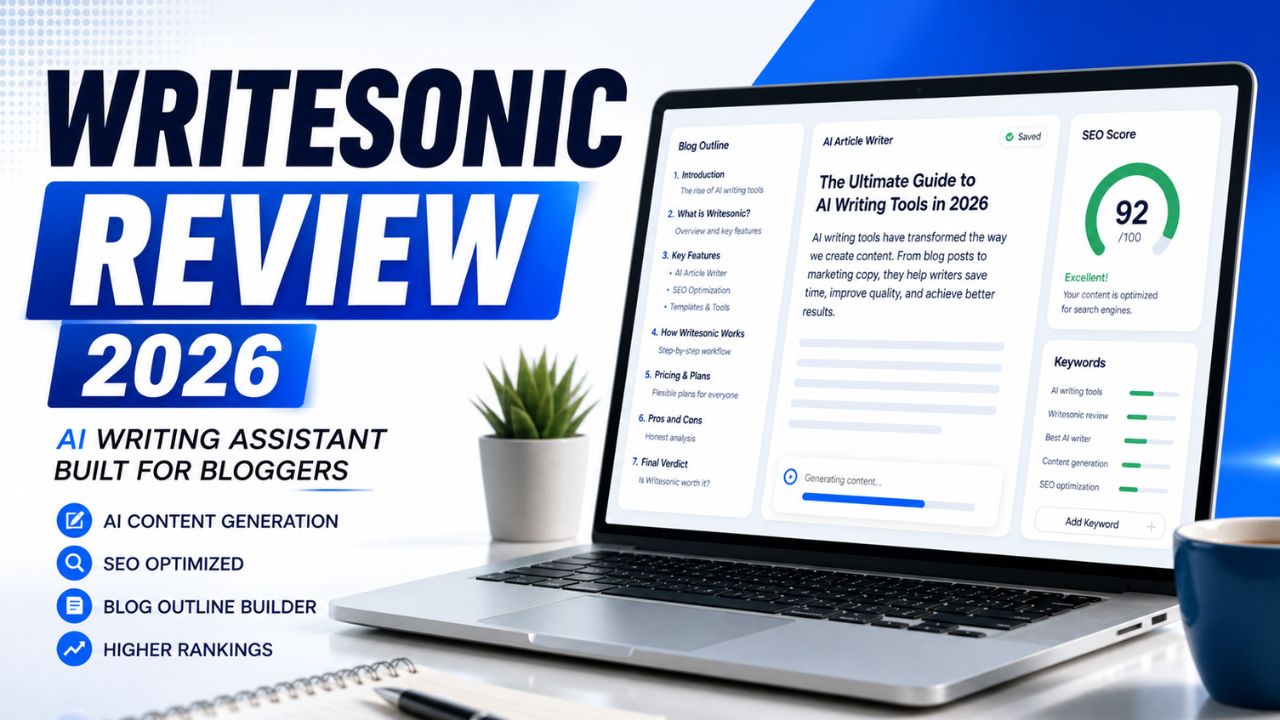
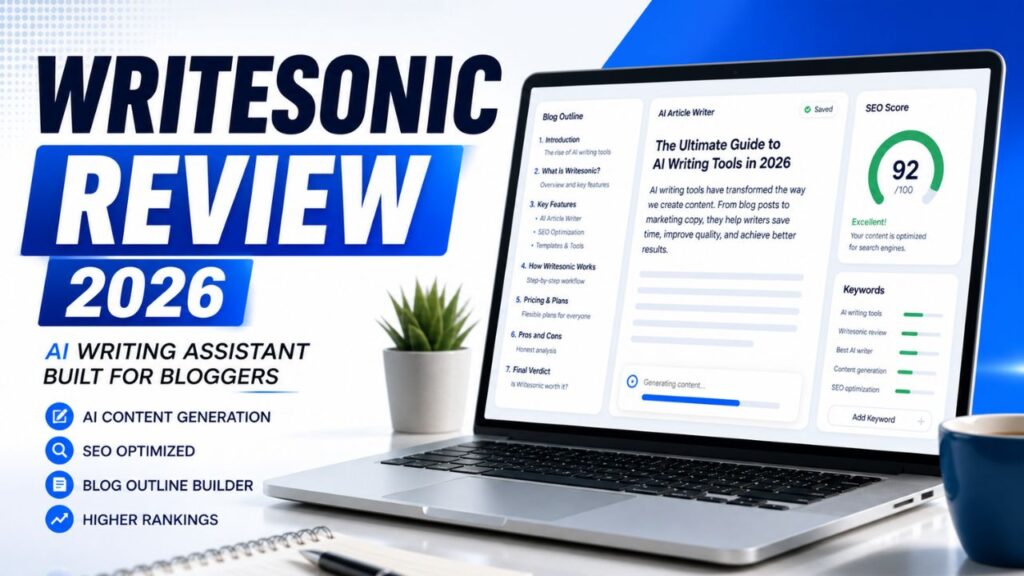
Writesonic Review 2026: Is It the Best AI Writing Tool for Bloggers?

Writesonic Review 2026

AI writing tools are easy to find now. Useful AI writing tools are harder to choose.

That is the real problem for bloggers in 2026. Almost every tool promises faster drafts, better SEO, higher rankings, and more content. But when you actually use them, many drafts still sound generic, repetitive, or too polished in the wrong way.

Blogging is not only about writing more words.

You still need search intent, topic research, useful structure, fact-checking, internal links, examples, CTAs, affiliate disclosures, and a human final verdict. An AI writing tool can help with speed, but it cannot replace judgment.

That is why Writesonic is worth reviewing carefully.

Writesonic is no longer just a basic AI writing tool. Its current platform focuses heavily on AI search visibility, SEO workflows, AI Article Writer, Chatsonic, content optimization, site audits, and agent-style marketing tasks.


Writesonic Review 2026


But is it actually useful for bloggers, affiliate marketers, and content creators?

In this Writesonic review 2026, we will look at what Writesonic does, how it works, its best features, pricing considerations, pros and cons, alternatives, blogger workflows, money-making use cases, and whether it is worth using this year.

Writesonic Review 2026: What Is Writesonic?

Writesonic is an AI-powered content, SEO, and AI search visibility platform designed to help users create, optimize, and improve content workflows.

In simple beginner language, Writesonic helps you plan, write, improve, and optimize content faster.

It started as a more traditional AI writing tool, but its current positioning has moved further into SEO, GEO, AI visibility, and content execution. Writesonic’s official website now focuses on helping brands track visibility across AI answers, identify content gaps, and act on those opportunities with AI agents and content tools.

For bloggers, that means Writesonic is not only about writing a quick draft. It can also support article creation, keyword research, content optimization, audits, and AI-assisted marketing workflows.

This makes Writesonic more interesting for serious bloggers than a simple one-click paragraph generator.

It also means beginners should be clear about what they need. If you only need occasional short writing help, a general AI assistant may be enough. If you want a more structured SEO content workflow, Writesonic becomes more relevant.

Why Writesonic Matters for Bloggers in 2026

Writesonic matters because blogging has become more competitive.

Bloggers are not only competing with other blogs anymore. They are competing with YouTube videos, Reddit threads, AI Overviews, social posts, product pages, forums, and AI-generated content at scale.

Publishing random articles is not enough.

A useful blog post needs to match search intent, answer real questions, include helpful structure, cite important sources, include related internal links, and help the reader make a decision.

Writesonic can help with parts of this workflow.

A blogger can use it to create article outlines, draft sections, generate FAQs, rewrite weak content, plan SEO content, create supporting marketing copy, and improve older posts.

The real value is not replacing the blogger. The value is reducing blank-page time and making the content process more structured.

That is the key point of this Writesonic review 2026: Writesonic is most useful when you use it as an assistant, not as a copy-paste publishing machine.

If you are comparing AI writing tools more broadly, read this guide on AI writing tools tested in 2026. If your goal is affiliate content, this guide on writing affiliate review posts with AI will help you use tools more responsibly.

How Writesonic Works

Writesonic works by giving users different tools for writing, SEO, AI chat, optimization, audits, and marketing tasks.

A basic blogger workflow usually looks like this:

  1. Choose a content type, such as blog article, landing page, ad, or social post.
  2. Add your topic, keyword, audience, and instructions.
  3. Use Writesonic to generate an outline or draft.
  4. Edit the content manually.
  5. Use SEO or optimization features to improve the post.
  6. Add examples, sources, internal links, CTAs, and human judgment.
  7. Publish only after review.

For long-form blog posts, Writesonic’s AI Article Writer is the main feature to understand.

Writesonic’s documentation says AI Article Writer includes multiple versions, including AI Article Writer 4, 5, and 6. Article Writer 6 is described as a more advanced option with tone customization, internal linking, source citation, AI-generated cover image creation, FAQ integration, and call-to-action support.

That makes it more structured than simply asking a chatbot for a full article.

Still, the final quality depends on your input, niche knowledge, editing, and fact-checking.

7 Powerful Writesonic Features for Bloggers

The most important part of this Writesonic review 2026 is understanding which features actually matter for bloggers.

1. AI Article Writer

Writesonic’s AI Article Writer is its main long-form content tool.

According to Writesonic’s documentation, AI Article Writer is a suite of tools designed to streamline long-form article creation. Article Writer 6 is positioned for more advanced content creation and SEO-focused workflows.

For bloggers, this can help create structured drafts faster.

You can use it for:

  • Blog post drafts
  • SEO article outlines
  • FAQ sections
  • Intro and conclusion drafts
  • Article rewrites
  • Call-to-action sections

The limitation is important: do not publish raw AI drafts. Even when the structure looks strong, you still need to edit for accuracy, examples, reader fit, brand voice, and trust.

2. Article Writer 6 Workflow

Article Writer 6 gives users more control than a basic instant draft workflow.

Writesonic’s documentation describes three writing modes: a 10-step article workflow, a 4-step article workflow, and an instant article workflow. The 10-step mode gives the most control and can include article type, competitor or reference selection, keywords, word length, outline, brand voice, CTA, image settings, FAQs, and other advanced settings.

For serious bloggers, this matters because better inputs usually create better drafts.

If you want trust-friendly content, use the slower, more controlled workflow instead of relying only on instant generation.

3. SEO AI Agent

Writesonic’s SEO AI Agent is designed to support SEO and content marketing workflows.

Writesonic’s documentation describes the SEO AI Agent as combining AI capabilities with SEO strategies. It includes workflow areas such as market analysis, keyword research, audience segmentation, content strategy, blog creation, and optimization.

For bloggers, this is useful because SEO content is not only writing. You need research, keyword intent, content planning, optimization, and updates.

The SEO AI Agent may be helpful if you want a more guided workflow instead of starting from a blank prompt.

4. Chatsonic

Chatsonic is Writesonic’s AI chat tool.

For bloggers, Chatsonic can help with brainstorming, outlines, content ideas, summaries, marketing copy, research support, and repurposing.

It can be useful if you want an AI assistant inside the same platform where you manage writing and SEO workflows.

As with any AI chat tool, you should verify important facts, pricing, product claims, and recommendations before publishing.

5. SEO and Content Optimization

Writesonic includes SEO and content tools that help users research, plan, and improve content.

For bloggers, this matters because writing fast is not enough. Your article still needs to match search intent, answer reader questions, include useful headings, and compete with existing pages.

SEO recommendations can support your process, but you should not follow every suggestion blindly.

Use SEO tools as guidance. The final article still needs original value and human judgment.

6. AI Search Visibility and GEO Workflows

Writesonic’s current homepage focuses heavily on AI search visibility and GEO-style workflows.

It describes tracking brand visibility across AI answer engines, identifying citation gaps, prioritizing issues, and using AI agents to create or refresh content.

This may be more advanced than what a beginner blogger needs on day one. But for growing sites, it reflects where content marketing is moving.

Search is no longer only about traditional Google rankings. Bloggers also need to think about whether their brand, tools, and content are visible in AI-generated answers.

Writesonic’s AI visibility features may be useful for teams and serious marketers, but casual bloggers should evaluate whether they really need those advanced features before paying.

7. Rewriting and Content Improvement

Writesonic can also help rewrite, improve, and repurpose existing content.

This is one of the safer ways to use AI writing tools because you already have a human-reviewed base.

For example, you can use Writesonic to rewrite a weak intro, create a cleaner CTA, turn a blog section into a LinkedIn post, or make an old article section easier to read.

Bloggers should not only create new content. Updating old posts is often just as important.

Writesonic Pros and Cons

No Writesonic review 2026 should ignore the tradeoffs. Writesonic can be useful, but it is not perfect.

Pros Cons
Strong long-form article workflow Still requires human editing and fact-checking
Article Writer 6 offers more control than simple AI drafts Advanced features may be more than casual bloggers need
SEO AI Agent can support keyword and content planning Content can still sound generic without clear instructions
Useful for SEO, GEO, and AI search visibility workflows Pricing and usage limits can change by plan
Helpful for scaling content systems Not a replacement for real experience or product research


The biggest benefit is speed and workflow structure. The biggest limitation is that Writesonic output still needs a real editor.

Writesonic Pricing in 2026

Writesonic pricing can change, and plan details depend on usage, content volume, SEO features, AI search visibility needs, and team requirements.

At the time of writing, Writesonic’s official website and pricing flow focus heavily on AI visibility, SEO, content execution, and agent-style workflows. Its official pages also promote a free trial.

Because Writesonic has shifted beyond basic AI writing, compare the plan against your actual workflow, not only the monthly price.

Before upgrading, ask:

  • How many long-form articles do I publish each month?
  • Do I need SEO AI Agent workflows?
  • Do I need AI search visibility tracking?
  • Do I need content optimization and site audits?
  • Will Writesonic save enough time to justify the cost?

For beginners, the safest pricing advice is simple: test the free trial or lowest suitable option first, create one real blog post workflow, and upgrade only if the tool genuinely saves time and improves your process.

For this Writesonic review 2026, Writesonic is easiest to justify when content production and SEO are serious parts of your business.

Try Writesonic for AI Blog Writing

If you want structured AI article writing plus SEO workflow support, test Writesonic with one real blog post before upgrading.

Try Writesonic

Is Writesonic Beginner-Friendly?

Yes, Writesonic can be beginner-friendly, but it depends on which features you use.

If you only use basic templates or article generation, the workflow is fairly easy. You choose a tool, enter your topic or keyword, and generate content.

The SEO-focused features may take more time to understand.

Beginners should not start by trying to use every feature. Start with one workflow:

  1. Create an outline.
  2. Generate a draft.
  3. Edit manually.
  4. Fact-check important claims.
  5. Add examples and internal links.
  6. Optimize the final article.

This keeps Writesonic useful without making the process overwhelming.

Writesonic vs Other AI Writing Tools

A practical Writesonic review 2026 should compare Writesonic with the types of tools bloggers are already considering.

Writesonic vs ChatGPT

ChatGPT is more flexible for brainstorming, outlining, editing, research support, and custom workflows.

Writesonic is more structured for article writing, SEO workflows, AI visibility, and content execution.

If you like building your own prompts, ChatGPT may be enough. If you want dedicated article and SEO workflows, Writesonic may feel more organized.

Writesonic vs Rytr

Rytr is usually a simpler budget AI writing tool.

Writesonic is more feature-rich, especially for long-form content, SEO, and marketing workflows.

Budget users may prefer a simpler tool. Bloggers who want more content workflow support may prefer Writesonic.

Writesonic vs Surfer AI

Surfer AI is strongly tied to SEO content optimization workflows.

Writesonic includes writing, SEO, AI search visibility, and content execution features. The best choice depends on your budget, workflow, and how much SEO guidance you need.

Writesonic vs Writer-GPT

Writer-GPT may be a better fit for users who want a simpler AI SEO content tool.

Writesonic is broader and more advanced, especially if you care about SEO AI Agent workflows and AI visibility. For a lighter SEO writing tool comparison, read this Writer-GPT review.

How Bloggers Can Use Writesonic

Writesonic can fit into a blogging workflow if you use it carefully.

A simple workflow looks like this:

  1. Choose a focus keyword.
  2. Use Writesonic to create an outline.
  3. Generate the first draft section by section.
  4. Edit for human tone and accuracy.
  5. Add personal examples or testing notes.
  6. Check SEO structure.
  7. Add affiliate disclosure and CTAs.
  8. Publish in WordPress.
  9. Update the article after it gets data.

This workflow keeps Writesonic in the right role.

It helps with speed and structure, but you still control the final quality.

If you are building a blog around AI tools, affiliate reviews, or online business, you need a reliable website where your content can rank and convert.

Build Your AI Writing Blog

If you want to publish AI writing tool reviews and SEO content, start with a WordPress site that gives you control over traffic, links, and monetization.

Start your AI content blog with Hostinger

How to Make Money With Writesonic

Writesonic does not automatically make money for you, but it can support several online business models.

Blogging

Writesonic can help bloggers create outlines, drafts, FAQs, social captions, and content updates faster.

If this helps you publish more useful content consistently, it can support traffic growth over time.

Affiliate Marketing

Affiliate marketers can use Writesonic to draft product reviews, comparison posts, buying guides, email sequences, and social content.

The key is to add real research, honest pros and cons, current pricing checks, alternatives, and a human verdict.

Freelance Writing

Freelancers can use AI tools to speed up outlines, first drafts, rewrites, content briefs, and supporting copy.

However, clients pay for judgment, editing, strategy, and quality. Do not deliver raw AI content as finished work.

Content Agency

Agencies can use Writesonic as part of a content production system, especially when combined with editors, SEO review, content briefs, and human quality control.

Need AI Content Workflow Help?

If you want help setting up a blog writing workflow, content calendar, SEO process, or AI-assisted article system, freelancers can save setup time.

Find AI content experts on Fiverr

Who Should Use Writesonic?

Writesonic is best for bloggers and marketers who want structured AI writing and SEO workflow support.

It is a good fit for:

  • Bloggers publishing regular long-form content
  • Affiliate marketers creating reviews and comparisons
  • Content teams needing drafts and optimization
  • SEO writers who want workflow support
  • Freelancers who need faster first drafts
  • Small businesses creating marketing copy

If blogging is a serious part of your business, Writesonic is worth testing.

Who Should Skip Writesonic?

Writesonic is not the best fit for every user.

You may want to skip it if:

  • You only need occasional short writing help.
  • You do not want to edit AI drafts.
  • You already have a content workflow that works well.
  • You only want the cheapest AI writing tool.
  • You expect AI to publish perfect articles without review.

For casual writing help, a general AI assistant may be enough. For structured SEO content workflows, Writesonic becomes more useful.

Common Writesonic Mistakes Beginners Make

Publishing Raw AI Drafts

This is the biggest mistake. Writesonic can create useful drafts, but every article still needs editing, fact-checking, and human examples.

Using Weak Inputs

If you give Writesonic a vague topic, the output may feel generic. Add audience, keyword, tone, examples, structure, and content goal.

Ignoring Product Research

For affiliate reviews, do not let AI invent product details. Check official pages, pricing, feature docs, and real limitations before publishing.

Overusing CTAs

Too many buy buttons can make a review feel desperate. Place CTAs after useful information, not before the reader understands the product.

Forgetting Internal Links

AI drafts often miss natural internal links. Add links to related posts so readers and search engines understand your content structure.

Recommended Resource Before the Verdict

Want an AI Blog Writing Workflow?

If you use Writesonic or any AI writing tool, a simple workflow checklist can help you avoid raw AI content. Include keyword research, outline, draft, fact-check, internal links, CTA placement, and final human edit.

Access the AI Blog Writing Workflow Checklist

Recommended Book for AI Content Creators

If you want to understand how AI can support writing and knowledge work, a useful book to explore is Co-Intelligence: Living and Working with AI by Ethan Mollick.

It can help bloggers think about AI as a work partner instead of a shortcut. That mindset is important when using tools like Writesonic because the best content still needs human editing, experience and judgment.

Recommended Reading

If you use AI for writing, this book can help you think more clearly about where AI helps and where human judgment matters.

Check Co-Intelligence on Amazon

Writesonic Review 2026 Verdict: Is It Worth It?

After researching this Writesonic review 2026, my honest verdict is that Writesonic is worth considering if you are serious about AI-assisted SEO content.

It is not perfect. It still needs editing. It can still produce generic sections if your input is weak. It is not a replacement for product research, original examples, or a human final verdict.

But Writesonic is stronger than a basic AI writing tool because it includes more structured content and SEO workflow features.

For bloggers who publish regularly, Writesonic can help create outlines, drafts, FAQs, marketing copy, and optimized content faster.

If you only need occasional writing help, you may not need it. But if you want an AI writing platform with SEO-focused tools, Writesonic is worth testing in 2026.

Start Testing Writesonic

If you want AI article writing with SEO workflow support, test Writesonic on one real blog post and compare the time saved with the editing needed.

Try Writesonic for AI content writing

Frequently Asked Questions

Is Writesonic worth it in 2026?

Writesonic is worth considering if you need AI-assisted long-form content, SEO workflow support, content optimization, and marketing copy tools. It may be too much if you only need occasional short writing help.

Can Writesonic replace human writers?

No. Writesonic can speed up drafting and content planning, but human editing, fact-checking, experience, and judgment are still needed for trustworthy blog content.

Is Writesonic beginner-friendly?

Yes, basic Writesonic tools are beginner-friendly. Advanced SEO and content workflow features may take more time to learn.

Does Writesonic help with SEO?

Yes. Writesonic includes SEO-focused features such as AI Article Writer, SEO AI Agent, content optimization, AI search visibility, and site audit workflows depending on plan access.

Does Writesonic have a free plan?

Writesonic pricing and free access can change, so check the official pricing page or current signup flow for plan details before using it.

Can I make money using Writesonic?

Yes, Writesonic can support blogging, affiliate marketing, freelancing, and agency content workflows. Income depends on your niche, traffic, offers, editing quality, and consistency.

Is Writesonic better than ChatGPT?

Writesonic is more structured for article writing and SEO workflows. ChatGPT is more flexible for general brainstorming, editing, and custom workflows. The better choice depends on how you work.

Is Writesonic good for affiliate reviews?

Writesonic can help draft affiliate reviews, but you should provide real research, honest pros and cons, pricing checks, alternatives, and a human verdict before publishing.

Conclusion

This Writesonic review 2026 shows that Writesonic is still one of the more useful AI writing platforms for bloggers who care about SEO and content workflows.

It is not magic. It will not automatically create perfect articles, rank your site, or replace your judgment.

But it can help you write faster, organize content better, create SEO-focused drafts, improve productivity, and support a more consistent publishing system.

The best way to use Writesonic is simple: let it help with outlines, drafts, rewrites, FAQs, content improvement, and marketing copy. Then edit manually, check facts, add examples, and make the final article genuinely useful.

If you use it that way, Writesonic can be a valuable tool in your AI blogging stack.

How We Checked This Review

Before updating this review, we checked Writesonic’s official website, AI Article Writer documentation, Article Writer 6 documentation, and SEO AI Agent documentation. This helps keep the review practical and safer for bloggers comparing AI writing and SEO tools.

Affiliate Disclosure

As an Amazon Associate, I earn from qualifying purchases. Some links in this article are affiliate links, which means I may earn a commission at no extra cost to you if you buy through them. I only recommend tools, books, and services that may help beginners, creators, and online business owners create better content or grow their work more effectively.

jasper AI Review 2026: Is It Worth $59/Month for Bloggers?

jasper AI Review 2026

Jasper is one of those AI writing tools that creates strong opinions.

Some bloggers still see it as a premium content platform that saves serious time. Others feel it is too expensive now that tools like ChatGPT, Claude, Writesonic, and cheaper writing assistants exist.

Both views can be true.

Jasper is not the cheapest AI writing tool. It is also not a magic article machine that can replace research, editing, product testing, or human judgment. But for marketers and content teams that care about brand voice, repeatable workflows, and campaign content, Jasper still has a clear place in the market.

The real question for AI Sage Labs readers is simple: is Jasper worth around $59/month for bloggers in 2026?


jasper AI Review 2026


In this Jasper AI review 2026, we will look at what Jasper does, current pricing, main features, pros and cons, who should use it, who should skip it, alternatives, and whether it is worth paying for as a blogger.

Jasper AI Review 2026: What Is Jasper?

Jasper is an AI-powered marketing and content platform built for creating on-brand content faster.

In simple beginner language, Jasper helps you write and repurpose marketing content using AI while keeping your brand voice and knowledge in the workflow.

Jasper started as a more traditional AI writing assistant, but by 2026 it has moved deeper into marketing workflows. Its official pricing and platform pages now highlight features such as Canvas, Brand Voice, Knowledge assets, Audiences, Essential Agents, Jasper Chat, integrations, browser extension, and business-level governance.

For bloggers, Jasper can help with:

  • Blog post drafts
  • Affiliate review outlines
  • Email copy
  • Social captions
  • Content repurposing
  • Campaign ideas
  • Brand-consistent marketing copy

Jasper is not the best fit for every blogger. It makes the most sense when content production is already part of a serious business workflow.

If you are still comparing writing tools broadly, read this guide to AI writing tools tested in 2026. If you want a more SEO-focused alternative, this Writesonic review is worth reading too.

Why Jasper Still Matters in 2026

Jasper still matters because many AI writing tools solve only one part of the content problem.

A general AI assistant can help you draft text. But serious blogging and marketing work often need more structure:

  • A consistent brand voice
  • Reusable knowledge about your product or site
  • Content workflows for different formats
  • Campaign-style thinking
  • Team collaboration
  • Governance for larger businesses

That is where Jasper tries to differentiate itself.

It is less of a cheap writing helper and more of a marketing content platform. That can be useful for brands, agencies, SaaS companies, and content teams.

For solo bloggers, the value depends on publishing volume and income.

If you publish one post a week and your blog is not earning yet, Jasper may feel expensive. If you publish several posts per week, manage affiliate content, write emails, create social posts, and care about brand consistency, Jasper becomes more interesting.

That is why this Jasper AI review 2026 is not a simple yes or no. Jasper can be useful, but only for the right workflow.

How Jasper Works

Jasper works by giving you a content workspace where you can create, edit, and repurpose content with AI.

The basic workflow looks like this:

  1. Create a Jasper account or start a trial.
  2. Set up your Brand Voice and relevant knowledge assets.
  3. Choose a content workflow, agent, template, or document.
  4. Add your topic, keyword, brief, product details, or instructions.
  5. Generate a draft or content asset.
  6. Edit, fact-check, and improve the output.
  7. Repurpose the content into other formats if needed.

For example, a blogger could use Jasper to create a first draft for an affiliate review, then repurpose sections into email copy, social posts, and a short promotional blurb.

The key is to treat Jasper as a drafting and workflow assistant, not as a final publisher.

You still need to check facts, test tools where possible, add real examples, include affiliate disclosures, and make sure the final article sounds like a human wrote it.


n8n.io
Make.com
Cursor AI
Perplexity
🚀 SAVE 80%
Automation → ₹3,999/year
Workflow Automation • 1000+ Apps
Cloud AI Ready Analytics


7 Jasper Features That Matter Most for Bloggers

Jasper has many business-focused features, but bloggers do not need to use everything. In this Jasper AI review 2026, these are the features that matter most.

1. Brand Voice

Brand Voice is one of Jasper’s strongest features.

Jasper’s pricing page describes Brand Voice as a way for AI to analyze your content’s tone and set rules so Jasper’s writing sounds like your brand.

For bloggers, this matters because generic AI writing is easy to spot.

If every post sounds like a default AI template, readers may lose trust. Brand Voice can help Jasper stay closer to your tone, audience, and style.

This is useful for affiliate blogs because trust and consistency matter. A review site should feel like one recognizable voice, not a random collection of AI drafts.

The limitation is that Brand Voice is not a magic fix. You still need to edit. But it can reduce the amount of rewriting needed to make drafts feel more consistent.

2. Canvas and Long-Form Content Creation

Jasper’s Canvas is designed for creating on-brand content in a structured workspace.

For bloggers, this can help with long-form drafts such as reviews, tutorials, list posts, buying guides, and comparison articles.

A good workflow is:

  1. Create a content brief.
  2. Ask Jasper for an outline.
  3. Generate one section at a time.
  4. Edit each section manually.
  5. Add examples, screenshots, pricing checks, and personal judgment.

This is safer than asking Jasper for one full post and publishing it without review.

Long-form content still needs structure, search intent, internal links, useful examples, and a strong conclusion. Jasper can help with the first draft, but the final article is still your responsibility.

3. Knowledge Assets

Jasper’s current Pro plan includes Knowledge assets, according to the official pricing page.

Knowledge assets let you give Jasper information it can use when creating content. That may include product details, brand documents, audience notes, style instructions, or other reference material.

For bloggers, this is useful when you write repeatedly about the same niche.

For example, an AI tools blog may have notes about:

  • Target audience
  • Preferred tone
  • Affiliate disclosure rules
  • Common CTA language
  • Internal link priorities
  • Review structure

Giving Jasper better context can improve output quality and reduce repetitive prompting.

4. Jasper Chat

Jasper Chat is Jasper’s conversational AI assistant.

It can help with brainstorming, rewriting, outlines, content ideas, quick drafts, and marketing copy.

The advantage over a blank general AI chat is that Jasper can work inside the broader Jasper environment with your brand settings and knowledge assets.

For bloggers, Jasper Chat can be useful for:

  • Generating headline ideas
  • Improving introductions
  • Rewriting weak paragraphs
  • Creating FAQ ideas
  • Drafting email subject lines
  • Repurposing article sections

It is still not a replacement for fact-checking or niche expertise.

5. Browser Extension

Jasper’s browser extension brings Jasper into places where you already write.

Jasper’s help center says the extension works in Chrome and Edge and lets users access Jasper across web-based writing environments, including social content and email workflows.

For bloggers, this can reduce friction because you do not always need to copy and paste between tools.

You may use Jasper inside Google Docs, email, social platforms, or other web apps where you write content.

The privacy note is worth understanding. Jasper’s help center says the extension can access text on web pages the user visits, though users can restrict access by disabling the extension on specific sites. That is normal for writing extensions, but users should still be thoughtful about where they enable it.

6. SEO and Content Optimization Support

Jasper has SEO-focused features and pages that describe keyword-optimized outlines, drafts, integrations, schema ideas, FAQs, and SEO workflows.

However, this area needs careful wording in 2026.

Older Jasper reviews often mentioned Surfer SEO integration as a major selling point. Jasper’s own SEO page still references SurferSEO as an add-on, but Surfer’s current Jasper integration page says the Jasper integration is no longer available.

That means bloggers should not assume the old Jasper-plus-Surfer workflow works the same way today. Check current Jasper and Surfer documentation before buying either tool for that specific integration.

The safe takeaway is this: Jasper can support SEO writing, but it is not a complete replacement for dedicated SEO tools, keyword research, Google Search Console, internal linking, or human search intent analysis.

7. Marketing Agents and Campaign Workflows

Jasper’s current positioning is heavily focused on marketing workflows and agents.

The pricing page mentions Essential Agents on Pro and Advanced Agents on Business. It also references Jasper Grid, custom agents, no-code AI App Builder, and business-level governance for larger teams.

For solo bloggers, these features may be more than you need.

For agencies, SaaS teams, content teams, and marketers managing campaigns, these features are more relevant. They can help turn Jasper from a simple writing assistant into a broader content production system.

This is part of why Jasper is expensive compared with basic AI writers. You are paying for a marketing platform, not only text generation.

Jasper AI Pricing in 2026

Jasper pricing has changed over time, so always check the official pricing page before subscribing.

At the time of this update, Jasper’s official pricing page lists two main plans: Pro and Business.

Plan Current Official Pricing Best For Key Notes
Pro $59/month per seat billed yearly or $69/month billed monthly Individual marketers and small teams Includes 1 seat, Canvas, Essential Agents, 2 Brand Voices, 5 Knowledge assets, and 3 Audiences
Business Custom pricing Larger teams and enterprises Includes advanced agents, custom workflows, API access, governance, unlimited IQ customization, and support

Jasper also promotes a 7-day free trial for Pro.

This is important because the old Creator-plan pricing appears in many older reviews, but Jasper’s current official page now emphasizes Pro and Business. If you see outdated pricing screenshots online, check Jasper’s live pricing page before making a decision.

For bloggers, the practical question is not only “Can I afford Jasper?” It is “Will Jasper save enough time or create enough workflow value to justify the price?”

Test Jasper Before Paying Long Term

Use the trial on real blog content, not random prompts. Try one review outline, one long-form draft, one email, and one social repurposing workflow before deciding.

Check Jasper pricing and trial details

Is Jasper Worth $59/Month for Bloggers?

For many beginner bloggers, Jasper is not the first tool I would buy.

At around $59/month on annual billing, Jasper is a serious subscription. If your blog is not earning yet, that money may be better spent on hosting, a domain, basic design, email tools, or lower-cost writing support.

Jasper becomes more reasonable when:

  • You publish content consistently.
  • Your blog already has traffic or income.
  • You create content for multiple channels.
  • You care strongly about brand voice.
  • You manage campaigns, clients, or team content.
  • You can turn time saved into more revenue.

If you only publish one article every few weeks, Jasper may be too much. If you publish multiple articles per week and repurpose them into emails, social posts, and affiliate content, Jasper can make more sense.

That is the honest answer in this Jasper AI review 2026: Jasper is powerful, but it needs enough content volume to justify the cost.

Jasper AI Pros and Cons

No Jasper AI review 2026 should ignore the tradeoffs. Jasper is useful, but it is not perfect for every blogger.

Pros Cons
Strong brand voice and marketing workflow features Expensive for beginners
Good for long-form drafts and content repurposing Still requires editing and fact-checking
Knowledge assets can improve repeated content workflows Current official pricing is more premium than many alternatives
Browser extension helps write across web apps Some old reviews mention features or plans that may be outdated
Useful for marketers, agencies, and teams Not necessary for casual blogging

The biggest benefit is brand-consistent marketing content. The biggest drawback is price.

Who Should Use Jasper?

Jasper is best for users who create content regularly and need a more structured AI marketing workflow.

It is a good fit for:

  • Bloggers publishing several times per week
  • Affiliate marketers creating review and comparison content
  • Content teams managing a brand voice
  • Agencies creating content for clients
  • SaaS marketers creating campaigns
  • Freelancers who need faster client drafts
  • Businesses that need governance and brand consistency

If your content system already earns money, Jasper may help you produce and repurpose content faster.

Who Should Skip Jasper?

Jasper is not the best fit for every blogger.

You may want to skip it if:

  • You are just starting and have no blog income yet.
  • You only publish occasionally.
  • You want the cheapest AI writing option.
  • You need built-in SEO guidance at a lower total cost.
  • You prefer flexible general-purpose AI chat tools.
  • You do not want to spend time setting up brand and knowledge assets.

For many beginners, ChatGPT, Claude, Writesonic, Rytr, or other lower-cost tools may be enough.

Jasper vs Other AI Writing Tools

Jasper vs Writesonic

Writesonic may be a better fit for bloggers who want AI writing plus SEO-focused workflows at a lower starting cost.

Jasper is stronger for brand voice, marketing workflows, and teams that care about brand consistency.

Jasper vs ChatGPT

ChatGPT is more flexible and often cheaper for general brainstorming, editing, outlining, and research support.

Jasper is more structured for marketing content, brand voice, knowledge assets, and campaign workflows.

Jasper vs Grammarly

Jasper creates drafts and marketing content. Grammarly edits and polishes writing.

They solve different problems. A blogger could use Jasper for drafting and Grammarly for final cleanup.

Jasper vs Surfer

Jasper is mainly a marketing content platform. Surfer is an SEO optimization platform.

Because the old Jasper-Surfer integration situation appears to have changed, do not buy Jasper only because an older review says the integration is available. Check both official pages first.

How Bloggers Can Use Jasper

A practical Jasper workflow for bloggers looks like this:

  1. Choose a topic and search intent.
  2. Create a short content brief.
  3. Add product details, audience notes, and target angle.
  4. Use Jasper to create an outline.
  5. Generate sections one at a time.
  6. Edit manually for accuracy and tone.
  7. Add screenshots, examples, pros and cons, and internal links.
  8. Run the article through an editor like Grammarly.
  9. Publish in WordPress with clear affiliate disclosure.
  10. Repurpose key points into emails and social posts.

This workflow keeps Jasper in the right role.

It helps with speed and structure. You still control the final quality.

If your blog is built around affiliate content, make sure every Jasper-assisted review still includes your own judgment. Readers do not need another generic AI draft. They need help making a decision.

If you are building a serious blog, your content also needs a reliable website foundation.

Great AI Content Still Needs a Fast Website

Jasper can help you create drafts faster, but your blog still needs reliable hosting, clean structure, and SEO-friendly publishing.

Start your blog with Hostinger

How to Make Money With Jasper

Jasper does not automatically make money for you, but it can support real income workflows.

Affiliate Review Content

You can use Jasper to draft product reviews, alternatives posts, buying guides, and comparison articles faster.

Email Marketing

Jasper can help create newsletter drafts, product recommendation emails, welcome sequences, and promotional copy.

Freelance Writing

Freelancers can use Jasper to create first drafts faster, then add editing, research, and strategy before delivering client work.

Agency Content Workflows

Agencies can use Jasper for brand-consistent content drafts across multiple clients or campaigns.

Digital Products

Jasper can help outline ebooks, checklists, worksheets, templates, and sales page copy, though the product still needs human quality control.

If you do not want to build your content system alone, hiring help can save time.

Need Help Building an AI Content Workflow?

A freelancer can help with blog content systems, AI writing workflows, editing processes, and publishing templates.

Find AI content experts on Fiverr

Best Way to Test Jasper

If you are considering Jasper, use the trial seriously.

Do not spend the trial clicking around randomly. Test it on the exact content you publish.

A good 7-day test looks like this:

  1. Set up your Brand Voice.
  2. Add one or two useful Knowledge assets.
  3. Create one affiliate review outline.
  4. Draft one long-form article section by section.
  5. Create one email from the same article.
  6. Create three social captions.
  7. Compare the time saved with your normal workflow.

At the end, ask one question:

Did Jasper save enough time or improve enough output quality to justify the monthly cost?

If the answer is not clearly yes, wait. You can always come back when your blog has more content volume or income.

Recommended Resource Before the Verdict

Want an AI Blog Writing Workflow Checklist?

A simple checklist can help you turn AI drafts into trustworthy blog posts with research, fact-checking, internal links, disclosures, visuals, and final editing.

Access the AI Sage Labs AI blog writing workflow checklist.

Recommended Book for AI Writing Workflows

If you want to think more clearly about using AI in writing and work, a useful book to explore is Co-Intelligence: Living and Working with AI by Ethan Mollick.

It is not a Jasper tutorial, but it helps creators understand how to work with AI as a partner instead of treating it like a shortcut.

Check Co-Intelligence on Amazon

Jasper AI Review 2026 Verdict: Is It Worth It?

After researching this Jasper AI review 2026, my honest verdict is that Jasper is worth considering for serious bloggers, marketers, and teams that need brand-consistent content workflows.

It is not the cheapest AI writing tool. It is not the best first purchase for a brand-new blogger. It is also not a replacement for research, editing, SEO judgment, or real experience.

But Jasper can be useful if you publish consistently, create content across multiple channels, and can turn saved time into more output or revenue.

For beginners, I would usually start cheaper. For active bloggers with income and a real content schedule, Jasper’s Pro plan may be worth testing.

The smartest approach is simple: use the trial, test it on real blog content, and continue only if the workflow value is obvious.

Check Jasper AI pricing and trial details

FAQs About Jasper AI

Is Jasper AI worth it in 2026?

Jasper can be worth it for bloggers and marketers who publish consistently and need brand voice, knowledge assets, and structured content workflows. It may be too expensive for brand-new bloggers.

How much does Jasper cost?

At the time of this update, Jasper’s official pricing page lists Pro at $59/month per seat billed yearly or $69/month billed monthly. Business uses custom pricing. Always check the official pricing page before buying.

Does Jasper have a free plan?

Jasper does not currently promote a permanent free plan on its main pricing page. It does promote a 7-day free trial for Pro.

What is Jasper best for?

Jasper is best for marketing content, brand-consistent drafts, long-form content support, campaign copy, repurposing, and team content workflows.

Is Jasper better than ChatGPT?

It depends on your workflow. ChatGPT is more flexible and often cheaper. Jasper is more structured for marketing workflows, brand voice, knowledge assets, and content teams.

Is Jasper better than Writesonic?

Jasper is stronger for brand voice and marketing workflow structure. Writesonic may be more attractive for bloggers who want AI writing and SEO-focused content workflows at a lower starting cost.

Can Jasper write blog posts?

Yes, Jasper can help draft blog posts. However, you should edit, fact-check, add examples, include sources, and make sure the final article is useful before publishing.

Can I make money with Jasper?

Yes, Jasper can support affiliate blogging, freelance writing, email marketing, digital products, and agency content workflows. Income depends on your niche, traffic, offer, content quality, and consistency.

Conclusion

This Jasper AI review 2026 shows that Jasper is still a serious AI writing and marketing platform, but it is not the right tool for everyone.

Its strengths are brand voice, knowledge assets, marketing workflows, Jasper Chat, Canvas, browser extension, and business-focused content systems.

Its weakness is price.

If you are just starting your blog, use cheaper tools first. Build traffic. Learn your niche. Publish consistently. When your content system starts to earn, then test Jasper to see whether it saves enough time to justify the cost.

If you are already publishing regularly and need more brand consistency, Jasper is worth testing with real content during the trial.

Use AI to speed up your workflow, but keep human judgment in charge.

Try Jasper AI or check current pricing

Hire AI writing help on Fiverr

Launch your AI writing blog with Hostinger

How We Checked This Review

Before writing this review, we checked Jasper’s official pricing page, Jasper’s SEO and integrations pages, Jasper’s browser extension help documentation, Surfer’s current Jasper integration page, and Google’s guidance about AI-generated content. Pricing, integrations, and plan features can change, so always confirm current details before subscribing.

Affiliate Disclosure

As an Amazon Associate, I earn from qualifying purchases. Some links in this article are affiliate links, which means I may earn a commission at no extra cost to you if you buy through them. I only recommend tools, books, and services that may help beginners, creators, and online business owners create better content or grow their work more effectively.

Grammarly Review 2026: Is It Still Worth It for Bloggers? (Honest Take)

Grammarly Review 2026

Every blogger has had that uncomfortable moment.

You publish a post, feel good about it, come back a few days later, and suddenly notice a clunky sentence, a missing comma, an awkward phrase, or a paragraph that made sense in your head but does not read clearly on the page.

It happens to everyone.

Writing is hard. Editing your own writing is harder because your brain already knows what you meant to say. That is why small mistakes survive even after you read the draft three times.

This is where Grammarly still matters.

In 2026, Grammarly is not only a grammar checker. It is an AI-powered writing assistant that helps with grammar, clarity, tone, rewrites, plagiarism checks, AI prompts, and team writing workflows.

But is Grammarly Pro still worth paying for as a blogger, or is the free plan enough?

In this Grammarly review 2026, we will look at what Grammarly does, how it has changed, its best features, pricing, pros and cons, alternatives, best use cases, and whether bloggers should upgrade to Pro.


Grammarly Review 2026

Grammarly Review 2026: What Is Grammarly?

Grammarly is an AI-powered writing assistant that helps improve grammar, spelling, punctuation, clarity, tone, and overall writing quality.

In simple beginner language, Grammarly acts like a second pair of eyes on your writing.

It can catch mistakes, suggest cleaner sentence versions, warn you when your tone feels off, help rewrite text, check for plagiarism, and support AI-assisted writing inside its editor and connected apps.

For bloggers, Grammarly is useful because publishing content is not only about having ideas. Your writing also needs to feel clear, trustworthy, and easy to read.

A helpful article can lose authority if it is full of typos, awkward sentences, or confusing wording.

Grammarly helps reduce those problems before you publish.

It is especially useful for:

  • Blog posts
  • Affiliate reviews
  • Email newsletters
  • Product descriptions
  • Social captions
  • Client writing
  • Course lessons
  • Landing page copy

If you use AI writing tools such as Jasper, Writesonic, ChatGPT, or Claude, Grammarly can also work as a final polish layer. It helps clean up drafts before they go live.

If you are comparing AI writing tools more broadly, read this guide to AI writing tools tested in 2026. If you want a full drafting platform, this Writesonic review may also help.

How Grammarly Has Changed in 2026

Many people still think Grammarly is only a grammar and spell checker.

That is outdated.

Grammarly now includes advanced writing features such as full-sentence rewrites, tone adjustments, plagiarism detection, generative AI prompts, style support, brand tones, snippets, team functionality, and Grammarly Docs.

Another important change is plan naming.

Grammarly’s support documentation explains that Grammarly Pro replaces the old Grammarly Business plan for web purchases, while Grammarly Premium remains available through the App Store and Google Play. Grammarly Pro includes the full Grammarly experience for individuals and teams, with 2,000 monthly generative AI prompts and collaboration features.

Grammarly is also now part of Superhuman, a suite of AI tools that includes Superhuman Go, Grammarly, Coda, and Superhuman Mail.

For bloggers, the practical takeaway is simple: Grammarly has grown from a correction tool into a broader writing and editing assistant.

That is why this Grammarly review 2026 focuses on how it fits into a real blogging workflow, not only whether it catches commas.

How Grammarly Works

Grammarly works by analyzing your writing and suggesting improvements.

You can use it in several ways:

  • Inside the Grammarly editor or docs experience
  • Through the browser extension
  • Inside apps like Gmail, Google Docs, and many web text fields
  • On desktop or mobile depending on your setup
  • Inside team workflows on Pro or Enterprise plans

The basic workflow for bloggers is simple:

  1. Write your draft in Google Docs, WordPress, Grammarly Docs, or another editor.
  2. Let Grammarly check grammar, spelling, tone, and clarity.
  3. Review each suggestion manually.
  4. Accept suggestions that improve the writing.
  5. Ignore suggestions that change your intended voice.
  6. Run a final read before publishing.

The important part is manual review.

Grammarly is helpful, but you should not accept every suggestion blindly. Sometimes a sentence is technically unusual because you meant it to sound conversational. Sometimes Grammarly may make a sentence cleaner but less personal.

Use Grammarly as an editor, not as the boss of your writing.

7 Grammarly Features That Matter Most for Bloggers

Grammarly has many features, but bloggers do not need to care about every enterprise detail. In this Grammarly review 2026, these are the features that matter most.

1. Grammar, Spelling, and Punctuation Checks

This is still Grammarly’s foundation.

It checks common grammar mistakes, spelling errors, punctuation issues, sentence structure problems, and other technical writing problems.

For bloggers, this matters because small errors can hurt trust.

A reader may forgive one typo. But if a review post has many mistakes, the reader may wonder whether the recommendation is careless too.

Grammarly’s free plan can already help with basic writing corrections. That makes it useful even before upgrading.

For non-native English writers, this feature is especially valuable. If you write for US, UK, Canadian, or global English-speaking audiences, Grammarly can help your writing feel cleaner and more professional.

2. Full-Sentence Rewrites

Full-sentence rewrites are one of the strongest reasons to consider Grammarly Pro.

Sometimes a sentence is not technically wrong, but it still feels long, stiff, confusing, or clumsy.

Grammarly Pro can suggest a cleaner version of the sentence.

This is useful for bloggers because online readers skim. Shorter, clearer sentences usually perform better than dense paragraphs full of complicated wording.

For example, a sentence like this:

Due to the fact that bloggers are required to maintain multiple publishing workflows simultaneously, editing tools can be useful for improving overall efficiency.

Could become:

Because bloggers manage many publishing tasks at once, editing tools can help them work more efficiently.

The second version is easier to read.

That is the kind of improvement Grammarly can help with every day.

3. Tone Suggestions

Tone matters more than many bloggers realize.

A post can be accurate but still sound cold, harsh, vague, or overly formal. A review can be useful but still feel too salesy. An email can be short but accidentally sound rude.

Grammarly Pro includes tone suggestions and one-click tone adjustments according to Grammarly’s support documentation.

For bloggers, this helps keep content aligned with your voice.

If your blog style is beginner-friendly and conversational, Grammarly can help flag places where the writing suddenly feels stiff or unclear.

Do not rely on tone suggestions blindly, but use them as a helpful warning signal.

4. Grammarly AI Prompts

Grammarly now includes generative AI support.

Grammarly’s support documentation says Grammarly Pro includes 2,000 monthly generative AI prompts. Premium through app stores includes fewer prompts, while the exact experience may vary depending on plan and platform.

For bloggers, this is useful for small writing tasks such as:

  • Rewriting a paragraph
  • Shortening a section
  • Creating a better email opening
  • Drafting social captions
  • Expanding a thin paragraph
  • Creating headline variations
  • Polishing a call to action

Grammarly is not the best tool for writing a full 3,000-word article from scratch. Tools like Writesonic, Jasper, ChatGPT, or Claude are better for full drafting workflows.

But Grammarly’s AI prompts are useful when you are already editing and need quick help improving a specific section.

5. Plagiarism Checker

Grammarly’s plagiarism checker is available for Pro and Plus users in Grammarly Docs and Superhuman Go, according to Grammarly’s support documentation.

It scans writing against databases, websites, academic papers, and published works to help identify unintentional similarities.

For bloggers, this matters for two reasons.

First, if you use AI writing tools, you should be careful about originality. AI drafts can sometimes produce wording that feels too similar to existing web content.

Second, if you hire freelance writers, a plagiarism check gives you another safety layer before publishing.

A plagiarism checker is not perfect legal protection, but it is a useful habit for serious publishers.

6. Grammarly Docs

Grammarly Docs gives users a writing surface inside Grammarly where they can draft, edit, and improve content with Grammarly’s writing support.

For bloggers, this can be helpful if you want a dedicated editing space before moving content into WordPress.

Some bloggers prefer Google Docs or WordPress directly. That is fine. Grammarly’s real strength is that it can work across different writing environments.

The best place to write is the place where you actually finish drafts.

7. Browser Extension and Cross-App Support

The browser extension is one of Grammarly’s most practical features.

Instead of copying everything into a separate editor, Grammarly can work where you write online.

This is useful for bloggers because writing happens everywhere:

  • WordPress
  • Google Docs
  • Gmail
  • Social media platforms
  • Landing page builders
  • Client dashboards
  • Comment replies

Having editing help inside those tools saves time and reduces friction.

That said, because Grammarly processes text in the cloud, users who write highly sensitive material should review Grammarly’s privacy and security documentation before using it in every workspace.

Grammarly Pricing in 2026

Grammarly pricing can change, so always check the official pricing page or support documentation before upgrading.

At the time of this update, Grammarly’s support documentation lists Grammarly Pro pricing as:

Plan Price Best For Main Notes
Free $0 Basic grammar and spelling help Good starting point for casual users
Pro Monthly $30 USD/member/month Short-term flexibility Higher monthly cost, no annual commitment
Pro Quarterly $60 USD/member/three months Testing Pro for a few months Averages $20/month
Pro Annual $144 USD/member/year Regular bloggers and writers Averages $12/month
Enterprise Custom pricing Large teams Advanced controls, security, and organization features


For most bloggers, the annual Pro plan is the best value if you already know Grammarly fits your workflow.

However, do not rush into annual billing if you have never used Grammarly before. Start with the free plan, test it on real blog posts, then decide whether the Pro features are worth paying for.

Test Grammarly on Real Blog Drafts First

Use Grammarly Free on a few actual posts, then upgrade only if the Pro rewrites, tone tools, plagiarism checker, and AI prompts will save real editing time.

Check Grammarly plans

Is Grammarly Pro Worth It for Bloggers?

For many active bloggers, yes.

Grammarly Pro is one of the easier paid tools to justify because it improves nearly everything you write.

It helps with blog posts, emails, social posts, affiliate reviews, newsletters, product descriptions, and client communication.

The strongest reasons to upgrade are:

  • Full-sentence rewrites
  • Tone suggestions
  • Plagiarism detection
  • 2,000 monthly generative AI prompts
  • Team and collaboration features
  • Brand tones and writing consistency features

If you publish content regularly, those features can save time and improve the final quality of your posts.

If you only write occasionally, the free plan may be enough.

That is the honest answer in this Grammarly review 2026: Grammarly Free is useful, but Grammarly Pro is worth considering when writing is part of your business.

Grammarly Pros and Cons

No Grammarly review 2026 should ignore the tradeoffs. Grammarly is useful, but it is not perfect.

Pros Cons
Excellent grammar, spelling, and punctuation support Pro monthly billing is expensive compared with annual pricing
Full-sentence rewrites can make blog content clearer Suggestions can sometimes be too formal or aggressive
Tone suggestions help keep writing consistent Not a full article-generation platform
Plagiarism checker is useful for bloggers using AI drafts Cloud processing may not fit highly sensitive writing workflows
Works across many writing environments You still need human judgment before publishing


The biggest benefit is editing quality. The biggest limitation is that Grammarly improves writing, but it does not replace strategy, research, or a human editor.

Who Should Use Grammarly?

Grammarly is a good fit for almost every blogger, but Pro is most useful for people who write regularly.

It is best for:

  • Bloggers publishing weekly or more
  • Affiliate marketers writing review posts
  • Non-native English writers
  • Freelance writers
  • Students and course creators
  • Newsletter writers
  • Small business owners
  • Anyone using AI drafts before publishing

If your content needs to sound professional, Grammarly can help.

Who Should Skip Grammarly Pro?

You may not need Grammarly Pro if:

  • You only write casually.
  • You already have a human editor.
  • You do not want another subscription.
  • You write in a very unusual style and dislike automated suggestions.
  • You mostly need full article generation instead of editing.
  • You handle highly sensitive content and prefer not to use cloud editing tools.

For full article generation, tools like Writesonic, Jasper, ChatGPT, or Claude may be more useful. For final editing and polish, Grammarly is stronger.

Grammarly vs Other Writing Tools

Grammarly vs Jasper

Jasper is a content generation and marketing workflow platform. Grammarly is an editing and writing improvement tool.

A blogger may use Jasper to create a draft and Grammarly to polish it before publishing. For more detail, read this Jasper AI review.

Grammarly vs Writesonic

Writesonic is better for AI-assisted article drafting and SEO content workflows.

Grammarly is better for final editing, clarity, tone, grammar, and plagiarism checks.

Grammarly vs ChatGPT

ChatGPT is more flexible for brainstorming, outlining, drafting, and rewriting.

Grammarly is better for real-time editing across writing environments and consistent polish.

Grammarly vs ProWritingAid

ProWritingAid is strong for deep style analysis and long-form writing feedback.

Grammarly is usually easier and faster for everyday blogging, email, and web writing.

How Bloggers Can Use Grammarly

Grammarly fits naturally into a blog publishing workflow.

A simple workflow looks like this:

  1. Write your draft in Google Docs, WordPress, or your preferred editor.
  2. Run Grammarly suggestions while editing.
  3. Fix grammar and spelling issues.
  4. Review clarity rewrites one by one.
  5. Check tone for important sections.
  6. Use AI prompts for small improvements.
  7. Run plagiarism checks on important posts.
  8. Do one final human read.
  9. Publish in WordPress.

This workflow is especially useful for affiliate review posts.

Affiliate content needs trust. If your writing feels messy, readers may hesitate before clicking your recommendations. Grammarly helps make the post cleaner, but you still need honest pros and cons, real research, and clear disclosure.

If you are building a blog business, make sure your polished content lives on a fast and reliable website.

Good Writing Needs a Good Blog Foundation

Grammarly can polish your content, but your website still needs reliable hosting, clean structure, and fast loading times.

Start your blog with Hostinger

How to Make Money With Grammarly

Grammarly does not make money for you automatically, but it can support income-producing work.

Affiliate Blogging

Cleaner writing can make review posts feel more professional and trustworthy. That can support affiliate clicks and reader confidence.

Freelance Writing

Freelancers can use Grammarly to polish client drafts, reduce editing mistakes, and deliver cleaner work.

Email Marketing

Email copy needs clarity and tone control. Grammarly can help make newsletters and product recommendation emails sound cleaner.

Digital Products

If you sell ebooks, checklists, templates, or guides, Grammarly can help polish the final copy before launch.

Client Communication

Professional emails, proposals, and project messages can help freelancers and agencies build trust.

If you need help with blog editing, proofreading, or content systems, hiring a freelancer can save time.

Need Help Polishing Blog Content?

A freelance editor or blog expert can help clean up drafts, improve structure, and prepare content for publishing.

Find blog editing help on Fiverr

Is Grammarly Safe?

Grammarly’s support and security pages state that Grammarly has completed SOC 2 Type 1 and Type 2 examinations and has certifications such as ISO 27001, ISO 27017, and ISO 27018. Grammarly also says it encrypts data in transit and at rest.

For most bloggers writing normal public content, Grammarly is generally suitable.

However, no cloud tool is perfect for every privacy situation. If you write highly sensitive legal, medical, financial, client, or confidential business content, review Grammarly’s privacy and security documentation before using it in that workflow.

For normal blog posts, affiliate reviews, emails, and public content, Grammarly’s security posture is strong enough for many users, but your risk tolerance matters.

Best Way to Start With Grammarly

The best way to start is simple: use the free plan first.

Install Grammarly and use it on real content for a week.

Try it on:

  • One blog post
  • One email newsletter
  • One affiliate review section
  • One social caption
  • One client or business email

Pay attention to what it catches.

If the free version already helps, Pro may be worth testing for rewrites, plagiarism checks, tone adjustments, and AI prompts.

If you barely use the free version, do not upgrade yet.

Recommended Resource Before the Verdict

Want a Blog Editing Checklist?

A simple editing checklist can help you review grammar, clarity, tone, affiliate disclosures, internal links, sources, CTAs, and final formatting before publishing.

Access the AI Sage Labs blog editing checklist.

Recommended Book for Better Writing

If you want to improve your writing and content quality, a useful book to explore is They Ask, You Answer by Marcus Sheridan.

It is not a grammar book, but it teaches a powerful content mindset: answer real reader questions clearly and honestly. That is exactly the kind of writing Grammarly can help you polish.

Check They Ask, You Answer on Amazon

Grammarly Review 2026 Verdict: Is It Worth It?

After researching this Grammarly review 2026, my honest verdict is that Grammarly is still one of the most useful writing tools for bloggers.

The free plan is good enough for basic grammar and spelling support.

Grammarly Pro becomes worth considering when you publish regularly and want better rewrites, tone support, plagiarism checks, AI prompts, and more polished writing across your workflow.

It is not a full blog post generator. It will not replace original thinking, product research, SEO strategy, or a human editor for high-stakes content.

But as a daily editing layer, Grammarly is extremely practical.

For bloggers, affiliate marketers, freelancers, and non-native English writers, Grammarly Pro can be a smart upgrade if writing quality directly affects your business.

Check Grammarly Pro pricing

FAQs About Grammarly

Is Grammarly free?

Yes. Grammarly has a free plan that helps with basic grammar, spelling, and writing corrections. Paid Grammarly Pro adds more advanced features.

How much does Grammarly Pro cost?

At the time of this update, Grammarly’s support documentation lists Pro at $30/month, $60 quarterly, or $144/year, which averages $12/month on annual billing.

Is Grammarly Pro worth it for bloggers?

Grammarly Pro is worth considering if you publish regularly and want full-sentence rewrites, tone suggestions, plagiarism checks, AI prompts, and stronger writing polish.

Does Grammarly work in WordPress?

Grammarly can work in many browser-based writing environments through its extension, including common web editors. Bloggers should test it inside their own WordPress setup because plugin and browser behavior can vary.

Can Grammarly replace a human editor?

No. Grammarly can catch technical issues and suggest clearer wording, but it cannot fully replace a human editor who understands your niche, argument, facts, and reader intent.

Does Grammarly check plagiarism?

Yes. Grammarly’s plagiarism checker is available for Pro and Plus users in Grammarly Docs and Superhuman Go, according to Grammarly’s support documentation.

Is Grammarly good for AI-generated content?

Yes, Grammarly can help polish AI-generated drafts by improving grammar, clarity, tone, and originality checks. You should still fact-check and edit AI drafts manually.

Is Grammarly safe?

Grammarly publishes security and compliance information, including SOC 2 Type 2 and ISO certifications. For highly sensitive content, review Grammarly’s privacy and security documentation before using it.

Conclusion

This Grammarly review 2026 shows that Grammarly is still one of the most practical tools in a blogger’s workflow.

It does not promise to write your entire blog for you. That is a strength, not a weakness.

Grammarly helps with the part of content creation many bloggers rush: the final edit.

Better grammar, clearer sentences, cleaner tone, and stronger polish can make your content feel more professional. For affiliate bloggers, freelancers, and serious content creators, that matters.

Start with the free plan. Use it on real drafts. Upgrade to Pro only when the advanced features clearly save time or improve your publishing quality.

If writing is part of your business, Grammarly is still worth considering in 2026.

Try Grammarly or check current plans

Hire blog editing help on Fiverr

Launch your blog with Hostinger

How We Checked This Review

Before writing this review, we checked Grammarly’s official support and security documentation for current Pro pricing, Pro features, generative AI prompt limits, plagiarism availability, plan changes, and security certifications. Pricing and plan details can change, so always confirm current details on Grammarly’s official pages before upgrading.

Affiliate Disclosure

As an Amazon Associate, I earn from qualifying purchases. Some links in this article are affiliate links, which means I may earn a commission at no extra cost to you if you buy through them. I only recommend tools, books, and services that may help beginners, creators, and online business owners create better content or grow their work more effectively.

Best AI Writing Tools In 2026: Tested What Actually Works for Bloggers

AI Writing Tools In 2026

Choosing an AI writing tool in 2026 is harder than it should be.

Every tool promises faster content, better SEO, stronger copy, higher rankings, and fewer hours staring at a blank page. Some tools genuinely help. Others create generic drafts that still need so much editing that you wonder why you paid for them.

For bloggers, the stakes are real.

If you choose the wrong tool, you waste money, slow down your workflow, and may publish content that sounds robotic. If you choose the right tool, you can plan faster, draft faster, edit better, repurpose content more easily, and stay consistent without burning out.

That is why this guide exists.

Instead of pretending one AI tool is perfect for everyone, this guide breaks down the best AI writing tools in 2026 by actual blogger use case: long-form content, SEO, editing, budget writing, short-form copy, free writing help, and research-heavy drafting.

You will also see where each tool falls short, because no AI writing tool replaces human thinking, research, editing, or real experience.


AI Writing Tools In 2026


Best AI Writing Tools in 2026: What Counts as Good?

A good AI writing tool is not the one with the loudest marketing.

For bloggers, a useful AI writing tool should help with at least one real workflow problem:

  • Creating better outlines
  • Drafting long-form content faster
  • Improving grammar and clarity
  • Supporting SEO and search intent
  • Creating email and social copy
  • Repurposing content into other formats
  • Reducing editing time
  • Helping non-native English writers publish cleaner content

The best tool depends on the job.

Jasper may be strong for brand-consistent marketing content. Writesonic may fit SEO and AI search visibility workflows better. Grammarly is stronger for editing than drafting. Rytr is better for beginners on a budget. ChatGPT is the most flexible free starting point for many users.

That is why this list does not rank tools only by popularity. It ranks them by how they fit real blogging workflows.

If your goal is income, also read this guide on how to make money with AI tools. If your goal is review writing, this guide on how to write affiliate review posts with AI will help you use these tools responsibly.

Why Choosing the Wrong AI Writing Tool Is Expensive

AI writing tools are not all built for the same job.

Some are full content platforms. Some are SEO tools. Some are editing tools. Some are better for short copy. Some are flexible chat assistants. Some are affordable but limited.

Paying for the wrong one creates two problems.

First, you waste money on features you do not need.

Second, you may force the tool into a workflow it was never designed for. That leads to frustration, weak drafts, and slow publishing.

There is also the quality problem.

Google’s guidance around AI-generated content focuses on whether content is helpful and reliable for people. AI-assisted content is not automatically bad. But thin, generic content made only to manipulate rankings is risky.

That means the safest way to use AI writing tools in 2026 is simple:

  • Use AI for speed and structure.
  • Add human research and examples.
  • Check facts and pricing.
  • Include internal links and useful sources.
  • Write for a real reader, not only a keyword.
  • Use Grammarly or another editor before publishing.

The tool should support your judgment. It should not replace it.

What an AI Writing Tool Actually Is

An AI writing tool is software that uses large language models and related AI systems to help create, improve, or repurpose written content.

Depending on the tool, it may help with:

  • Blog post outlines
  • Long-form article drafts
  • Email copy
  • Social captions
  • Product descriptions
  • Headline ideas
  • Grammar checks
  • Sentence rewrites
  • SEO content briefs
  • Content repurposing

What it is not: a replacement for expertise.

Even the best AI writing tools in 2026 can still make mistakes, sound generic, miss context, invent details, or misunderstand search intent.

The best bloggers use AI as a drafting partner. They still own the final article.


ChatGPT Plus
Canva Pro
Midjourney
Claude Pro
⚡ SAVE 80%
Market: ₹15,000 → ₹2,999/year

132+ Premium AI Tools
Instant
Verified
24/7


7 Best AI Writing Tools in 2026 for Bloggers

Here are the tools that make the most sense for bloggers, affiliate marketers, freelancers, and content creators in 2026.

1. Jasper: Best for Brand-Consistent Marketing Content

Jasper is a premium AI writing and marketing content platform.

Its biggest strength is brand consistency. Jasper’s current platform includes features such as Brand Voice, Knowledge assets, Audiences, Canvas, Jasper Chat, Essential Agents, integrations, and business-level marketing workflows.

For bloggers, Jasper is useful when your content system already has momentum.

It can help with:

  • Affiliate review drafts
  • Long-form blog outlines
  • Email campaigns
  • Social post repurposing
  • Brand-consistent copy
  • Marketing campaigns

Jasper is not the cheapest option. Its official pricing page currently lists Pro at $59/month per seat when billed yearly or $69/month billed monthly, with Business on custom pricing.

This means Jasper is not the best first purchase for most beginner bloggers.

It makes more sense when:

  • You publish consistently.
  • Your blog already earns money.
  • You need brand voice and knowledge assets.
  • You create content across multiple formats.
  • You manage a team, agency, or serious content operation.

Main limitation: price. Jasper is powerful, but many beginners can start with lower-cost tools first.

Best for: active bloggers, marketers, agencies, and content teams that need brand consistency.

For more detail, read this Jasper AI review.

2. Writesonic: Best for SEO and AI Search Visibility Workflows

Writesonic has moved beyond basic AI writing.

Its current positioning focuses heavily on SEO, AI search visibility, AI Article Writer, content optimization, SEO audits, Chatsonic, and AI agent-style workflows.

This makes Writesonic one of the more interesting AI writing tools in 2026 for bloggers who care about search traffic.

Writesonic can help with:

  • SEO article drafts
  • AI Article Writer workflows
  • Content optimization
  • SEO audits
  • AI search visibility tracking
  • FAQ sections
  • Marketing copy

Its official pricing page currently emphasizes SEO, content, and AI search tracking, with paid plans that vary by articles, audits, AI search features, and content workflow needs. Older low-cost pricing references may be outdated, so check the live pricing page before buying.

Writesonic is especially useful for bloggers who want more structure than a blank AI chat window.

The limitation is that it may feel like more than you need if you only want occasional writing help. Its strongest value appears when you use the SEO and content workflow features, not just basic drafting.

Best for: SEO-focused bloggers, affiliate marketers, and content teams that want AI writing plus optimization features.

For the full breakdown, read this Writesonic review.

3. Grammarly Pro: Best for Editing and Polishing

Grammarly is different from most tools on this list.

It is not mainly a full article generator. It is an editing and writing improvement tool.

That makes it extremely useful for bloggers.

Grammarly helps with:

  • Grammar checks
  • Spelling and punctuation
  • Full-sentence rewrites
  • Tone suggestions
  • Plagiarism checks on Pro
  • AI writing prompts
  • Clarity improvements

Grammarly’s support documentation currently lists Grammarly Pro at $30/month, $60 quarterly, or $144/year, which averages $12/month on annual billing. Pro also includes 2,000 monthly generative AI prompts, according to Grammarly’s support docs.

For bloggers, Grammarly is often one of the easiest upgrades to justify because it improves nearly everything you write.

A strong workflow is to draft with another tool, then polish the final article with Grammarly before publishing.

Main limitation: Grammarly is not built for full long-form article generation. Use it for editing and improvement.

Best for: bloggers, non-native English writers, affiliate marketers, freelancers, and anyone who wants cleaner writing.

For details, read this Grammarly review.

4. Rytr: Best Budget AI Writing Tool

Rytr is one of the most budget-friendly AI writing tools for beginners.

Its official pricing page currently lists a Free plan with 10,000 characters per month, an Unlimited plan around $9/month on monthly billing or $7.50/month on annual billing, and a Premium plan around $29/month or $24.16/month annually.

Rytr is useful for simple writing tasks such as:

  • Blog introductions
  • Paragraph drafts
  • Email ideas
  • Social captions
  • Product descriptions
  • Meta titles
  • Calls to action

Rytr is not the strongest tool for complex long-form SEO articles. It usually needs more human editing and structure than premium tools.

But for new bloggers with a tight budget, it is a practical way to start using AI without spending $50 or more per month.

Main limitation: long-form content can feel shallow, and Free/Unlimited language options are more limited than Premium based on the current pricing page.

Best for: beginner bloggers, side hustlers, and users who want affordable AI writing support.

5. Copy.ai: Best for Short-Form Marketing Copy

Copy.ai is strongest for short-form marketing content.

Its current pricing page lists a Chat plan for small teams at $29/month billed monthly or $24/month annually, with unlimited words in chat, 5 seats, and access to models from OpenAI, Anthropic, and Gemini. Copy.ai also has higher-priced workflow and enterprise plans for go-to-market teams.

For bloggers, Copy.ai can help with:

  • Social media posts
  • Email subject lines
  • Product descriptions
  • Ad copy
  • Landing page copy
  • Short promotional blurbs
  • Blog title variations

Copy.ai is less compelling if your main need is long-form blog articles. It can help, but its strongest use case is marketing copy and short-form workflows.

Main limitation: not my first pick for SEO-focused long-form blogging.

Best for: bloggers who also write emails, ads, product copy, landing page copy, and social posts.

6. ChatGPT: Best Free and Flexible AI Writing Assistant

ChatGPT is still one of the most useful writing assistants for bloggers because it is flexible.

You can use it for almost every stage of the content workflow:

  • Brainstorming topics
  • Creating outlines
  • Rewriting sections
  • Summarizing research notes
  • Creating FAQ ideas
  • Drafting emails
  • Creating social captions
  • Repurposing content

OpenAI’s official ChatGPT pricing page currently lists a Free plan and Plus at $20/month. Free includes limited access to flagship models and tools, while Plus gives expanded access and higher limits.

For beginners, ChatGPT Free is often the best place to start because it costs nothing and teaches you how to think with AI.

The limitation is that ChatGPT is not a dedicated SEO tool, brand voice platform, or editing app. You need to build your own prompts and workflows.

Main limitation: requires better prompting and manual process design.

Best for: bloggers who want a flexible AI assistant without committing to a specialized paid writing tool immediately.

7. Claude: Best for Thoughtful Drafting and Long Context Work

Claude is another strong AI assistant for writing, planning, editing, and content strategy.

It is especially useful when you want thoughtful rewriting, article structure feedback, content critique, or help working through a longer brief.

For bloggers, Claude can help with:

  • Outlining long articles
  • Rewriting sections in a more natural tone
  • Improving structure
  • Summarizing source notes
  • Creating content briefs
  • Reviewing drafts for clarity

Claude is not a dedicated blogging platform. It does not replace SEO tools, WordPress, Grammarly, or your own editorial process.

But as a thinking and drafting partner, it is one of the stronger general AI assistants for writers.

Main limitation: not a dedicated SEO or publishing workflow tool.

Best for: writers who want a thoughtful assistant for structure, rewriting, and draft improvement.

AI Writing Tools Compared

Here is a simple comparison of the best AI writing tools in 2026 for bloggers.

Tool Best For Free Option Starting Paid Price Main Limitation
Jasper Brand-consistent marketing content 7-day trial $59/month yearly for Pro Expensive for beginners
Writesonic SEO and AI search visibility workflows Trial/free entry available Varies by current SEO/content plan Can be more platform than casual users need
Grammarly Editing and polishing Yes $12/month average on annual Pro billing Not a full article generator
Rytr Budget AI writing Yes, 10k characters/month $9/month monthly or $7.50/month yearly Long-form depth is limited
Copy.ai Short-form marketing copy Limited free plan historically available $29/month monthly or $24/month yearly for Chat Less ideal for SEO blog posts
ChatGPT Flexible free writing help Yes $20/month for Plus No native SEO workflow
Claude Thoughtful drafting and rewriting Free access may vary by region/limits Check current Anthropic pricing Not a dedicated SEO tool

Best AI Writing Tool by Use Case

The right tool depends on what you need most.

Best for Beginner Bloggers

Start with ChatGPT Free, Grammarly Free, and Canva Free for visuals. If you need a dedicated budget writer, add Rytr.

Best for SEO Bloggers

Writesonic is the strongest fit if your priority is SEO and AI search visibility workflows.

Best for Editing

Grammarly Pro is the best fit for grammar, clarity, tone, rewrites, and plagiarism checks.

Best for Brand Voice

Jasper is strongest when brand consistency, marketing workflows, and knowledge assets matter.

Best for Short-Form Copy

Copy.ai is useful for emails, social posts, promotional blurbs, and marketing copy.

Best Free Option

ChatGPT Free is the best place to start for many bloggers because it is flexible and costs nothing.

How Bloggers Should Use AI Writing Tools

The best workflow is not “generate and publish.”

A safer workflow looks like this:

  1. Choose a topic and search intent.
  2. Research the reader’s problem.
  3. Use AI to create an outline.
  4. Draft one section at a time.
  5. Add examples, sources, and original judgment.
  6. Check pricing and product claims.
  7. Add internal links and affiliate disclosure where needed.
  8. Run the draft through Grammarly or another editor.
  9. Do a final human read before publishing.

This keeps AI in the right role.

It speeds up the work without removing your responsibility for quality.

If your blog is meant to earn from affiliate links, readers need to trust you. Do not let AI remove the honest human part of your review.

Build the Blog Before Buying Every Tool

AI writing tools work best when they support a real website, clear niche, useful content, and a consistent publishing system.

Start your AI content blog with Hostinger

Common Mistakes to Avoid

Buying Too Many Tools Too Early

You do not need Jasper, Writesonic, Grammarly, Rytr, Copy.ai, ChatGPT Plus, and Claude Pro on day one. Start with one main writing tool and one editing tool.

Publishing Raw AI Drafts

Raw AI drafts can sound generic and may include errors. Edit every article before publishing.

Ignoring Search Intent

An AI-written article can be grammatically clean and still fail because it does not answer what the reader actually searched for.

Trusting Pricing From Old Reviews

AI tool pricing changes quickly. Check official pricing pages before buying or writing reviews.

Skipping Disclosure

If your article includes affiliate links, disclose that clearly. Trust matters more than hiding monetization.

How to Make Money With AI Writing Tools

AI writing tools do not automatically make money, but they can support real income paths.

Affiliate Blogging

Use AI to draft review structures, comparison posts, FAQs, and update sections. Add your own research and honest verdict before publishing.

Freelance Writing

Use AI to speed up outlines and first drafts, then deliver human-edited content to clients.

Email Marketing

Use AI to draft newsletters, product recommendation emails, and follow-up sequences.

Digital Products

Use AI to create outlines, worksheets, checklists, and sales page drafts. Polish everything before selling.

Content Repurposing

Turn blog posts into social captions, email summaries, video scripts, and lead magnets.

If you need help building a writing workflow, hiring a freelancer can save time.

Need Help Building an AI Content System?

A freelancer can help set up your blog workflow, AI writing process, editing checklist, and content calendar.

Find AI content experts on Fiverr

Recommended Resource Before the Verdict

Want an AI Writing Tool Selection Checklist?

A simple checklist can help you decide which tool to buy first based on your budget, niche, publishing volume, SEO needs, and editing workflow.

Access the AI Sage Labs AI writing tool selection checklist.

Recommended Book for Better Content

If you want to create content that actually helps readers, a useful book to explore is They Ask, You Answer by Marcus Sheridan.

It is not an AI writing tool book, but it teaches the mindset behind useful content: answer real reader questions honestly and clearly.

Check They Ask, You Answer on Amazon

Best AI Writing Tools in 2026 Verdict

The best AI writing tool is not the most expensive one. It is the tool that fits your workflow.

If you need brand consistency and marketing workflows, Jasper is worth testing. If SEO and AI search visibility matter most, Writesonic is stronger. If you need editing and polish, Grammarly is one of the best upgrades. If you are on a budget, Rytr is practical. If you need short-form copy, Copy.ai is useful. If you want a flexible free assistant, start with ChatGPT. If you want thoughtful rewriting and structure help, Claude is worth exploring.

For most beginner bloggers, the smartest stack is simple:

  • ChatGPT Free for ideas and outlines
  • Grammarly Free or Pro for editing
  • Rytr if you want a low-cost dedicated writer
  • Writesonic or Jasper only when your workflow justifies the cost

Start small. Learn one tool well. Publish useful content. Upgrade when a paid tool removes a real bottleneck.

That is the practical way to use AI writing tools in 2026.

FAQs About AI Writing Tools in 2026

What is the best AI writing tool for bloggers in 2026?

The best tool depends on your workflow. Jasper is strong for brand voice, Writesonic for SEO workflows, Grammarly for editing, Rytr for budget users, Copy.ai for short copy, and ChatGPT for flexible free writing help.

What is the best free AI writing tool?

ChatGPT Free is one of the best free starting points because it is flexible and useful for brainstorming, outlines, rewriting, and content planning. Rytr also has a free plan with monthly character limits.

Is Jasper still worth it in 2026?

Jasper can be worth it for bloggers and marketers who publish consistently and need brand voice, knowledge assets, and marketing workflows. It is usually too expensive for beginners who are not earning from their blog yet.

Is Writesonic better than Jasper?

Writesonic may be better for SEO and AI search visibility workflows. Jasper may be better for brand voice and marketing content systems. The better choice depends on your main bottleneck.

Can AI writing tools help with SEO?

Yes, some AI writing tools can help with SEO structure, outlines, keyword ideas, FAQs, and optimization. But they do not replace search intent research, useful content, internal linking, and human editing.

Is AI-generated content safe for Google?

AI-assisted content can be safe when it is helpful, accurate, edited, and created for readers. Low-quality AI content created only to manipulate rankings is risky.

Should bloggers use Grammarly with AI writing tools?

Yes. Grammarly is useful as a final editing layer after using tools like Jasper, Writesonic, ChatGPT, Claude, or Rytr.

How many AI writing tools do I need?

Most bloggers only need one writing assistant and one editing tool at first. Add specialized SEO or brand voice tools only when your workflow needs them.

Conclusion

This guide covered the best AI writing tools in 2026 for bloggers who want practical help, not hype.

The right tool depends on your situation.

Beginners can start with free tools. Budget bloggers can try Rytr. SEO-focused bloggers can compare Writesonic. Serious brand-focused publishers can test Jasper. Almost everyone can benefit from Grammarly as an editing layer.

But the tool is only part of the system.

Your niche, search intent, reader trust, editing process, internal links, sources, and final judgment matter more than the software you choose.

Use AI to work faster, not to publish weaker content faster.

That is what actually works in 2026.

Check Grammarly plans

Hire AI content help on Fiverr

Launch your AI writing blog with Hostinger

How We Checked This Guide

Before writing this guide, we checked official pricing and feature pages for Jasper, Writesonic, Grammarly, Rytr, Copy.ai, ChatGPT, and Google’s guidance about AI-assisted content. Pricing and plan details change often, so always confirm current details on official pages before subscribing.

Affiliate Disclosure

As an Amazon Associate, I earn from qualifying purchases. Some links in this article are affiliate links, which means I may earn a commission at no extra cost to you if you buy through them. I only recommend tools, books, and services that may help beginners, creators, and online business owners create better content or grow their work more effectively.