
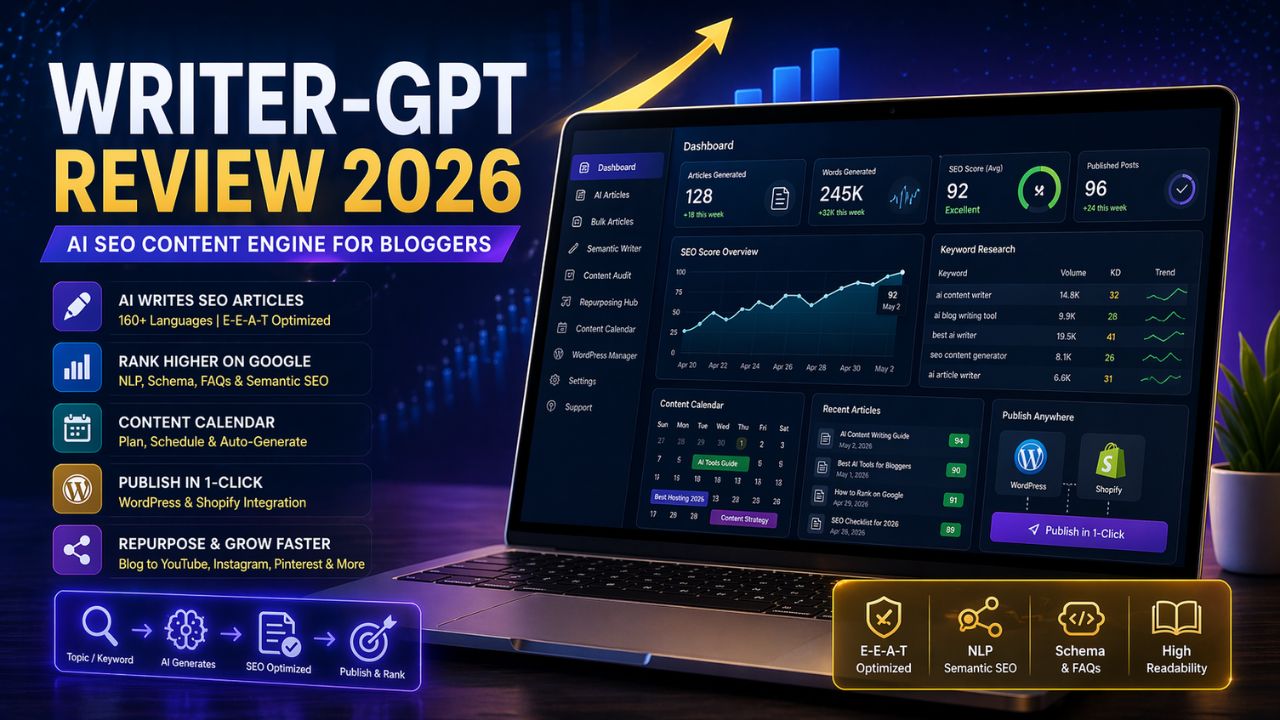
AI content tools are not impressive anymore just because they can write paragraphs.
In 2026, almost every major AI assistant can generate a blog draft. The real question is whether the tool helps you create content that is structured, useful, edited, optimized, and ready for a real publishing workflow.
That is why this Writer-GPT review 2026 matters for bloggers, affiliate marketers, freelancers, and agencies.
Most beginners do not struggle because they have no ideas. They struggle because the full content process has too many moving parts. You need keyword research, article structure, headings, search intent, internal links, screenshots, CTAs, editing, SEO checks, and updates after publishing.
Writing is only one part of the system.
Writer-GPT, also commonly searched as WriteGPT, is positioned as an AI-powered writing and productivity tool that can help users create, rewrite, summarize, and improve content faster. For bloggers, the appeal is simple: if a tool can reduce drafting time and help create more structured content, it may become part of a serious content workflow.
But there is an important warning before we begin. No AI writing tool should be treated as a one-click ranking machine. Google does not reward content just because it is long or AI-assisted. The content still needs to be helpful, accurate, original, and written for people first.
In this guide, we will look at what Writer-GPT is, how it works, who it is best for, its likely strengths and limitations, how bloggers can use it safely, and whether it is worth considering in 2026.
Writer-GPT Review 2026: What Is Writer-GPT?
Writer-GPT is an AI-powered content tool designed to help users write, rewrite, summarize, and improve text faster.
Depending on the version or product page you are using, Writer-GPT may also be branded as WriteGPT. The public product information focuses on AI writing support, workflow assistance, and productivity for users who want to create content more efficiently.
For bloggers and affiliate marketers, the main idea is simple:
Instead of starting every post from a blank page, you can use Writer-GPT to help with outlines, draft sections, summaries, rewrites, emails, social captions, and content repurposing.
That can save time, especially if you already have research notes and a clear publishing structure.
However, the tool should not replace research, editing, fact-checking, or human judgment. If you publish raw AI output, the content may feel generic and may not build reader trust.
Who Is Writer-GPT Best For?
This Writer-GPT review 2026 is written mainly for AI Sage Labs readers: bloggers, affiliate marketers, creators, freelancers, and small agencies who want to create more content without losing quality.
Writer-GPT may be useful for:
- Bloggers who need help drafting long-form articles
- Affiliate marketers writing product reviews and comparisons
- Freelancers who want to speed up first drafts
- Agencies producing content for multiple clients
- Creators repurposing blog posts into emails or social captions
- Beginners who need help organizing ideas into a structure
Writer-GPT may not be ideal for:
- People expecting one-click SEO rankings
- Users who do not want to edit AI output
- Writers who need deep investigative journalism
- Brands with strict legal or compliance review needs
- Advanced SEO teams that already use a full content operations stack
The tool makes the most sense when you treat it as a writing assistant, not as a replacement for your content strategy.

Why AI SEO Content Tools Matter in 2026
Content creation has changed dramatically over the past few years. A blogger is no longer competing only with other bloggers. They are competing with content systems.
Large websites use teams, templates, editors, SEO tools, automation, and AI-assisted workflows. Solo bloggers cannot always match that manually.
That is where AI writing tools become useful. They help reduce repetitive work so you can focus on research, examples, trust, and better recommendations.
A strong AI content workflow can help with:
- Creating article outlines faster
- Drafting first versions of sections
- Rewriting weak paragraphs
- Summarizing research notes
- Creating FAQ answers
- Repurposing posts into social captions
- Improving readability
- Maintaining a consistent publishing schedule
But the important word is workflow.
AI is useful when it supports a good process. It becomes risky when people use it to publish generic content at scale without fact-checking or adding real value.
Google’s official guidance says the focus should be helpful, reliable, people-first content. That applies whether content is created manually, with AI assistance, or with a mix of both.
How Writer-GPT Works
A useful Writer-GPT review 2026 should explain the workflow, not just list features. The tool becomes more valuable when you use it inside a repeatable content process.
Most AI writing tools follow a similar workflow, and Writer-GPT appears to fit that pattern.
Step 1: Enter a Topic, Keyword, or Prompt
You start by giving the tool a task. That could be a keyword, blog title, paragraph, content brief, email idea, or rewrite instruction.
For example:
Create a beginner-friendly blog outline about AI writing tools for affiliate marketers.
The quality of your input matters. A vague prompt creates a vague result. A clear prompt creates a more useful draft.
Step 2: Choose the Content Goal
Depending on the tool interface, you may choose a content type or use a direct prompt. The goal could be a blog section, summary, rewrite, caption, email, or article draft.
For bloggers, the best approach is to work section by section instead of asking for a full article in one prompt.
Step 3: Generate the Draft
Writer-GPT can then generate text based on your instructions. This may include headings, paragraphs, bullet points, summaries, or rewritten content.
This is where the tool saves time. Instead of staring at a blank page, you get a first draft to edit.
Step 4: Edit and Improve
This is the step beginners should never skip.
AI output needs editing. You should check facts, remove generic wording, add examples, improve flow, verify claims, and make sure the article matches your audience.
Step 5: Publish or Repurpose
After editing, you can move the content into WordPress, email, social media, or your content calendar.
For serious bloggers, Writer-GPT should be one part of a larger publishing system that includes SEO, internal linking, visuals, CTAs, and content updates.
Key Features of Writer-GPT
This Writer-GPT review 2026 focuses on the features that matter most for bloggers and content creators.
1. AI Content Drafting
The core benefit is AI-assisted writing. Writer-GPT can help create drafts for articles, blog sections, emails, summaries, and marketing content.
This is useful for bloggers who publish regularly and do not want to start from scratch every time.
Best use case: turning research notes into a rough article draft.
Real limitation: the first draft still needs editing, examples, and fact-checking.
2. Rewriting and Content Improvement
AI rewriting can be useful when a paragraph feels awkward or too long.
You can use Writer-GPT to simplify complex sections, rewrite introductions, improve readability, or create alternate versions of a CTA.
For affiliate content, this is helpful because clarity affects conversions. A confusing review loses readers before they reach the recommendation.
Best use case: rewriting weak sections of a review or guide.
Real limitation: rewriting should not become copying. Always keep the content original and useful.
3. Summarization
Summarization is valuable for research-heavy posts.
For example, if you collect notes from official product pages, help docs, or feature pages, Writer-GPT may help summarize those notes into a cleaner structure.
This can save time when preparing review posts or comparisons.
Best use case: turning messy research notes into a content brief.
Real limitation: summaries can miss important details, so review the original source before publishing.
4. Blog Outline Support
A strong outline is one of the most important parts of SEO content.
Writer-GPT can help organize a topic into headings and subheadings, especially when you provide the audience, focus keyword, search intent, and article type.
For example, an affiliate review outline should include what the product is, who it is best for, key features, pricing notes, pros and cons, alternatives, final verdict, and FAQs.
Best use case: creating a repeatable structure for long-form blog posts.
Real limitation: AI outlines can miss unique angles unless you add your own content strategy.
5. Content Repurposing
One blog post can become many smaller content assets.
Writer-GPT can help turn a blog section into:
- Social media captions
- Email newsletter drafts
- Short summaries
- Video script ideas
- LinkedIn posts
- FAQ answers
This matters because bloggers should not depend only on Google traffic. Repurposing helps you get more value from every article.
Best use case: turning one review post into social and email content.
Real limitation: repurposed content still needs platform-specific editing.

Writer-GPT for Bloggers
The blogging angle is the most important part of this Writer-GPT review 2026 because bloggers need more than a draft. They need a repeatable publishing system.
Bloggers can use Writer-GPT to reduce the friction of publishing.
A practical blogging workflow could look like this:
- Choose a low-competition keyword.
- Create a search-intent brief.
- Ask Writer-GPT for an outline.
- Edit the outline manually.
- Draft the article section by section.
- Add internal links and examples.
- Check facts from official sources.
- Create the featured image.
- Publish in WordPress.
- Repurpose into email and social content.
This kind of workflow is better than asking the tool for a complete article and publishing it without review.
If you are still building your content workflow, read this related guide on AI writing tools tested in 2026.
Writer-GPT for Affiliate Marketers
For affiliate marketers, this Writer-GPT review 2026 needs a clear warning: AI can speed up content, but it should never fake product experience.
Affiliate marketers can use Writer-GPT for review posts, comparison articles, alternatives posts, and buying guides.
But affiliate content has a higher trust requirement than basic informational content.
If you use AI to write an affiliate review, do not let it invent experience. Give it real notes from official sources, product pages, pricing pages, screenshots, and your own observations.
Writer-GPT can help with:
- Review outlines
- Feature explanations
- Pros and cons
- Comparison tables
- FAQ drafts
- CTA variations
- Final verdict polishing
The final recommendation should come from you.
If you want a deeper workflow, read this guide on how to write affiliate review posts with AI.
Writer-GPT for Agencies and Freelancers
Agencies and freelancers may find Writer-GPT useful because content work often repeats across clients.
For example, an agency may need:
- Blog outlines for multiple clients
- Social captions from blog posts
- Newsletter drafts
- Content briefs
- Rewrite options
- FAQ drafts
AI tools can speed up that work, but agencies need strict review systems. Client content must be accurate, original, and brand-safe.
If you use Writer-GPT for client work, create clear rules:
- Do not publish raw AI output.
- Fact-check every claim.
- Follow the client’s tone.
- Check for duplicated phrasing.
- Add human examples and expertise.
- Keep client data private.
This makes the tool useful without risking trust.
Writer-GPT Pricing
Pricing is another reason to read a Writer-GPT review 2026 before signing up, because AI writing tools often use credits, limits, or feature tiers that are not obvious at first.
Pricing can change, so always check the official Writer-GPT or WriteGPT pricing page before buying.
When reviewing any AI writing tool, do not only look at the monthly price. Check what the plan includes.
Important pricing questions include:
- Is there a free plan or free trial?
- How many words, credits, or generations are included?
- Are advanced features locked behind higher plans?
- Can you export content easily?
- Does the plan support team use?
- Does usage reset monthly?
- Is annual billing cheaper?
For bloggers, the right plan depends on publishing volume. If you publish one post per week, you may need less than an agency producing dozens of drafts every month.
Writer-GPT Pros and Cons
Pros
- Can speed up first drafts
- Useful for rewriting and improving sections
- Helpful for summarizing research notes
- Can support blog outlines and content structure
- Useful for repurposing content into social and email formats
- Good fit for bloggers, affiliates, freelancers, and agencies
Cons
- Still requires human editing
- May produce generic content if prompts are weak
- Pricing and plan limits need to be checked before buying
- Should not be used to fake product experience
- Not a complete SEO strategy by itself
- Independent third-party review data may be limited depending on the exact product version
Writer-GPT vs ChatGPT
ChatGPT is more flexible. You can use it for research, planning, writing, coding, analysis, brainstorming, and many different tasks.
Writer-GPT is more focused on writing and content improvement workflows.
If you want a general AI assistant, ChatGPT may be more flexible. If you want a writing-focused tool with a simpler content workflow, Writer-GPT may feel easier for specific writing tasks.
The best choice depends on your working style.
Writer-GPT vs Writesonic
Writesonic is a more established AI writing platform with a clearer blogging and marketing content position.
Writer-GPT may appeal to users who want a simpler writing assistant, but Writesonic may offer a broader set of content marketing features depending on your plan and needs.
If you are comparing options, read this Writesonic review for bloggers.
How to Use Writer-GPT Safely for SEO Content
The most practical takeaway from this Writer-GPT review 2026 is that safe SEO content comes from process, not from one-click generation.
The safest way to use Writer-GPT is to keep humans in control of the strategy.
Use this workflow:
- Pick a clear keyword.
- Study the search intent.
- Collect real research from trusted sources.
- Create an outline with Writer-GPT.
- Draft one section at a time.
- Add your own examples and judgment.
- Fact-check every important claim.
- Add internal links.
- Add a trusted external source.
- Edit for human tone.
- Publish only after review.
This approach protects quality and reduces the risk of thin AI content.
How to Make Money With Writer-GPT
Writer-GPT does not make money for you automatically. It can only support the work that creates income.
Here are practical ways bloggers can use it.
1. Affiliate Blogging
You can use Writer-GPT to draft product reviews, comparison posts, and buying guides. Then you add real research, screenshots, pros and cons, and affiliate CTAs.
2. Freelance Writing
Freelancers can use AI to speed up outlines, first drafts, and rewrites. This can help increase output, but the final quality still depends on editing.
3. Content Agency Work
Agencies can use AI tools to create briefs, outlines, and draft sections faster across multiple clients.
4. Content Repurposing Services
You can turn long blog posts into social captions, newsletters, scripts, and summaries for clients.
5. Niche Website Publishing
If you publish helpful content consistently on a focused niche site, AI tools can speed up production and updates.
Start Your AI Content Blog
If you want to turn AI content tools into a real affiliate or niche website, you need a WordPress blog where your articles can rank, convert, and grow over time.
Need Help With AI Content Workflows?
If you do not want to build your content workflow alone, you can hire freelancers to help with WordPress setup, content briefs, SEO formatting, blog editing, or AI workflow setup.
Hire AI Content Help
A freelancer can help you set up a repeatable blog workflow, format posts, design content templates, or build an AI-assisted content system.
Recommended Book for AI Content Creators
If you want to understand how AI fits into modern writing, work, and creativity, Co-Intelligence: Living and Working with AI by Ethan Mollick is a useful book to explore.
It is not a Writer-GPT manual, but it can help bloggers think more clearly about how to use AI as a collaborator instead of a shortcut.
Recommended Reading
If you want to build better AI-assisted writing habits, this book is a helpful next step.
Final Verdict: Is Writer-GPT Worth It?
This Writer-GPT review 2026 comes down to one practical point: Writer-GPT can be useful if you need help creating and improving content faster, but it should not replace your strategy or editing.
It is best for bloggers, affiliate marketers, freelancers, and agencies who already understand that AI writing needs human review.
It is not ideal for people who want to publish one-click AI content without research, editing, or SEO thinking.
If you use Writer-GPT as a drafting and improvement assistant, it can save time. If you use it as a replacement for judgment, the content may become generic and weak.
The smartest approach is simple: use Writer-GPT for speed, then add human research, examples, trust, and final editing.
Frequently Asked Questions
Is Writer-GPT good for beginners?
Yes, Writer-GPT can be useful for beginners who need help drafting, rewriting, and organizing content. Beginners should still edit the output and learn basic SEO principles.
Can Writer-GPT replace human writers?
No. Writer-GPT can support the writing process, but it should not replace human research, judgment, editing, examples, or final recommendations.
Is Writer-GPT good for SEO?
Writer-GPT can help with structure and drafting, but SEO depends on keyword research, search intent, helpful content, internal links, site authority, and regular updates. It is not a complete SEO system by itself.
Can I use Writer-GPT for affiliate marketing?
Yes, you can use Writer-GPT for affiliate marketing content such as reviews, comparisons, and buying guides. Do not let it invent experience or claims. Use real research and edit carefully.
Does Writer-GPT create full blog posts?
Writer-GPT can help create blog drafts, but the best workflow is to draft section by section, then edit and fact-check before publishing.
Is Writer-GPT better than ChatGPT?
ChatGPT is more flexible as a general AI assistant. Writer-GPT may be more focused for writing and content improvement tasks. The better choice depends on your workflow.
Should agencies use Writer-GPT?
Agencies can use Writer-GPT to speed up briefs, drafts, rewrites, and repurposing. However, client content should always go through human review and quality control.
Conclusion
AI writing tools are changing content creation, but they are not magic.
Writer-GPT can help bloggers and marketers draft faster, rewrite better, summarize research, and repurpose content. That can be valuable if you are trying to publish consistently and build a content system.
But the tool is only one part of the workflow.
To create content that ranks and converts, you still need search intent, useful structure, trusted sources, internal links, examples, editing, and a clear reader-first purpose.
If you use Writer-GPT with that mindset, it can become a helpful part of your blogging toolkit.
Start small, test it on one real article, and judge the tool by how much better your final edited content becomes.
Sources Used
- WriteGPT Official Website
- Google Search Central: Creating helpful, reliable, people-first content
- Google Search Central: Guidance about AI-generated content
Affiliate Disclosure
As an Amazon Associate, I earn from qualifying purchases. Some links in this article are affiliate links, which means I may earn a commission at no extra cost to you if you buy through them. I only recommend tools, books, and services that may help bloggers, creators, and online business owners save time, build better systems, or grow their business.
Very helpful article, thanks for sharing. xqqsjqhv
Really enjoyed this post, thanks for sharing. NanoB263 Looking forward to reading more of your work here.